

Rana Mondal: Are Needle-Free Protocols Genuinely the Future of IVF Stimulation?
Rana Mondal, Senior Clinical Fellow in Obstetrics and Gynaecology with Special Interest in Early Pregnancy at Bedfordshire Hospitals NHS Foundation Trust, shared a post on LinkedIn about a paper he co-authored with Mouli Nandi published in Gynecology and Obstetrics:
“Are needle-free protocols genuinely the future of IVF stimulation, or does eliminating injections compromise clinical efficiency?
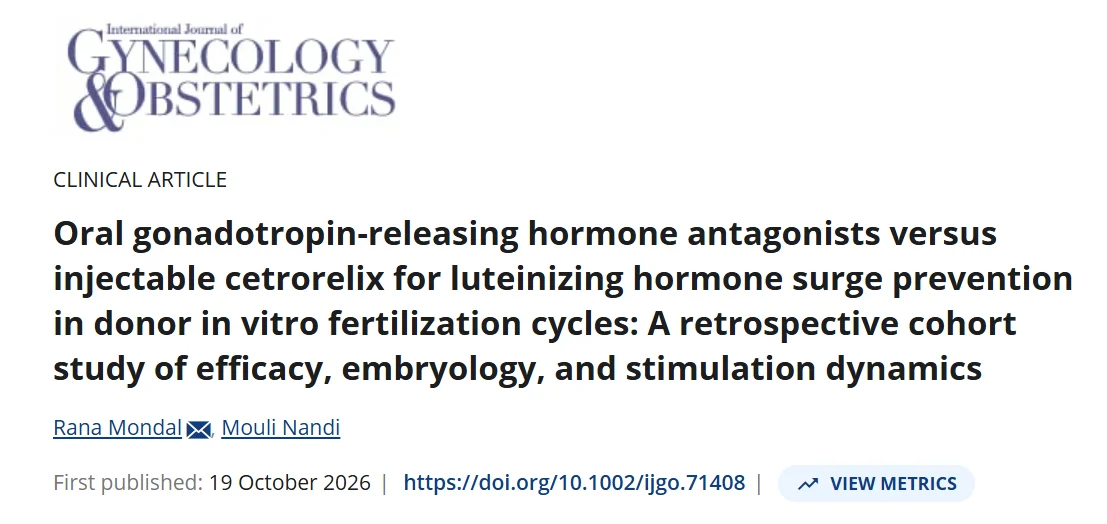
Our latest clinical study, published in the International Journal of Gynecology & Obstetrics (FIGO/Wiley), examines the real-world trade-offs between oral and injectable GnRH antagonists:
‘Oral gonadotropin-releasing hormone antagonists versus injectable cetrorelix for luteinizing hormone surge prevention in donor in vitro fertilization cycles: A retrospective cohort study of efficacy, embryology, and stimulation dynamics’
The Clinical Problem: Injectable GnRH antagonists like Cetrorelix represent the current standard of care for LH surge suppression. However, the daily subcutaneous injection burden remains a major pain point in assisted reproduction.
While oral antagonists (Elagolix and Relugolix) offer a patient-friendly alternative, their impact on downstream embryological parameters and stimulation dynamics warrants careful evaluation.
Key Findings Across 173 Donor IVF Cycles:
- Endocrine Suppression: Observed composite endocrine escape rates were low across all groups (3.3% to 3.6%), though event numbers were small and underpowered to prove non-inferiority.
- Oocyte Maturity (MII): Injectable Cetrorelix yielded significantly higher mature oocyte rates (83.9%) compared to both oral agents (~75%; p < 0.001).
- Stimulation Burden: Oral protocols required significantly more gonadotropins (+308 IU for Relugolix; +698 IU for Elagolix) and prolonged stimulation by 1.4 to 3.0 days (p < 0.001).
- Blastocyst Yield: Usable blastocyst numbers significantly favored Cetrorelix (2.47 vs. 2.11 for Relugolix and 1.98 for Elagolix; p = 0.008), primarily reflecting the larger initial pool of mature oocytes.
- Safety Profile: 0% incidence of moderate/severe OHSS across all groups, underscoring the protective efficacy of GnRH agonist triggering in donor cycles.
- Clinical Implications: While oral GnRH antagonists clearly reduce injection burden and offer high adherence, they come with measurable physiological costs: higher gonadotropin consumption, extended stimulation cycles, and reduced mature oocyte yields. For oral small molecules with short half-lives, strict dosing intervals and trough coverage appear critical.
These findings highlight that patient convenience must be weighed against stimulation economics and yield.
Robust, prospectively powered randomized trials are essential before these off-label oral regimens can be positioned alongside standard injectables.
To reproductive endocrinologists and clinical embryologists: How do you perceive the balance between injection-free protocols and cycle efficiency in your practice?”
Title: Oral gonadotropin-releasing hormone antagonists versus injectable cetrorelix for luteinizing hormone surge prevention in donor in vitro fertilization cycles: A retrospective cohort study of efficacy, embryology, and stimulation dynamics
Authors: Rana Mondal, Mouli Nandi
You can read the Full Article in Gynecology and Obstetrics.
Stay informed with the latest updates in fertility and reproductive medicine on Fertility News.
-
Oct 25, 2026, 17:47Fiona Pathiraja-Møller: Periods Are Valuable Health Data, and Science Is Finally Treating Them That Way
-
Oct 25, 2026, 17:41Mark Amols: Does Your PCOS Treatment Feel Like a “Band-Aid”?
-
Oct 25, 2026, 17:39Alejandro González: Vaginal Microbiome and Assisted Reproduction
-
Oct 25, 2026, 17:37Asma Khalil: Doppler in Maternal-Fetal Medicine – Theory and Hands-on Course
-
Oct 25, 2026, 17:34Houssein El Hajj: Honoured to Receive the 2026 IJGC Best Video Award from IJGC
-
Oct 25, 2026, 17:32Shilpa Sharma: Proud to Have Attended the 9th ART Fertility Conference
-
Oct 25, 2026, 17:18Margaret Cali: You Don’t Have to Hold It All Together to Be Doing Your Best
-
Oct 25, 2026, 17:17Vipin Chandra: A Proud Moment When a Young Researcher Takes Our Collective Work to a Global Stage
-
Oct 25, 2026, 17:13Vanshika Nepal: Cryopreservation in Assisted Reproductive Technology