
Niko McCarty: New Organoid Models Enhance Understanding of Embryo Implantation
Niko McCarty, Founding Editor at Asimov Press, shared a post on LinkedIn about papers by Qian Li and Matteo A. Molè et al. published in Cell:
“Last week, two papers appeared back-to-back in Cell, reporting organoids to study embryo implantation. One of the studies sheds a lot of light on why IVF often fails.
Being Cell papers (running to ~50 pages each, with tons of figures and supplemental details) I can’t do justice to both of them via social media. But I’ll give quick highlights from each, in the hopes you’ll check out the full things:
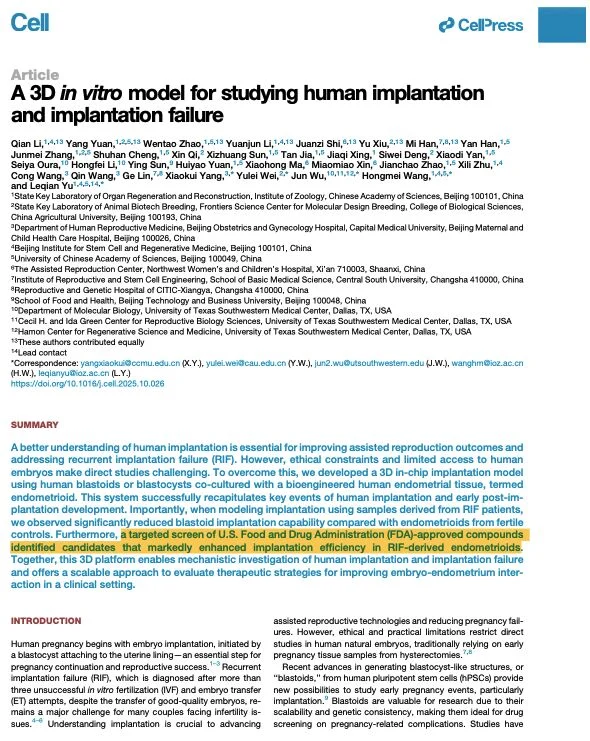
1. Li et al. ‘A 3D in vitro model for studying human implantation and implantation failure.’
This paper took cells from endometrial biopsies, expanded them in culture, and arranged them into a 3D matrix to build an ‘endometrioid.’ When this organoid was exposed to hormones which mimic the menstrual cycle — like estrogen and progesterone — the cells formed features akin to those seen when implantation normally happens.
The authors implanted human blastocysts (5-7 days post-fertilization) into these organoids, and they continued developing all the way to 10-14 days post-fertilization.
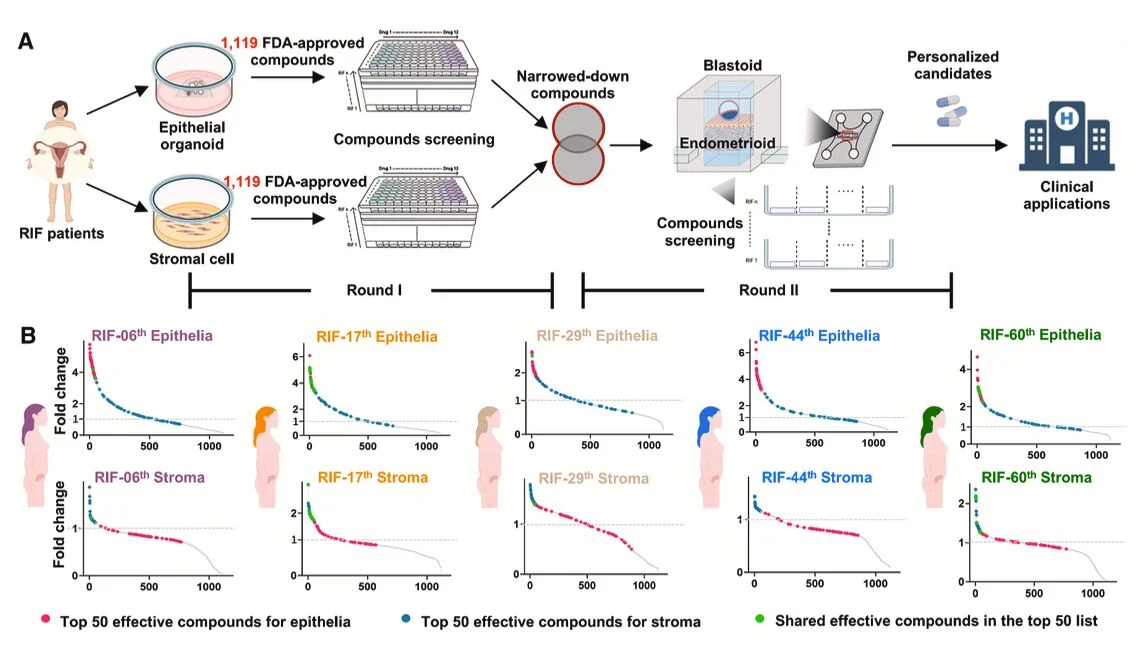
But the best part, I think, was when the authors used these ‘endometrioids’ to study why some people undergoing IVF have repeated failures, despite producing healthy embryos. The researchers took cells from patients who had 3+ unsuccessful IVF embryo transfers and made organoids out of them. They found that blastoids were more difficult to culture on these organoids, with attachment rates of ~20% (‘successful’ patients are closer to ~60%). Single-cell RNAseq showed that they had higher levels of genes associated with inflammation, fibrosis, etc.
The researchers also screened 1,000+ drugs on these endometrial cells to find ones that could boost implantation rates. And they actually found drugs (like apoptosis inhibitors) that boosted implantation rates 2-3x.
This seems like an obvious company in the making. I could imagine them building custom organoids for patients and using them to develop bespoke treatment options for IVF patients. This would be reserved for the wealthy, but perhaps over time this could be automated and scaled.
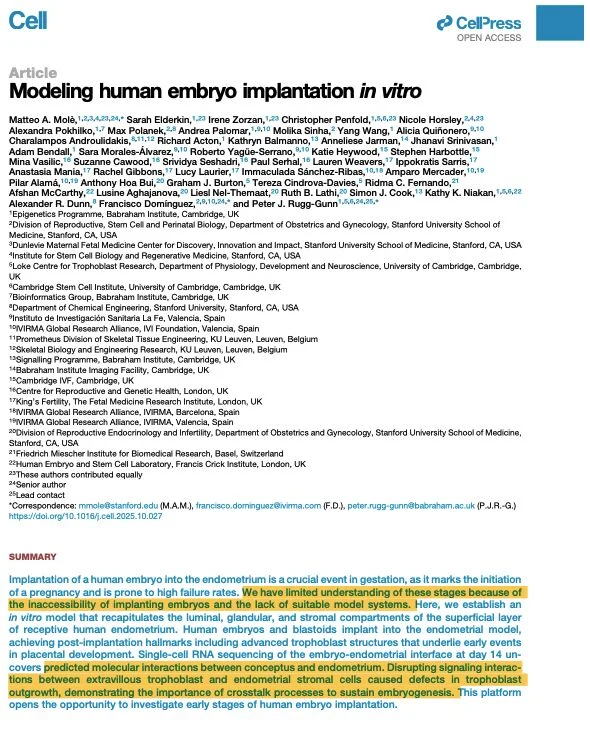
2. Mole et al. ‘Modeling human embryo implantation in vitro.’
The organoids here are extremely similar (also made by combining epithelial cells and stromal cells.) And these authors, too, showed that healthy embryos could be implanted into these organoids and develop up to 14 days post-fertilization.
But instead of going the clinical / drug screening route, this paper does a lot more molecular characterization. They really carefully studied which genes are switched on- or off at various stages of implantation, embryo development, etc.
The 14 day limit in these papers is likely not purely scientific. In the UK, there is a law banning the culturing of embryos beyond 14 days. In the US, the NIH will not fund research that creates embryos for research and cultures them beyond 14 days. But technically, you could go past this barrier using private funding. China (where research for the first paper was done) also seems to have a 14-day rule.”
Title: A 3D in vitro model for studying human implantation and implantation failure
Authors: Qian Li, Yang Yuan, Wentao Zhao, Yuanjun Li, Juanzi Shi, Yu Xiu, Mi Han, Yan Han, Junmei Zhang, Shuhan Cheng, Xin Qi, Xizhuang Sun, Tan Jia, Jiaqi Xing, Siwei Deng, Xiaodi Yan, Seiya Oura, Hongfei Li, Ying Sun, Huiyao Yuan, Xiaohong Ma, Miaomiao Xin, Jianchao Zhao, Xili Zhu, Cong Wang, Qin Wang, Ge Lin, Xiaokui Yang, Yulei Wei, Jun Wu, Hongmei Wang, Leqian Yu
Read the full article.
Title: Modeling human embryo implantation in vitro
Authors: Matteo A. Molè, Sarah Elderkin, Irene Zorzan, Christopher Penfold, Nicole Horsley, Alexandra Pokhilko, Max Polanek, Andrea Palomar, Molika Sinha, Yang Wang, Alicia Quiñonero, Charalampos Androulidakis, Richard Acton, Kathryn Balmanno, Anneliese Jarman, Jhanavi Srinivasan, Adam Bendall, Sara Morales-Álvarez, Roberto Yagüe-Serrano, Katie Heywood, Stephen Harbottle, Mina Vasilic, Suzanne Cawood, Srividya Seshadri, Paul Serhal, Lauren Weavers, Ippokratis Sarris, Anastasia Mania, Rachel Gibbons, Lucy Laurier, Immaculada Sánchez-Ribas, Amparo Mercader, Pilar Alamá, Anthony Hoa Bui, Graham J. Burton, Tereza Cindrova-Davies, Ridma C. Fernando, Afshan McCarthy, Lusine Aghajanova, Liesl Nel-Themaat, Ruth B. Lathi, Simon J. Cook, Kathy K. Niakan, Alexander R. Dunn, Francisco Domínguez, Peter J. Rugg-Gunn
Read the full article.
Stay updated on all scientific advances in the field of fertility with Fertility News.
-
Oct 21, 2026, 17:57Ula Sankowska: What I’ll Bring to ASRM INNOVATE in Baltimore
-
Oct 21, 2026, 17:40Robert Borowczyk: The Invisible Waiting Room
-
Oct 21, 2026, 17:35Fereshteh Safian: Behind the Scenes of Reproductive Medicine
-
Oct 21, 2026, 17:20The Relationship Between Trophectoderm Biopsy and Early Pregnancy Outcomes – RBMO
-
Oct 21, 2026, 17:09Jules McDonald: The Future of Fertility Is Happening in Abu Dhabi
-
Oct 21, 2026, 16:53Ashley Evans: I Never Imagined I’d Be a Fertility Story with a Group of People Whom I Have Never Met…
-
Oct 21, 2026, 16:41Karthik Raj: Asherman’s Syndrome – When the Endometrium Cannot Regenerate Normally
-
Oct 21, 2026, 16:36Katy Encalade: A Few Misconceptions I Think Every Woman Considering Egg Donation Deserves to Understand
-
Oct 21, 2026, 16:21The FeRGI Working Group 2026-2027 – ESHRE SIG Reproductive Genetics