

Sergio Haimovich: Good Practice Recommendations on Terminology, Classification, and Diagnosis of Adenomyosis
Sergio Haimovich, Director for Europe, Middle East and Africa at the AAGL Board of Directors, shared a post on LinkedIn:
”Adenomyosis remains one of the most complex and inconsistently defined conditions in gynecology.
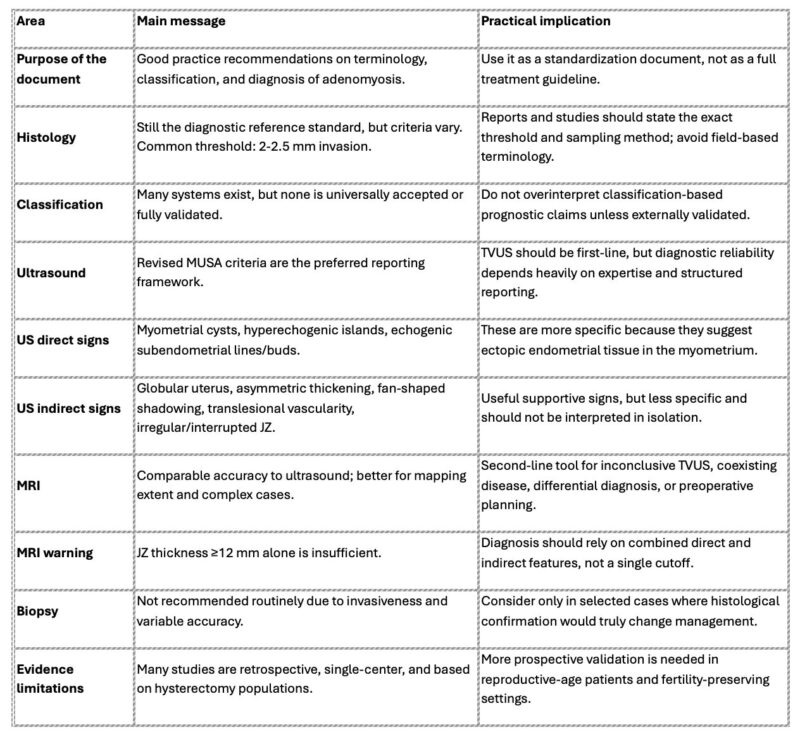
This table summarizes the key practical messages from the European Society of Human Reproduction and Embryology (ESHRE) draft Good Practice Recommendations on terminology, classification, and diagnosis of adenomyosis.
The central point is clear: before we can improve treatment strategies, surgical planning, fertility counseling, and research comparability, we need a shared diagnostic language.
The document highlights the need for standardized terminology, structured ultrasound and MRI reporting, careful interpretation of classification systems, and stronger prospective validation — especially in reproductive-age women and fertility-preserving settings.
Standardization is not just academic. It is the foundation for better clinical decisions and better care for patients with adenomyosis.”
Stay updated on all scientific advances in the field of fertility with Fertility News.
-
Oct 21, 2026, 17:57Ula Sankowska: What I’ll Bring to ASRM INNOVATE in Baltimore
-
Oct 21, 2026, 17:40Robert Borowczyk: The Invisible Waiting Room
-
Oct 21, 2026, 17:35Fereshteh Safian: Behind the Scenes of Reproductive Medicine
-
Oct 21, 2026, 17:20The Relationship Between Trophectoderm Biopsy and Early Pregnancy Outcomes – RBMO
-
Oct 21, 2026, 17:09Jules McDonald: The Future of Fertility Is Happening in Abu Dhabi
-
Oct 21, 2026, 16:53Ashley Evans: I Never Imagined I’d Be a Fertility Story with a Group of People Whom I Have Never Met…
-
Oct 21, 2026, 16:41Karthik Raj: Asherman’s Syndrome – When the Endometrium Cannot Regenerate Normally
-
Oct 21, 2026, 16:36Katy Encalade: A Few Misconceptions I Think Every Woman Considering Egg Donation Deserves to Understand
-
Oct 21, 2026, 16:21The FeRGI Working Group 2026-2027 – ESHRE SIG Reproductive Genetics