

Kiani Davis: Providing Information Isn’t Necessarily the Same As Providing Education
Kiani Davis, Medical Assistant at Kaiser Permanente, shared on LinkedIn:
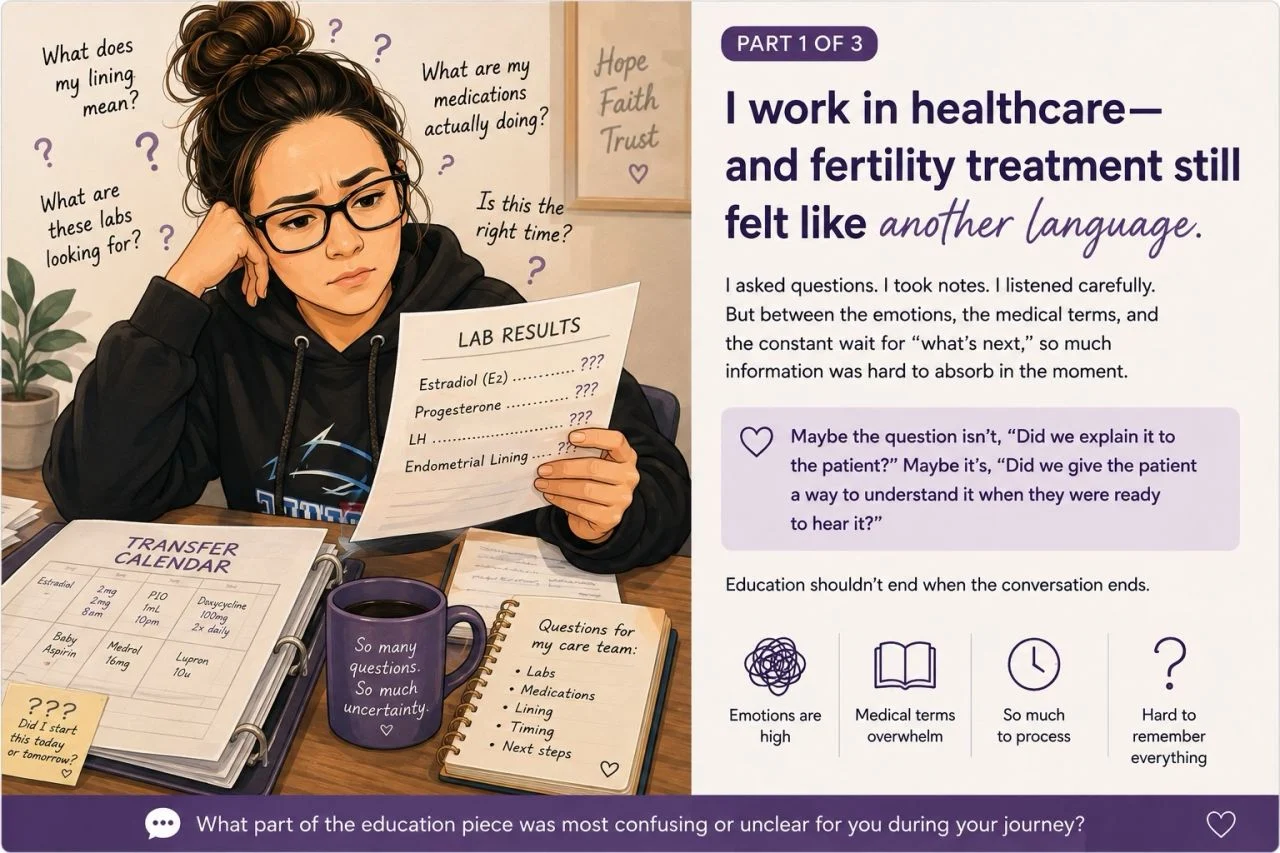
“I work in healthcare – and fertility treatment still felt like another language.
During my journeys as an egg donor and surrogate, I remember receiving so much information.
- Endometrial lining measurements
- Lab results
- Medication names and dosages
- Transfer timelines
- Instructions about what came next
But I didn’t always understand what it all meant.
- What was my care team looking for with my lining?
- Why was I taking each medication, and what was it actually doing?
- What did my lab results tell them?
- What needed to happen before we were ready for transfer?
And here’s the part that has stuck with me:
I work in healthcare.
If I sometimes felt overwhelmed trying to understand it all, what does that experience feel like for someone who doesn’t have a healthcare background?
But I also don’t think the answer is simply ‘explain more.’
Fertility treatment can come with so many emotions at once – hope, anxiety, excitement, fear, uncertainty.
Sometimes someone can explain everything to you.
You listen.
You nod.
You think you understand.
Then you leave the appointment and realize…
Wait. What did they say again?
That’s why I’ve started thinking differently about patient education.
Maybe the question isn’t:
‘Did we explain it to the patient?’
Maybe it’s:
‘Did we give the patient a way to understand it when they were ready to hear it?’
Imagine having a simple personalized summary after an appointment:
- Your lining: What we’re looking for and why.
- Your labs: What we’re monitoring.
- Your medications: What you’re taking, why, and what to expect.
- What’s next: What happens from here.
- Questions later: One clear place to get help.
Something patients can return to after the emotions settle and the questions start coming.
Because providing information isn’t necessarily the same as providing education.
And patients shouldn’t have to know which questions to ask in order to understand their own care.
That’s something I believe we have an opportunity to improve – not only in fertility care, but across healthcare.
If you’ve experienced fertility treatment, what do you wish had been explained more clearly?”
Other articles featuring Kiani Davis on Fertility News.
-
Aug 9, 2026, 16:21Peter Ngumba: Open Communication Is Essential When Navigating HIV and Fertility
-
Aug 9, 2026, 16:08Embryo Transfer is One of the Most Crucial Steps in Your IVF Journey – Milann Fertility and Birthing Hospital
-
Aug 9, 2026, 15:56Diethert Manfred: Lab-Grown Babies Aren’t Science Fiction Anymore
-
Aug 9, 2026, 15:46Aevum Bio Clinic Is Recruiting a Women’s Health and Fertility Doctor
-
Aug 9, 2026, 15:36How Do GLP1 Drugs Impact Egg Quality? – Noor Sciences
-
Aug 9, 2026, 15:19Aleesha Grier: Something Powerful Happens When We Bring Assisted Reproductive Healthcare Into the Light
-
Aug 9, 2026, 13:525 Evidence-Based Reasons Not to “Just Keep Trying” – Fertility Plus
-
Aug 9, 2026, 13:34The Future of Embryology Depends on How We Train the Next Generation – ASRM
-
Aug 9, 2026, 13:22Ritik Shukla: Menopause Is Not the End of Vitality – It’s the Beginning of a New Chapter