

Felicity Jehu-Appiah: Medical Information Is Only Valuable When People Can Understand It
Felicity Jehu-Appiah, Women’s Health Content Creation Assistant at TEKHI Global for Menopause Health, shared on LinkedIn:
“Medical information is only valuable when people can understand it.
In women’s health, the gap between scientific research and patient understanding can be surprisingly wide.
Every day, new research emerges on fertility, PCOS, endometriosis, menopause, menstrual health, reproductive health, and digital health.
But how do we take complex scientific evidence and turn it into information that is:
- Accurate
- Evidence-based
- Easy to understand
- Clinically responsible
- And, most importantly, trustworthy?
This is where medical writing plays an important role.
As someone building my career in medical writing with a particular interest in women’s health, I’ve been thinking deeply about what it means to translate complex research without losing the science behind it.
A good medical writer isn’t simply simplifying medical terminology.
They are interpreting evidence, understanding limitations, communicating uncertainty, choosing the right language for the audience, and ultimately helping patients make sense of information that matters to their health.
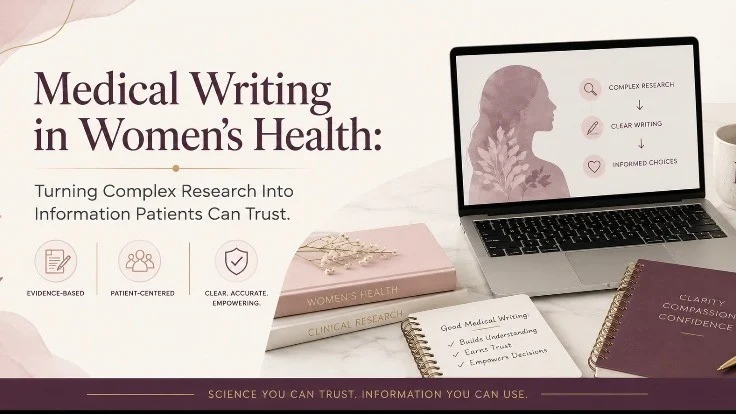
I explored this in my latest article: ‘Medical Writing in Women’s Health: Turning Complex Research Into Information Patients Can Trust’
In the article, I discuss the role of the medical writer as a bridge between scientific evidence and patient understanding—and why this role is becoming increasingly important in healthcare, digital health, and FemTech.
If you’re interested in medical writing, women’s health, clinical research, patient education, or evidence-based healthcare communication, I’d love to hear your thoughts.
What do you think is the biggest challenge in translating women’s health research into patient-friendly information?
Medical Writing in Women’s Health: Turning Complex Research Into Information Patients Can Trust
Women’s health is one of the areas of medicine where good medical writing can make a measurable difference.
Every day, new research is published on fertility, PCOS, endometriosis, menopause, menstrual health, reproductive health, pregnancy, hormonal disorders, and emerging digital health technologies.
Yet scientific knowledge does not automatically become useful knowledge.
A research paper may contain statistically significant findings, complex methodology, confidence intervals, limitations, and highly technical terminology. A clinical guideline may be evidence-based but difficult for a patient without a medical background to understand.
And somewhere between the scientific paper and the patient searching for answers online is a critical role:
The medical writer.
For me, medical writing in women’s health is not simply about making medical information sound professional.
It is about taking evidence, understanding it accurately, and translating it into information that is clear, responsible, clinically meaningful, and trustworthy.
Why women’s health needs better medical communication
Women frequently search for health information before, during, and after a clinical consultation.
They may search:
- ‘Why are my periods irregular?’
- ‘Can I get pregnant with PCOS?’
- ‘What happens during menopause?’
- ‘What does an abnormal Pap smear mean?’
- ‘Why am I having pelvic pain?’
- ‘Does endometriosis affect fertility?’
These questions may look simple.
The evidence behind them often isn’t.
A single women’s health topic can involve physiology, epidemiology, clinical guidelines, diagnostic criteria, treatment options, risk factors, patient preferences, and ongoing research.
This creates a communication challenge.
How do we simplify the science without distorting it?
That, to me, is one of the most important skills in medical writing.
Medical writing is more than simplifying medical terminology
There is a common misconception that medical writing simply means taking complicated medical terminology and replacing it with easier words.
It is much more than that.
A strong medical writer needs to understand:
- What the evidence actually shows
- How strong that evidence is
- What the study design allows researchers to conclude
- The difference between association and causation
- Relative versus absolute risk
- Study limitations
- Clinical relevance
- Patient context
- Appropriate use of medical terminology
- How to communicate uncertainty
- When evidence is insufficient to make a strong claim
For example, consider the statement:
‘This treatment improves fertility.’
That sounds straightforward.
But a medical writer should immediately ask:
According to what evidence?
Was the evidence from a randomized controlled trial?
An observational study?
A systematic review?
Was fertility measured by ovulation, pregnancy, or live birth?
Was the population representative?
How large was the effect?
Were there important limitations?
Is the evidence applicable to every patient—or only to a specific population?
This is where medical writing becomes an exercise in critical thinking, evidence appraisal, and responsible communication.
The medical writer sits between evidence and understanding
I think of medical writing as a bridge.
On one side is the scientific literature.
On the other side is the person who needs to understand it.
Between them is the medical writer.
The writer must cross that bridge without damaging the evidence.
That means avoiding two extremes.
Too technical
The information remains scientifically accurate but becomes inaccessible to the intended audience.
Too simplified
The information becomes easy to read but loses important clinical nuance.
The goal is somewhere in between:
Scientifically accurate enough to be trusted. Simple enough to be understood. Relevant enough to be useful.
That balance is especially important in women’s health.
Consider PCOS as an example
Polycystic ovary syndrome is a good example of why patient-centered medical writing matters.
PCOS is not simply a condition involving ‘ovarian cysts.’
It is a complex endocrine and metabolic condition with different manifestations among individuals.
A patient may experience irregular menstrual cycles, signs of androgen excess, difficulties with ovulation, metabolic complications, or fertility challenges.
Another person with PCOS may have a completely different experience.
If medical content reduces PCOS to:
‘PCOS causes infertility and weight gain,’
the information becomes misleading.
A better explanation acknowledges the complexity while still being understandable.
The writer can explain:
- What PCOS is
- Why menstrual cycles may become irregular
- How ovulation can be affected
- Why androgen levels matter
- The relationship between PCOS and metabolic health
- How PCOS may affect fertility
- Why symptoms vary between individuals
- What treatment options are available
- What current evidence does—and does not—tell us
The patient doesn’t necessarily need to understand every biochemical pathway.
But they deserve an explanation that is accurate, respectful, and free from unnecessary fear.
The same principle applies to menopause
Menopause is another area where medical communication can easily become oversimplified.
For years, menopause has often been discussed primarily in terms of hot flashes.
But the menopausal transition can involve changes across multiple areas of health, including menstrual patterns, sleep, mood, sexual health, bone health, cardiovascular risk, and overall quality of life.
A medical writer therefore has to do more than define menopause.
The writer must help readers understand what is happening, why it is happening, what is considered normal, what may require medical assessment, and where evidence-based treatment can help.
And importantly, the language matters.
Patients should not feel that a natural life transition means that their health concerns are being dismissed.
Good medical writing can educate without minimizing.
Evidence-based writing begins before the first sentence
One of the most important lessons I am developing as a medical writer is that good writing starts before writing.
It starts with research.
Before drafting an article, I would want to understand:
1. What is the clinical question?
What exactly are we trying to explain?
2. Who is the audience?
A patient, clinician, researcher, healthcare professional, or general reader may require completely different levels of detail.
3. What does the evidence say?
Primary research, systematic reviews, meta-analyses, clinical guidelines, and authoritative health organizations may all contribute to the evidence base.
4. How strong is the evidence?
Not every published study deserves the same weight.
5. What are the limitations?
Good medical communication should not hide uncertainty.
6. What does the reader actually need to know?
Information should have a purpose.
7. What claims require references?
Evidence-based writing should allow readers and professionals to trace important claims back to credible sources.
This process is what separates medical writing from simply producing health-related content.
Good medical writing respects uncertainty
One of the most important responsibilities of a medical writer is knowing when not to overstate the evidence.
Scientific research rarely gives us absolute certainty.
There may be promising findings that require further research.
There may be conflicting studies.
There may be strong evidence for one population but limited evidence for another.
There may be an association without proof of causation.
There may be statistically significant findings that have limited clinical significance.
A medical writer should be comfortable communicating this.
Instead of writing:
‘Research proves that X causes Y.’
The evidence may support:
‘Research has found an association between X and Y, although this does not necessarily mean that X causes Y.’
That difference may look small.
Scientifically, it can be enormous.
Patients deserve information without unnecessary jargon
One of the skills I particularly value in medical communication is plain-language translation.
Medical terminology has its place.
But when writing for patients, every technical term should earn its place.
For example:
‘Ovulation’
can be explained simply as the release of an egg from the ovary.
‘Endometrium’
can be introduced as the lining inside the uterus that changes throughout the menstrual cycle.
‘Insulin resistance’
can be explained as a situation where the body’s cells do not respond to insulin as effectively as they should.
The goal isn’t to remove medical accuracy.
The goal is to make medical knowledge accessible without making it inaccurate.
Women’s health also requires sensitivity
There is another dimension to medical writing that cannot be measured by readability scores alone:
human experience.
Topics such as infertility, pregnancy loss, menstrual disorders, endometriosis, sexual health, menopause, and reproductive conditions can be deeply personal.
The language used in an article can influence how a reader understands their own body.
That means medical writers need to be careful about:
- Stigmatizing language
- Fear-based headlines
- Absolute claims
- Blaming language
- Oversimplification
- Unrealistic treatment promises
- Body-shaming language
- Implying that every symptom is abnormal
- Presenting one person’s experience as universal
Evidence-based writing should still feel human.
The rise of digital health makes this even more important
Healthcare information is no longer confined to textbooks, hospital brochures, or medical journals.
Patients encounter health information through:
- Websites
- Search engines
- Social media
- Digital health platforms
- Patient portals
- Mobile applications
- Online communities
- News articles
- AI-powered tools
This creates enormous opportunities for healthcare education.
But it also creates enormous opportunities for misinformation.
A medical writer can play an important role in creating a healthier digital information environment.
That means producing content that is:
Evidence-based. Transparent. Patient-centered. Readable. Current. Responsible.
Medical writing and the future of women’s health
I am particularly interested in the intersection between women’s health, medical writing, clinical research, and digital health.
Women’s health is evolving rapidly.
We are seeing increasing attention to areas such as:
- Fertility and reproductive health
- Menstrual health
- PCOS
- Endometriosis
- Menopause
- FemTech
- Digital therapeutics
- Remote patient monitoring
- Health misinformation
- Patient education
- Personalized healthcare
- Data-driven healthcare
But innovation alone is not enough.
A new digital health product, clinical intervention, or research finding still needs to be communicated effectively.
Patients need to understand it.
Clinicians need to interpret it.
Healthcare organizations need to communicate it responsibly.
Researchers need to translate findings beyond the academic publication.
That is where medical writing becomes part of the larger healthcare ecosystem.
What I am building as a medical writer
My interest in medical writing is particularly focused on women’s health and evidence-based health communication.
With my medical background, I am interested in developing the ability to move comfortably between scientific literature and patient-facing communication.
That means learning to:
Read the research.
Understand the methodology, findings, strengths, and limitations.
Interpret the evidence.
Ask what the findings actually mean—and what they do not mean.
Translate the science.
Turn complex concepts into language that people can understand.
Structure the information.
Create logical, engaging content rather than simply presenting disconnected facts.
Reference appropriately.
Use credible sources and transparent citation practices.
Communicate responsibly.
Avoid exaggeration, misinformation, and unsupported medical claims.
Keep the patient at the center.
Because the ultimate purpose of health communication is not to demonstrate how much the writer knows.
It is to help the reader understand something that matters to their health.
Medical writing is ultimately about trust
When someone reads a health article, they are often making a decision about whether to trust the information.
That trust should not come from confident language alone.
It should come from the quality of the evidence, the transparency of the writing, the accuracy of the interpretation, and the integrity of the communication.
For me, that is the standard I want to continue developing as a medical writer:
Don’t just make medical information sound intelligent. Make it accurate. Make it understandable. Make it useful. And make it worthy of trust.
Because in women’s health, the distance between a scientific finding and a patient’s understanding can be enormous.
Medical writers help close that gap.
And I believe that is work worth doing.
A question for healthcare, research, and health-tech professionals:
What do you think is the biggest challenge in translating women’s health research into patient-friendly information?”
Other articles featuring Felicity Jehu-Appiah on Fertility News.
-
Aug 11, 2026, 16:14You Deserve Care That Treats You, Not a Statistic – Spring Fertility
-
Aug 11, 2026, 15:584 Voices, 15 Minutes, The Last Word of PCOS CON ’26 – PCOS Awareness Association
-
Aug 11, 2026, 15:47Esther Eleboh: Preventing OHSS in Women with PCOS/PMOS
-
Aug 11, 2026, 15:37Christina Walker: Can We Improve Fertility by Treating Metabolic Health Before Conception?
-
Aug 11, 2026, 15:30Devyanshi Dixit: Egg Freezing – What It Preserves and What It Doesn’t
-
Aug 11, 2026, 14:54Marie-Blanche Tchetgen: 7 Out of 10 Women Will Get Fibroids – Most Won’t See It Coming
-
Aug 11, 2026, 14:39Low AMH? The Number Is Not the Verdict – Fertility Plus
-
Aug 11, 2026, 14:25Aumatma Simmons: A Failed IVF Cycle Doesn’t Mean Pregnancy Is Impossible
-
Aug 11, 2026, 10:58Jennifer R. Berman։ Menopause Care Is Falling Short Because the Care Model Itself Is Fragmented…