

Chandana A։ Why Good-Quality Embryos Sometimes Don’t Implant
Chandana A, Consultant Reproductive Medicine and Laparoscopy at Ovum Hospitals, shared on LinkedIn։
“Why do good-quality embryos sometimes not implant?
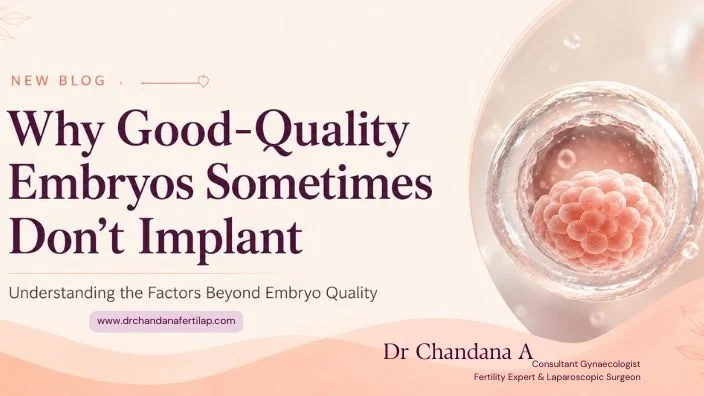
A good-quality embryo is an encouraging sign, but successful implantation depends on several factors beyond embryo appearance. In my latest blog, I discuss some of the important factors that may influence implantation and what couples should understand after an unsuccessful embryo transfer.
One of the most difficult questions I hear from couples after an IVF cycle is, ‘If my embryo was good quality, why didn’t it implant?՛
It is completely natural to feel confused and disappointed when an embryo that looked promising in the laboratory does not result in a pregnancy. However, embryo quality is only one part of a much more complex process.
Implantation requires the embryo, uterus, hormones, and several other biological factors to work together at the right time. A good-quality embryo is certainly encouraging, but it does not guarantee implantation. Understanding this distinction can help couples avoid unnecessary self-blame and approach the next step of their fertility journey with greater clarity.
A failed embryo transfer does not necessarily mean that anything was done incorrectly, nor does it mean that future attempts cannot be successful.
When we talk about a ‘good-quality embryo,’ we are primarily referring to how the embryo looks and develops under laboratory observation. Embryologists assess factors such as cell development, fragmentation, and, in the case of a blastocyst, the appearance of the inner cell mass and trophectoderm.
A favourable grade generally indicates better developmental potential, but embryo grading cannot tell us everything about the embryo. An embryo may look excellent under the microscope and still have a chromosomal abnormality that cannot be identified simply from its appearance.
Similarly, embryos with less favourable-looking grades can sometimes result in healthy pregnancies. This is why embryo grading should be understood as an important laboratory assessment rather than a guarantee of implantation or pregnancy. Embryo development is influenced by several biological factors, and visual appearance is only one piece of the larger picture.
The uterine environment and endometrium are another important part of implantation. For an embryo to attach successfully, the uterine lining needs to develop appropriately and be receptive during the relevant implantation window. Certain conditions, such as fibroids that distort the uterine cavity, endometrial polyps, adhesions, adenomyosis, or some forms of endometriosis, may affect implantation in selected patients.
The development of the endometrium and the timing of hormonal exposure, particularly progesterone in a frozen embryo transfer cycle, can also be important. However, it is equally important not to assume that every failed implantation is caused by the uterus or the endometrium.
Sometimes the embryo and uterus simply do not achieve the necessary biological synchronisation during that particular cycle. A single unsuccessful transfer does not automatically mean that extensive investigations or specialised treatments are required. Further evaluation should be guided by the patient’s individual history, previous treatment outcomes, and clinical findings.
There are also other factors that may influence implantation and IVF outcomes. Age is an important consideration, particularly because the likelihood of chromosomal abnormalities in eggs increases with advancing maternal age, which can influence embryo development and implantation potential.
Sperm health can also contribute to embryo development and reproductive outcomes, even when an embryo appears favourable in the laboratory. Underlying hormonal or metabolic conditions, ovarian factors, uterine health, and the circumstances of the individual IVF cycle may all need to be considered.
Most importantly, one unsuccessful embryo transfer does not necessarily indicate an implantation problem.
IVF is a highly individual process, and even when the embryo appears good quality and the treatment has been appropriately planned, implantation may not occur. Rather than immediately assuming that something is wrong, couples should review the complete clinical picture with their fertility specialist. Understanding what happened during the previous cycle can help determine whether any changes are genuinely needed before the next step.
If a good-quality embryo does not implant, the next step should be thoughtful evaluation rather than loss of hope. Depending on factors such as age, medical history, embryo development, previous transfer outcomes, uterine assessment, and the overall IVF journey, a fertility specialist may recommend proceeding with another embryo transfer or evaluating specific concerns before trying again.
Not every failed transfer requires the same approach, and not every patient needs every available fertility test.
Investigations should have a clear purpose and should be recommended based on the individual’s circumstances rather than simply because implantation did not occur once. If you have experienced an unsuccessful IVF cycle, remember that one failed transfer does not mean that pregnancy is impossible. Fertility treatment is a journey that often requires careful observation, patience, and personalised planning.
With appropriate evaluation and expert guidance, the next step can be planned to give you the best possible opportunity for a successful pregnancy.
Disclaimer: This blog is intended for educational and informational purposes only and should not be considered a substitute for professional medical advice, diagnosis, or treatment. Every fertility journey is unique. Please consult a qualified fertility specialist for personalised evaluation and guidance based on your individual circumstances.”
Stay informed with the latest updates in fertility and reproductive medicine on Fertility News.
-
Aug 23, 2026, 17:19Oluyemisi Famuyiwa: Financing Your Fertility Treatment
-
Aug 23, 2026, 17:11Favour Ayomi: The Questions That Changed Reproductive Science
-
Aug 23, 2026, 16:54Chang-Hoon Cho: A Comprehensive Immune Atlas of the Human Endometrium
-
Aug 23, 2026, 16:42Sharing Shannon’s Story with Preeclampsia This Story Saturday – Preeclampsia Foundation
-
Aug 23, 2026, 16:36Sarah Lewen: The More Capable the Machines Become, the More Human Connection Matters
-
Aug 23, 2026, 16:28Negin Asadi։ How Does the Blastocyst Attach to the Uterus?
-
Aug 23, 2026, 16:22Christopher Robinson։ Ultrasound Images of Scar and Cesarean Scar Defects
-
Aug 23, 2026, 16:17Somya Jha։ ICSI – 1 Sperm, 1 Egg, 1 Tiny Needle
-
Aug 23, 2026, 16:09Rachel Gerber Kule: Patients Don’t Have to Be Passive Passengers in Their Own Care