
Laser Hysteroscopy: Towards Precision and Fertility-Preserving Intrauterine Surgery
“Over the past two decades, hysteroscopy has undergone a remarkable transformation. What was once primarily a diagnostic procedure has progressively evolved into a minimally invasive surgical platform, allowing an increasing number of intrauterine conditions to be diagnosed and treated in the same outpatient session.
Miniaturized instruments, improved optics and the development of office-based ‘see-and-treat’ pathways have changed not only where hysteroscopic surgery is performed, but also how we think about it. The goal is no longer simply to treat an intrauterine lesion effectively. Particularly in women of reproductive age, attention is increasingly shifting towards minimizing invasiveness, preserving healthy tissue, and reducing the impact of surgery on the endometrium.
Within this evolving scenario, laser technology is attracting renewed interest.
Laser is certainly not new to gynecologic surgery. Nd: YAG, CO₂, KTP, and other laser systems have been investigated for intrauterine procedures for decades. What has changed is the technology available today. Modern diode laser platforms use thin and flexible optical fibers that can be introduced through the working channel of small-caliber hysteroscopes, making them particularly attractive for office-based surgery. Their interaction with water and hemoglobin allows cutting, vaporization, and coagulation to be combined within the same instrument.
In our recently published narrative review, ‘The Role of Laser Technology in Modern Hysteroscopy: Narrative Literature Review of Principles, Clinical Applications, and Current Limitations,’ we sought to critically examine the current position of laser-assisted hysteroscopy and, more importantly, its possible future role.
A structured literature search was conducted in PubMed, Scopus, and Web of Science, with the final search updated to December 2025. Overall, 312 records were initially identified, and 124 publications were ultimately included in the qualitative synthesis. The review covered the main laser platforms, their mechanisms of tissue interaction, clinical applications, safety, outpatient feasibility, and current limitations.
The picture emerging from the literature is promising, but it also calls for caution.
Where Does Laser Hysteroscopy Stand Today?
Laser-assisted hysteroscopy has been investigated across a broad range of intrauterine conditions, including endometrial polyps, submucous fibroids, intrauterine adhesions and septate uterus, as well as selected endometrial ablation procedures.
Among these applications, endometrial polypectomy currently offers some of the most interesting comparative data. Diode laser has been successfully used in office hysteroscopy, with studies suggesting good procedural tolerability and possible advantages over electrosurgery in terms of recurrence and patient satisfaction. More recent experience with dual-wavelength laser systems has also reported high procedural success.
Nevertheless, the number of high-quality randomized studies remains limited, and follow-up is frequently short. These findings are therefore encouraging, but not sufficient to establish laser as the preferred technique for hysteroscopic polypectomy.
A similar situation can be observed in hysteroscopic metroplasty. Modern diode laser systems have been used for the treatment of septate and dysmorphic uteri in outpatient settings, with encouraging results in terms of feasibility, tolerability and reproductive outcomes. However, comparative evidence has not demonstrated a clear advantage of laser over scissors or electrosurgical techniques in terms of pregnancy, miscarriage or live birth.
For submucous fibroids, different approaches have been described, ranging from laser-assisted enucleation to ablation and myolysis. Some of these techniques may be performed in an office setting and represent an interesting field for further development. At present, however, the evidence is mainly derived from relatively small prospective studies and case series, and conventional resectoscopic techniques remain the reference approach in many clinical scenarios.
Laser has also been used for intrauterine adhesiolysis, particularly in complex cases requiring precise dissection. Here again, its technical characteristics are appealing, but there is currently no convincing evidence that laser is superior to other established techniques. In women with severe intrauterine adhesions, prognosis continues to depend primarily on the extent of fibrosis and, importantly, on the amount of functional endometrium remaining after treatment.
This leads to one of the central messages of our review: laser should not currently be regarded as a replacement for conventional hysteroscopic surgery, but as an additional and potentially valuable tool for selected clinical situations.
Figure 1 – Current positioning of laser-assisted hysteroscopy
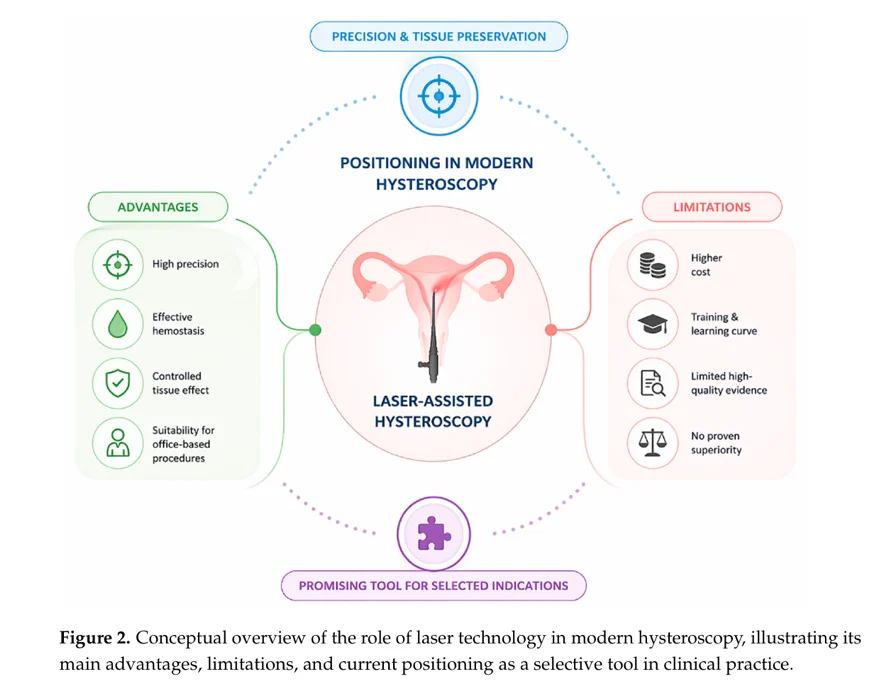
Figure 1. Conceptual overview of the role of laser technology in modern hysteroscopy, illustrating its main advantages, limitations, and current positioning as a selective tool in clinical practice. Adapted from Messina et al., Surgeries 2026;7:92.
The available literature supports this balanced interpretation. Modern diode laser systems offer precise tissue interaction, effective hemostasis and compatibility with miniaturized hysteroscopes, while their widespread adoption is still limited by costs, the need for dedicated training and, above all, the lack of sufficiently robust comparative evidence.
Beyond Lesion Removal: What Happens to the Endometrium?
For reproductive medicine, however, the most interesting question may be a different one.
When hysteroscopic surgery is performed in a woman who wishes to conceive, successful treatment cannot simply be defined as the complete removal of a polyp, fibroid, septum or adhesion.
What happens to the surrounding endometrium may be just as important as what we remove.
The endometrium is a highly regenerative tissue. Epithelial repair, glandular regeneration, stromal remodeling, vascularization, immune activity and extracellular matrix turnover are tightly coordinated following tissue injury. Damage to the basal endometrium or inadequate healing may contribute to fibrosis, recurrent intrauterine adhesions, thin endometrium, and potentially impaired implantation.
This is where the characteristics of laser–tissue interaction become particularly interesting.
Modern diode laser systems allow controlled energy delivery and may limit collateral tissue damage while providing effective hemostasis. Theoretically, these properties could be particularly valuable during fertility-preserving procedures such as septoplasty, adhesiolysis, polypectomy, and selected myomectomies, where preservation of the surrounding endometrium and myometrium is desirable.
But this distinction is essential: biological plausibility is not the same as demonstrated clinical superiority.
At present, we cannot state that using laser instead of mechanical or electrosurgical instruments improves implantation, pregnancy, or live-birth rates. The available evidence simply does not allow that conclusion.
Rather than weakening the rationale for studying laser hysteroscopy, this evidence gap identifies what should probably be the next major research question.
From Precision Surgery to Precision Reproductive Surgery
Future studies should move beyond the traditional endpoints used to evaluate hysteroscopic surgery.
Operative time, blood loss, technical success and complications remain important, but they do not fully describe the consequences of intrauterine surgery in women who wish to preserve or restore fertility.
For these patients, we should also evaluate how the endometrium heals.
Second-look hysteroscopy, postoperative adhesion formation, endometrial thickness and vascularity, menstrual recovery and recurrence could be combined with truly reproductive endpoints such as implantation, clinical pregnancy, miscarriage and live birth. Where feasible, tissue or intrauterine fluid biomarkers related to inflammation, fibrosis, angiogenesis and endometrial receptivity could provide further information on the biological response to different surgical techniques.
This concept led us to propose a broader framework in which the choice of hysteroscopic energy is no longer viewed exclusively as a technical decision.
Figure 2 – From hysteroscopy to precision reproductive surgery
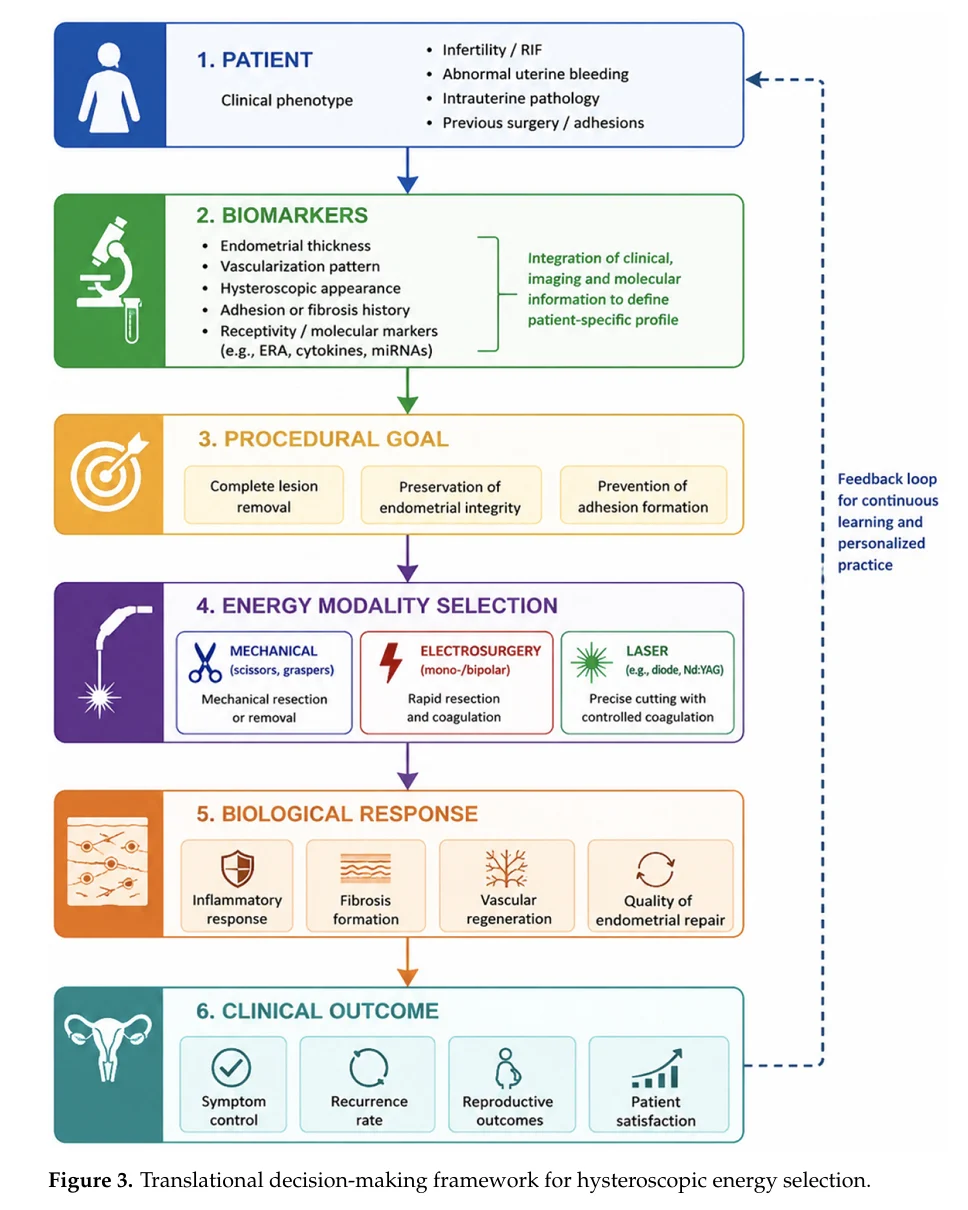
Figure 2. Translational framework for hysteroscopic energy selection. Patient characteristics and potential biomarkers may help define the procedural goal and guide the choice of surgical modality. Biological response and endometrial healing should ultimately be considered alongside conventional clinical and reproductive outcomes. Adapted from Messina et al., Surgeries 2026;7:92.
This approach brings hysteroscopy closer to the concept of precision reproductive surgery.
A woman with infertility, recurrent pregnancy loss, previous intrauterine adhesions, or a thin endometrium may have very different priorities from a woman undergoing treatment for abnormal uterine bleeding who has completed her reproductive plans. In the former, complete removal of the pathology remains important, but preservation or restoration of endometrial function becomes an equally relevant objective.
In the future, the question may therefore no longer be simply ‘Which instrument is best for this lesion?’ but rather ‘Which approach is most appropriate for this patient and for the biological outcome we want to preserve?’
The Office Setting May Be Where Laser Finds Its Place
The future of laser hysteroscopy will probably not depend on its ability to replace conventional instruments across all indications. A more realistic scenario is its progressive integration into selected office-based operative pathways.
This is particularly true for modern diode systems. Their flexible fibers and compatibility with small-caliber hysteroscopes fit naturally within the ‘see-and-treat’ philosophy. In appropriately selected patients, this may allow treatment without general anesthesia, shorter recovery, and greater procedural acceptability.
The possibility of combining miniaturization, precision and tissue preservation makes this approach particularly appealing when fertility preservation is a priority.
At the same time, office-based surgery should never be confused with simplified surgery. Appropriate patient selection, knowledge of laser–tissue interaction, correct fiber handling and specific training remain essential. Costs related to laser platforms and fibers also represent an important limitation to broader implementation.
What Comes Next?
The next phase of research should move beyond demonstrating that laser hysteroscopy is technically feasible.
We already know that it can be used successfully in a range of intrauterine procedures. The more relevant question is now whether, when, and in whom it provides a meaningful advantage.
This will require prospective comparative trials with standardized reporting of procedural outcomes, complications and recurrence, but also longer-term assessment of endometrial healing and reproductive outcomes. In fertility-preserving surgery, pregnancy and live birth should increasingly become part of the conversation rather than secondary considerations.
The evidence available today does not support routine first-line laser hysteroscopy across all indications. Modern diode laser systems should instead be regarded as a promising and evolving technology, particularly suited to selected office-based and fertility-preserving procedures.
Ultimately, the future contribution of laser may not lie in proving that it can replace the instruments we already have.
Its real value may be in helping us move towards a more conservative and biologically informed approach to intrauterine surgery – one in which success is measured not only by what we remove, but also by what we preserve.
For reproductive medicine, that distinction may be the one that matters most.”
Written by Alessandro Messina, MD
Division of Obstetrics and Gynecology, Degli Infermi Hospital, Biella, Italy
Studies cited
1. Title: Use of Diode Laser in Hysteroscopy for the Management of Intrauterine Pathology: A Systematic Review
Authors: Andrea Etrusco, Giovanni Buzzaccarini, Antonio Simone Laganà, Vito Chiantera, Salvatore Giovanni Vitale, Stefano Angioni, Maurizio Nicola D’Alterio, Luigi Nappi, Felice Sorrentino, Amerigo Vitagliano, Tommaso Difonzo, Gaetano Riemma, Liliana Mereu, Alessandro Favilli, Panagiotis Peitsidis, Antonio D’Amato
You can read the Full Article in Diagnostics.
2. Title: Outpatient hysteroscopic polypectomy: bipolar energy system (Versapoint®) versus diode laser – randomized clinical trial
Authors: Maria D. Lara-Domínguez, Jose E. Arjona-Berral, Rafaela Dios-Palomares, Camil Castelo-Branco
You can read the Full Article in Gynecological Endocrinology.
3. Title: A Novel 450-nm Laser Technique Versus Electrosurgical Excision for Hysteroscopic Endometrial Polypectomy: Efficacy and Safety
Authors: Pijun Gong, Hui Mao, Haiyan Wang, Tingting He, Li Bai, Jinyan Zhao, Zheng Ma, Xiang Xue
You can read the Full Article in the Journal of Lasers in Medical Sciences.
4. Title: Hysteroscopic laser ablation of symptomatic uterine fibroids: insights from a prospective study
Authors: S. G. Vitale, O. Moore, G. Riemma, J. Carugno, M. L. Yarto, S. Haimovich
You can read the Full Article in Climacteric.
5. Title: Office hysteroscopic metroplasty with diode laser for septate uterus: a multicenter cohort study
Authors: Berta Esteban Manchado, Maite Lopez-Yarto, Jorge Fernandez-Parra, Antonio Rodriguez-Oliver, Aida Gonzalez-Paredes, Antonio Simone Laganà, Simone Garzon, Sergio Haimovich
You can read the Full Article in Minimally Invasive Therapy and Allied Technologies.
6. Title: Fertility, pregnancy and perioperative outcomes after operative hysteroscopy for uterine septum: a network meta-analysis
Authors: Dimitrios Rafail Kalaitzopoulos, Maria Zografou Themeli, Georgios Grigoriadis, Maurizio D. Alterio, Salvatore Giovanni Vitale, Stefano Angioni, Angelos Daniilidis
You can read the Full Article in Archives of Gynecology and Obstetrics.
7. Title: Cyclical endometrial repair and regeneration
Authors: Lois A. Salamonsen, Jennifer C. Hutchison, Caroline E. Gargett
You can read the Full Article in Development.

8. Title: Conventional and modern markers of endometrial receptivity: a systematic review and meta-analysis
Authors: Laurentiu Craciunas, Ioannis Gallos, Justin Chu, Tom Bourne, Siobhan Quenby, Jan J Brosens, Arri Coomarasamy
You can read the Full Article in Human Reproduction Update.
Featured publication
Title: The Role of Laser Technology in Modern Hysteroscopy: Narrative Literature Review of Principles, Clinical Applications, and Current Limitations
Authors: Alessandro Messina, Alessio Massaro, Eleonora Dalmasso, Alessandro Libretti, Livio Leo, Bianca Masturzo
You can read the Full Article in Surgeries.
You can also read Alessandro Messina’s recent article on “Office Hysteroscopy Beyond Analgesia: What the VISION-HYST Trial Tells Us About the Clinical Environment” on Fertility News.
-
Sep 13, 2026, 15:11Sachintha Alwis: From Impaired Sperm Motility to Microrobotics
-
Sep 13, 2026, 15:08Laurence Orbuch: Before Endometriosis Surgery, Ask…
-
Sep 13, 2026, 15:05Ademola Ayodele: IUI, IVF or Egg Freezing – Which One Is Right for You?
-
Sep 13, 2026, 14:59Fiona Pathiraja-Møller: Tennis Players No Longer Have to Choose Between Career and Family
-
Sep 13, 2026, 14:571-Day Virtual Experience for People Impacted by PMOS – PCOS Awareness Association
-
Sep 13, 2026, 14:53Ozor Victor: Behind Every Embryo Is a Story of Science, Precision, and Hope
-
Sep 13, 2026, 14:50Diana Kayal: What They Don’t Tell You About IVF
-
Sep 13, 2026, 14:44Vikram Sinai Talaulikar: A Heartfelt Thank You to All Who Donated and Supported “Menopause and Cancer”
-
Sep 13, 2026, 14:41Nicole McPherson: Changing IVF Practices Is Hard – Integration Needs to Be Easy