

Sue Ritchie: Why Aren’t We Talking About Male Fertility More?
Sue Ritchie, Holistic Fertility and Health Specialist, shared on LinkedIn:
“Male Fertility Can Be Improved. So Why Aren’t We Talking About This More?
When a couple is struggling to conceive, who usually starts making the changes? More often than not, it’s the woman.
She’s researching fertility. Looking at her diet. Taking supplements. Tracking her cycle. Thinking about her weight, stress, sleep and lifestyle.
Meanwhile, the conversation around male fertility can sometimes go little further than a sperm test.
Yet creating a baby has always involved two people. And here’s the part I believe we need to talk about much more:
Male fertility isn’t necessarily fixed. There are tings men can do to support and potentially improve the quality of their sperm.
That should be an incredibly hopeful message for couples who are struggling to conceive.
The 90 days before conception matter for men too.
Men continually produce new sperm, and it takes approximately 90 days for sperm to develop. That means the sperm involved in conception three months from now is developing today.
So what happens during those months matters.
Nutrition, gut health, weight, sleep, stress, alcohol, smoking and vaping, exercise, environmental toxins and other lifestyle factors can all influence the environment in which sperm develops.
Yet how many men are actually being encouraged to use those 90 days to prepare?
In my experience, not nearly enough.
We’re missing an opportunity.
When poor sperm quality, concentration or motility is identified, couples may be told what the problem is without necessarily being given comprehensive support around what could potentially be done to improve it.
And sometimes the assumption is:
‘We’re going for IVF anyway, so does it really matter?’
I believe it does. IVF can help sperm and egg meet, but it doesn’t make the health of the sperm irrelevant. IVF is a fertilisation technology; it’s not a fertility treatment.
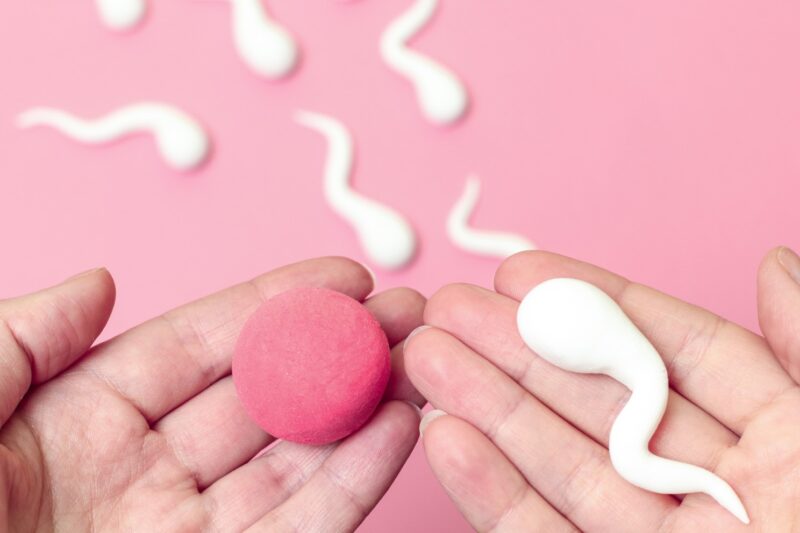
Whether you’re trying naturally or through IVF, surely it makes sense to create the healthiest egg and sperm possible before conception? This isn’t about guaranteeing an outcome.
It’s about doing what you reasonably can to improve the foundations you’re starting with.
Gut health may be part of that foundation.
This is one area I believe is still hugely underestimated in fertility for men as well as women.
We tend to think about gut health in terms of bloating, constipation, indigestion or other digestive symptoms and those are some early signs of poor gut health.
But the gut microbiome has a much wider influence throughout the body, including nutrient absorption, inflammation, immune function and hormone regulation.
Emerging research is also exploring the relationship between the gut microbiome, the male reproductive microbiome and reproductive health.
An imbalanced gut microbiome and the inflammation associated with it have been linked with poorer sperm concentration and motility and changes in hormone levels, including testosterone.
And this is why simply taking a probiotic isn’t necessarily the answer.
When someone’s microbiome is significantly out of balance, restoring gut health can require a much more structured and personalised approach.
It’s not about blaming men.
This is incredibly important.
Male fertility needs more attention, but this should never become another source of blame.
Finding out that sperm quality may be contributing to difficulties conceiving can be extremely difficult for a man.
It can affect confidence and masculinity. He may feel he’s letting his partner down.
The answer isn’t to say:
‘You need to sort your sperm out.’
It’s to change the conversation entirely.
‘What can we both do over the next 90 days to become healthier and give ourselves the best possible chance of conceiving?’
Suddenly, fertility preparation becomes something you’re doing together.
Not his problem.
Not her problem.
Your shared preparation for your future family.
Small changes can build a very different foundation.
Improving male preconception health doesn’t have to mean turning life upside down.
- It can mean looking at nutrition and gut health.
- Improving sleep.
- Moving more.
- Reducing alcohol.
- Stopping smoking or vaping.
- Reducing unnecessary exposure to endocrine-disrupting chemicals.
- Addressing weight where appropriate.
- Managing stress.
- Avoiding excessive heat around the testes.
- Looking at workplace exposure to chemicals, solvents, pesticides or heavy metals where relevant.
Individually, some of these things may sound quite simple. Together, over time, they can help create a healthier environment in which sperm develops.
And there’s another benefit that I think is equally important. You’re not only creating healthier habits to help you conceive and have a healthy baby.
You’re creating habits that can support your health through pregnancy, parenthood and the years ahead.
To me, that matters, and it’s a great gift for your future child.

Because the goal isn’t simply to make a baby. It’s to create the foundations for a healthy family.
Male fertility needs to become part of the normal fertility conversation.
I would love to see us reach the point where, when a couple is struggling to conceive, we don’t automatically focus most of our attention on the woman.
Where men aren’t simply tested and then forgotten about. Where both partners are encouraged to prepare. And where couples understand that the months before conception are not simply months of waiting.
They are an opportunity.
An opportunity to improve health. An opportunity to support egg and sperm quality. An opportunity to prepare for natural conception or IVF. Because the health of both parties really does matter.
And an opportunity to approach fertility as a couple rather than leaving one partner carrying most of the responsibility.
Because fertility isn’t solely a woman’s responsibility. It takes two to create a baby and preparation should involve two as well. It also brings couples closer together and strengthens their relationship.
If you’ve been struggling to conceive, have been told IVF may be your next step, or have already experienced unsuccessful IVF cycles, it may be worth asking a different question:
Have both of us really done everything we can to prepare our bodies for conception?
If you’d like help understanding what may be worth exploring for you or your partner, I offer a complimentary, confidential 30-minute Fertility Focus Call.
We’ll look at your individual situation and identify where there may be opportunities to strengthen your fertility foundations, whether you’re hoping to conceive naturally or through IVF.”
Other articles featuring Sue Ritchie on Fertility News.
-
Sep 18, 2026, 20:27Hrishikesh Pai: Rethinking Male Infertility
-
Sep 18, 2026, 20:25Eric Verdin: Wrapping Up the Reproductive Aging Summit at the Center for Healthy Aging in Women
-
Sep 18, 2026, 20:21Investigating Pregnancy Outcomes in Women with Idiopathic POI – RBMO
-
Sep 18, 2026, 20:13Salma Yasin: Every Day of BFS Study Week 2026 Has Been an Exceptional Learning Experience
-
Sep 18, 2026, 20:01Qingcai Wang: Over 35 and Torn Between Trying Longer and Starting IVF?
-
Sep 18, 2026, 19:58Bhumika: Can a Woman Become Pregnant Again While Already Pregnant?
-
Sep 18, 2026, 19:5215 More Experts Join the International Fertility Forum Mumbai 2026
-
Sep 18, 2026, 19:50Curious About What Happens Behind the Scenes in the Labs? – Sims IVF
-
Sep 18, 2026, 19:47Oluyemisi Famuyiwa: Fertility Changes Gradually, Not Suddenly