
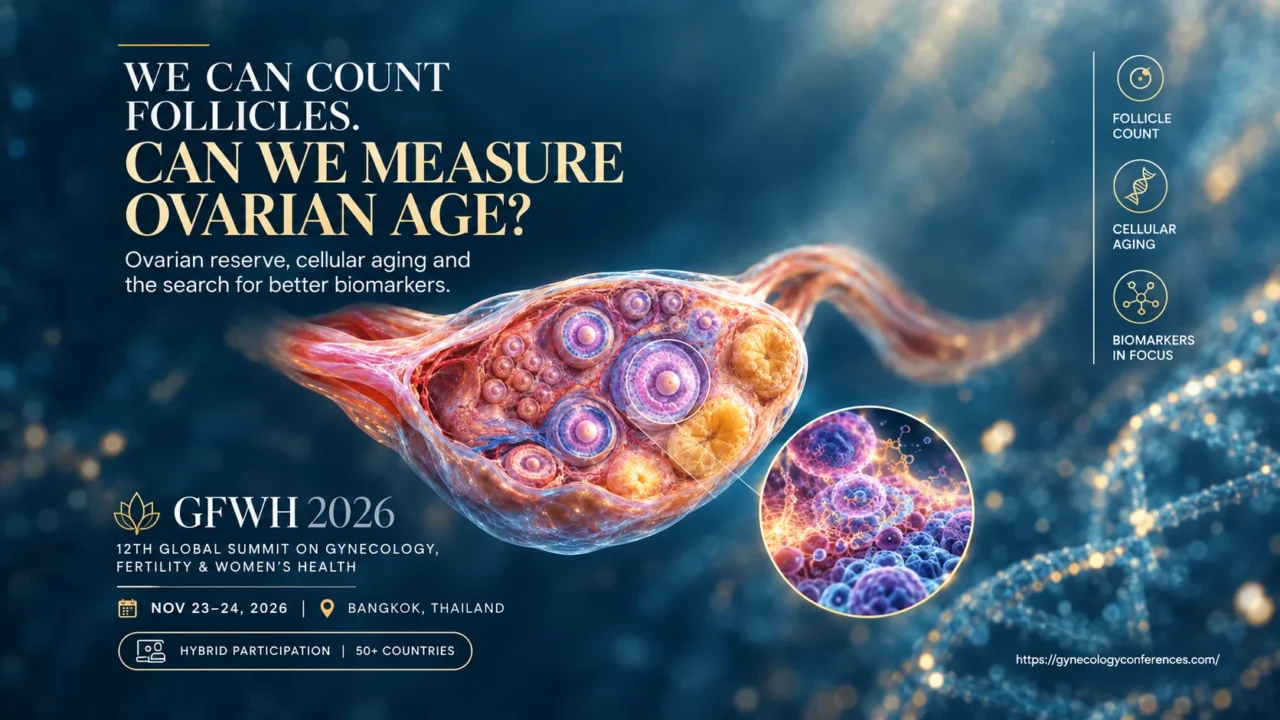
Devyanshi Dixit։ Can We Measure Ovarian Age?
Devyanshi Dixit, Program Manager at CLS Event and Publication and Conference Manager at the 12th Global Summit on Gynecology, Fertility and Women’s Health, shared on LinkedIn:
“The ovary may be aging before the menstrual cycle gives us any obvious clue.
Can we detect that change early enough to make a difference?
Ovarian aging is not a sudden event that begins when periods become irregular or menopause approaches.
It is a gradual biological process – and one that can remain clinically invisible for years.
The challenge is that biological change is not the same as a reliable prediction of fertility.
We already have tools to assess aspects of ovarian reserve:
- Anti-Müllerian hormone (AMH): provides information about the pool of small growing follicles.
- Antral follicle count (AFC): uses ultrasound to estimate the number of visible small follicles.
- FSH and other hormonal measures: can add context to an individual assessment.
These tests are clinically useful, particularly when estimating ovarian response during fertility treatment. But they cannot tell us exactly how many reproductive years remain, reliably predict natural conception for an individual, or fully capture egg quality.
That is where the next research challenge begins.
Researchers are exploring whether molecular signatures, cellular aging pathways, imaging, and combinations of biological markers could provide a more informative picture of reproductive aging.
The goal is not simply to measure ovarian reserve – but to understand ovarian function and its changes more precisely over time.
The clinical question is therefore bigger than whether we can measure ovarian aging.
Can we develop biomarkers that provide meaningful information earlier – without creating false reassurance or unnecessary alarm?
At the 12th Global Summit on Gynecology, Fertility and Women’s Health (GFWH 2026), these interdisciplinary conversations will continue on
- November 23–24, 2026
- Grand Mercure Bangkok Atrium, Bangkok, Thailand
- Hybrid participation
If you work in ovarian biology, reproductive endocrinology, fertility diagnostics, or biomarker research, I welcome your perspective.”
Other articles featuring Devyanshi Dixit on Fertility News.
-
Oct 14, 2026, 17:21Abhijit Kulkarni: The Missing Answer to Repeated IVF Failure May Lie in the Genes
-
Oct 14, 2026, 17:17A Very Special Visit That Made Our Day – Complete Fertility
-
Oct 14, 2026, 17:12Ensuring That Every Woman Receives the Highest Quality of Care Globally – FIGO
-
Oct 14, 2026, 17:08Sukhbir Singh: Why Are Canadians Leaving the Country for Endometriosis Care?
-
Oct 14, 2026, 17:03Angeline Beltsos: Thrilled to Announce That I’m Returning to Patient Care at Vios 2.0
-
Oct 14, 2026, 16:58Juan A. García Velasco: IVI RMA Global Evolves into IVI Institute, Strengthening Research and Innovation in Fertility Care
-
Oct 14, 2026, 16:49Devyanshi Dixit: Acknowledgement Matters After Baby Loss…
-
Oct 14, 2026, 16:41Joy Maria Mitchell: Prenatal Cytogenetics – Karyotype, FISH and Clinical Evaluation
-
Oct 14, 2026, 16:28Svitlana Yashchenok: Would You Introduce Non-Invasive PGT-A into Your Fertility Clinic Today?