

Rajeev Agarwal: Age and Male Fertility, Through the PREPARE Method
Rajeev Agarwal, Director of Renew Healthcare, shared on LinkedIn:
“We ask her age first. We should ask his, too.
Age and male fertility come up far less than they should. In over 25 years of practice, I have watched many couples treat the husband as a sample to be collected on the day, not as half of the plan.
The PREPARE method was built to change that, and it applies to both partners from the first visit.
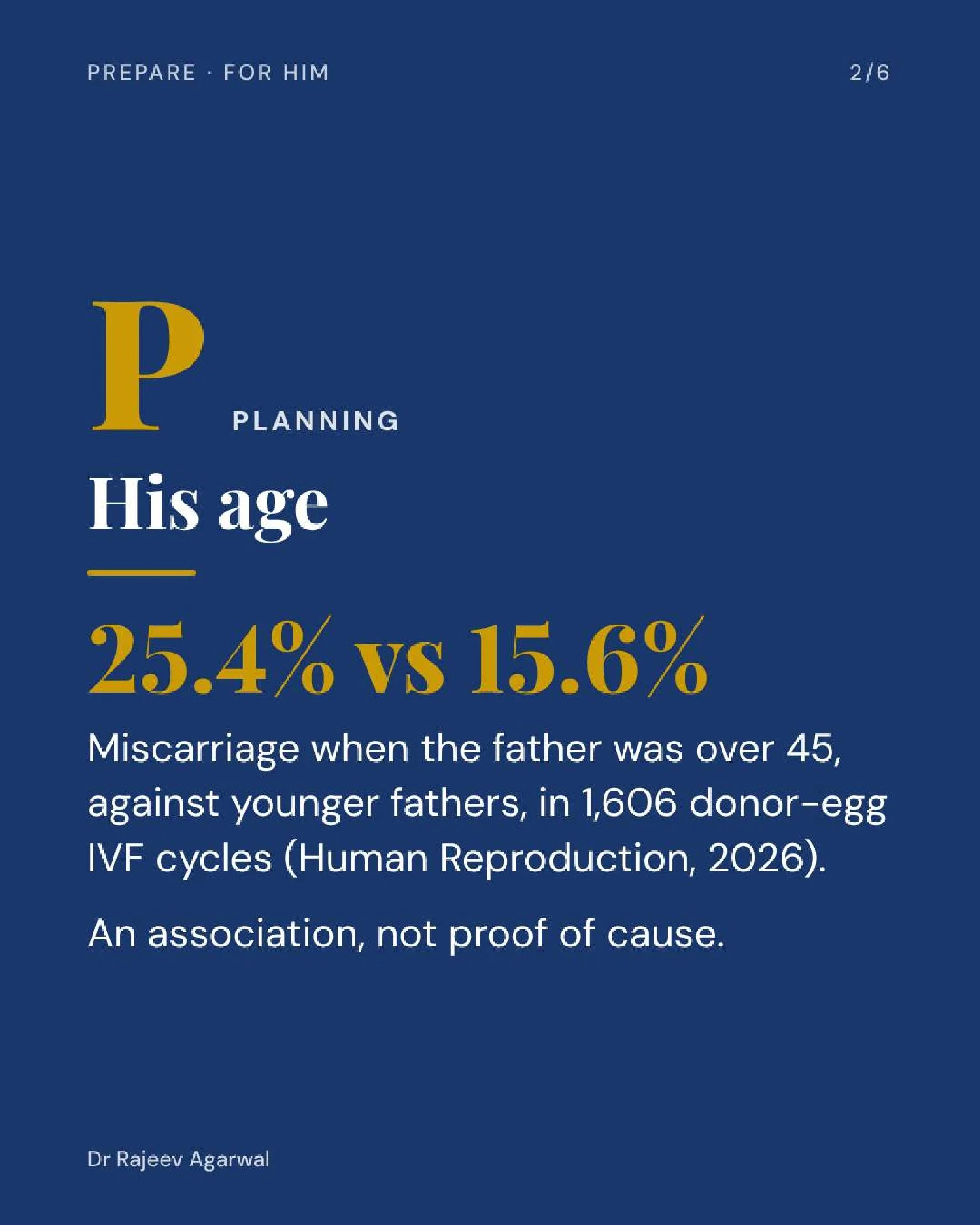
P for Planning includes his age. A new Human Reproduction study looked at 1,606 donor-egg IVF cycles. Because the eggs came from young donors, her age was taken out of the picture. When the father was over 45, miscarriage was 25.4% against 15.6%, and live birth 34.3% against 42.4%.
It is a retrospective study and embryo chromosomes were not tested, so it shows an association, not proof of cause. An earlier meta-analysis, adjusted for the mother’s age, found miscarriage risk about 43% higher at 45 or over than with fathers aged 25 to 29. The likely reasons are more new mutations and more sperm DNA damage with age, though neither is proven to explain it.
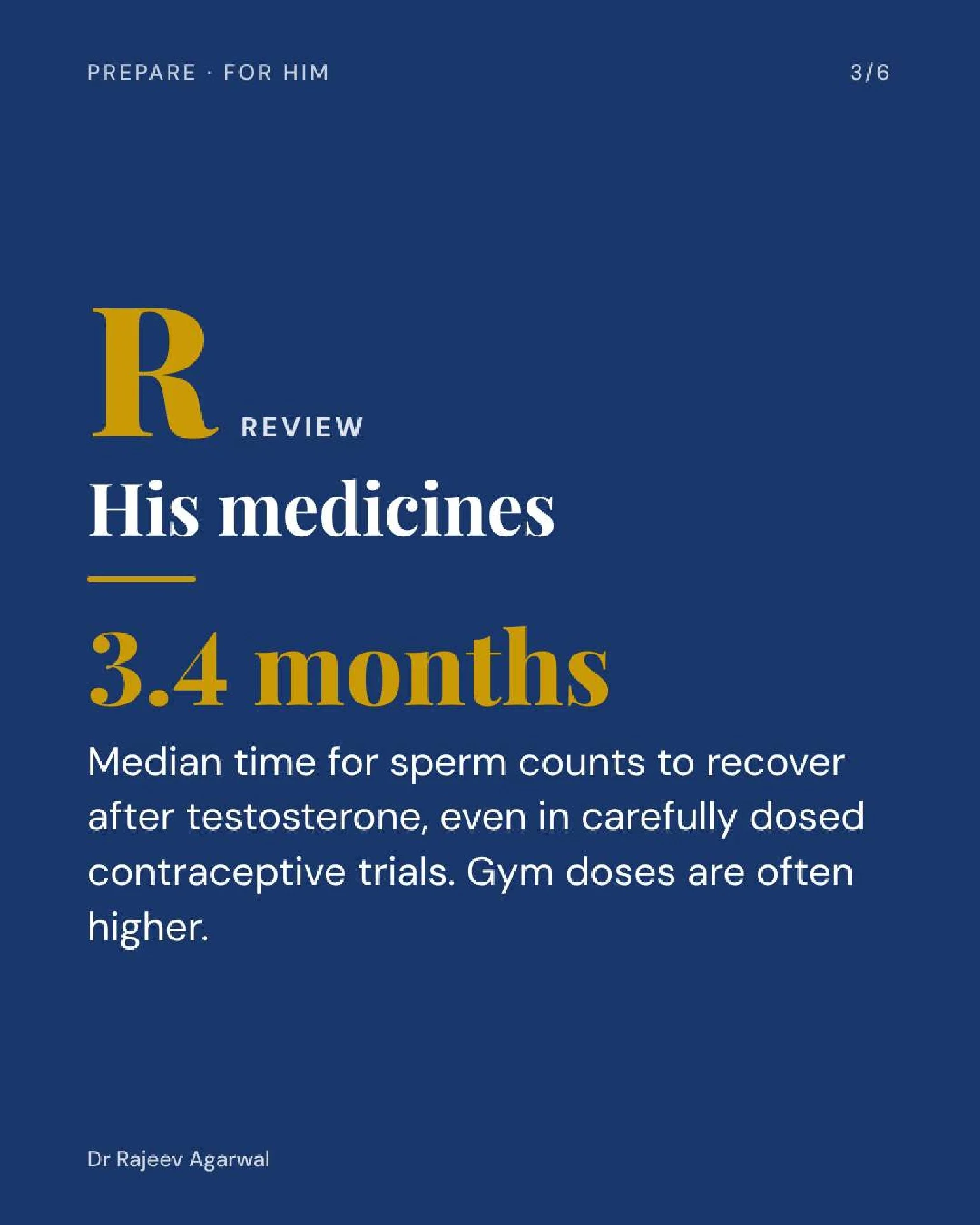
R for Review means his medicines. I now ask every man who goes to the gym about testosterone injections, steroids and ‘boosters’ that may contain hidden steroids. Testosterone switches off sperm production. Even in carefully dosed contraceptive trials, counts took a median of 3.4 months to recover, and about 1 in 10 men had not recovered by a year. Gym doses are often higher.
E for Evaluate means his semen analysis at the same visit as her blood tests. The AUA/ASRM guideline also asks for both partners to be assessed together, not one after the other.
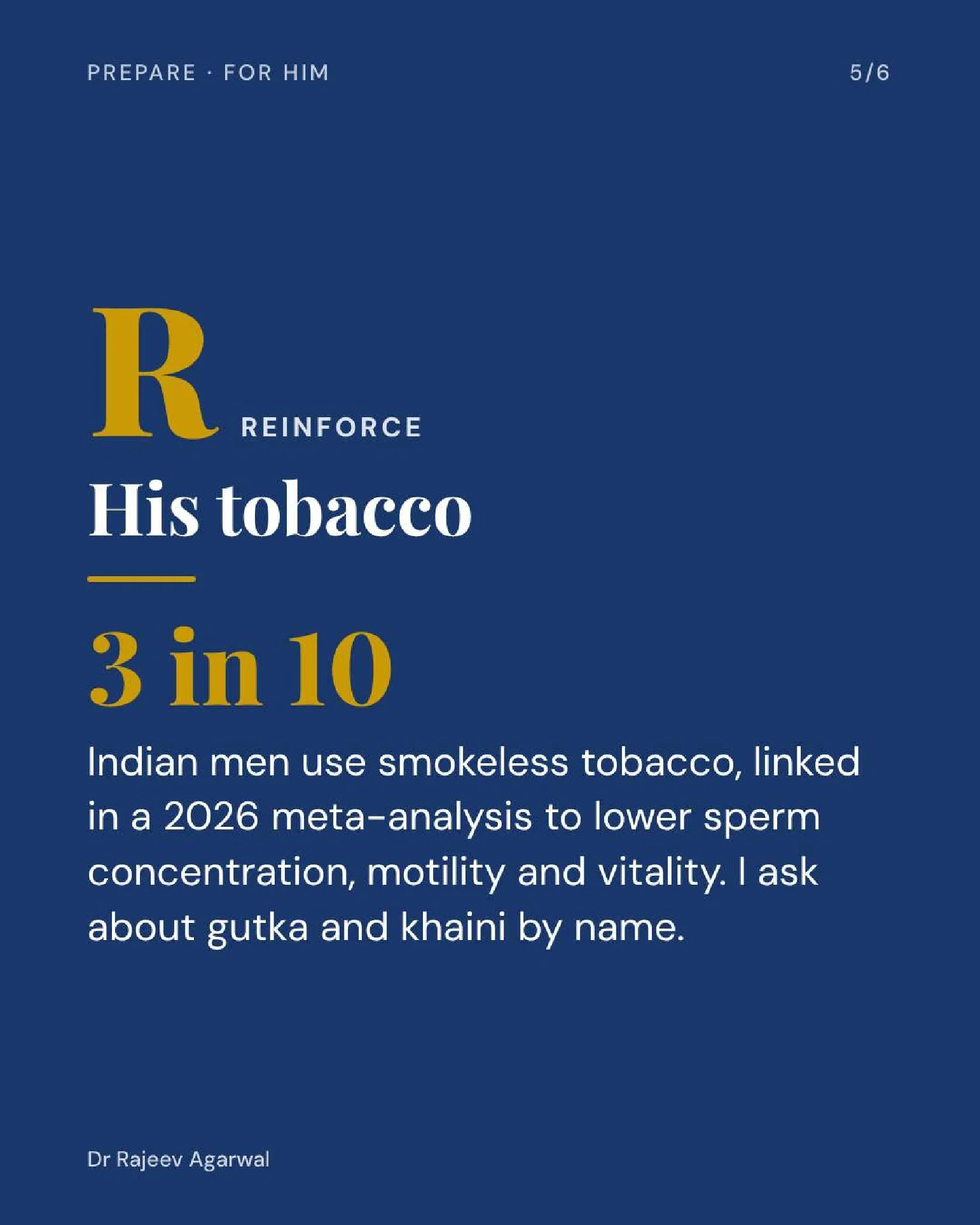
R for Reinforce is where India is different. Nearly 3 in 10 Indian men use smokeless tobacco. A 2026 meta-analysis of 16 studies and 3,401 men, mostly South Asian, linked it to lower sperm concentration, motility, and vitality. Most Western advice stops at cigarettes, so I ask about gutka and khaini by name.
Sperm take roughly two to two and a half months to develop. What he changes today shows up in the sperm that meets the egg about three months later.
A PREPARE checklist for him:
- Ask for his semen analysis at the first preconception visit, not after a year of trying.
- Stop tobacco in every form, including gutka and khaini, at least three months before trying.
- Tell the doctor about any testosterone, steroid or ‘booster’; recovery can take months.
- If he is over 40, say so at the first visit. It changes the planning, not the hope.
Colleagues: in your preconception clinic, how often does the husband come to the first visit?
Don’t just conceive, preconceive.”
Other articles featuring Rajeev Agarwal on Fertility News.

-
Oct 13, 2026, 16:58Slavian Bumbu: A Low AMH Is Not an Infertility Diagnosis
-
Oct 13, 2026, 16:43Keshav Malhotra: No Embryologist or Laboratory Technique Can Guarantee Euploid Embryos
-
Oct 13, 2026, 16:37Tony Gordon: What Is the Most Successful Form of Fertility Treatment?
-
Oct 13, 2026, 16:29IVI RMA Global Introduces IVI Fertility
-
Oct 13, 2026, 16:12Devyanshi Dixit: PCOS May Be One Diagnosis, But Is It One Biological Disease?
-
Oct 13, 2026, 15:505 Years of the Patient Engagement Forum – HFEA
-
Oct 13, 2026, 15:41Cell-Free Fetal DNA Testing for Single-Gene Conditions – RCOG
-
Oct 13, 2026, 15:24Somil Singhal: Method for Enhancing Embryo Implantation Using Embryo Glue and Its Importance
-
Oct 13, 2026, 15:06Clare Mansfield: Pregnancy Loss Is Grief, and Grief Looks Different for Everyone…