
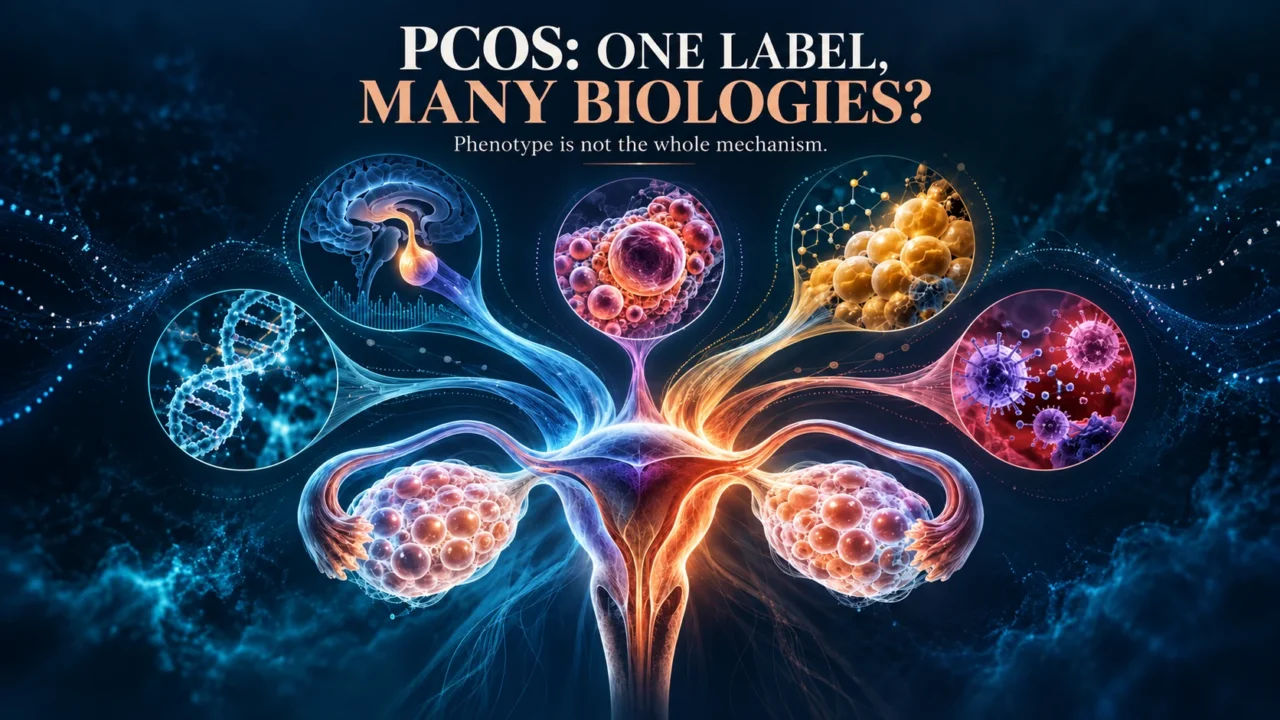
Devyanshi Dixit: PCOS May Be One Diagnosis, But Is It One Biological Disease?
Devyanshi Dixit, Program Manager at CLS Event and Publication and Conference Manager at the 12th Global Summit on Gynecology, Fertility and Women’s Health, shared on LinkedIn:
“PCOS may be one diagnosis. But is it one biological disease?
Two patients can meet the same diagnostic criteria for polycystic ovary syndrome (PCOS) and still have remarkably different clinical profiles.
One may primarily struggle with irregular ovulation and infertility. Another may have prominent hyperandrogenism and metabolic dysfunction. A third may have overlapping features that change across her reproductive life.
The diagnosis may be the same. The biology may not be.
This is more than a question of symptom variability. It challenges how we think about disease classification.
The 2023 International Evidence-based Guideline recognizes PCOS as a condition with diverse reproductive, metabolic, psychological, and other health implications. However, current diagnostic criteria were not designed to identify every underlying biological mechanism.
Research is beginning to explore this gap.
A 2025 review in Nature Reviews Endocrinology describes evidence for distinct reproductive and metabolic subtypes, including differences suggested by cluster analyses and genetic research. These findings are promising, but they do not yet establish a definitive biological taxonomy or prove that subtype-based treatment improves outcomes.
Why does this distinction matter?
Because a diagnosis tells us who meets the criteria. It does not necessarily tell us why the condition developed, which risks deserve the greatest attention, or how an individual’s health trajectory may evolve.
The next step is not simply to create more PCOS categories. It is to determine whether biologically meaningful subgroups can improve risk prediction, treatment selection, and long-term outcomes across diverse populations.
That will require stronger longitudinal evidence, better representation across ethnic groups, and closer collaboration between reproductive medicine, endocrinology, genetics, and metabolic research.
At GFWH 2026, these interdisciplinary questions belong in the same conversation.
- November 23–24, 2026
- Grand Mercure Bangkok Atrium, Bangkok, Thailand
- Hybrid participation
- Professionals from 50+ countries
For clinicians and researchers: What evidence would convince you that PCOS subtyping is ready to move from research into routine clinical practice?”
Other articles featuring Devyanshi Dixit on Fertility News.
-
Oct 13, 2026, 16:58Slavian Bumbu: A Low AMH Is Not an Infertility Diagnosis
-
Oct 13, 2026, 16:43Keshav Malhotra: No Embryologist or Laboratory Technique Can Guarantee Euploid Embryos
-
Oct 13, 2026, 16:37Tony Gordon: What Is the Most Successful Form of Fertility Treatment?
-
Oct 13, 2026, 16:29IVI RMA Global Introduces IVI Fertility
-
Oct 13, 2026, 16:00Rajeev Agarwal: Age and Male Fertility, Through the PREPARE Method
-
Oct 13, 2026, 15:505 Years of the Patient Engagement Forum – HFEA
-
Oct 13, 2026, 15:41Cell-Free Fetal DNA Testing for Single-Gene Conditions – RCOG
-
Oct 13, 2026, 15:24Somil Singhal: Method for Enhancing Embryo Implantation Using Embryo Glue and Its Importance
-
Oct 13, 2026, 15:06Clare Mansfield: Pregnancy Loss Is Grief, and Grief Looks Different for Everyone…