

Hossam Elzeiny: The Need for Clinically Relevant Studies in Fertility
Hossam Elzeiny, Fertility Specialist and Gynecologist at City Fertility, shared a post on LinkedIn:
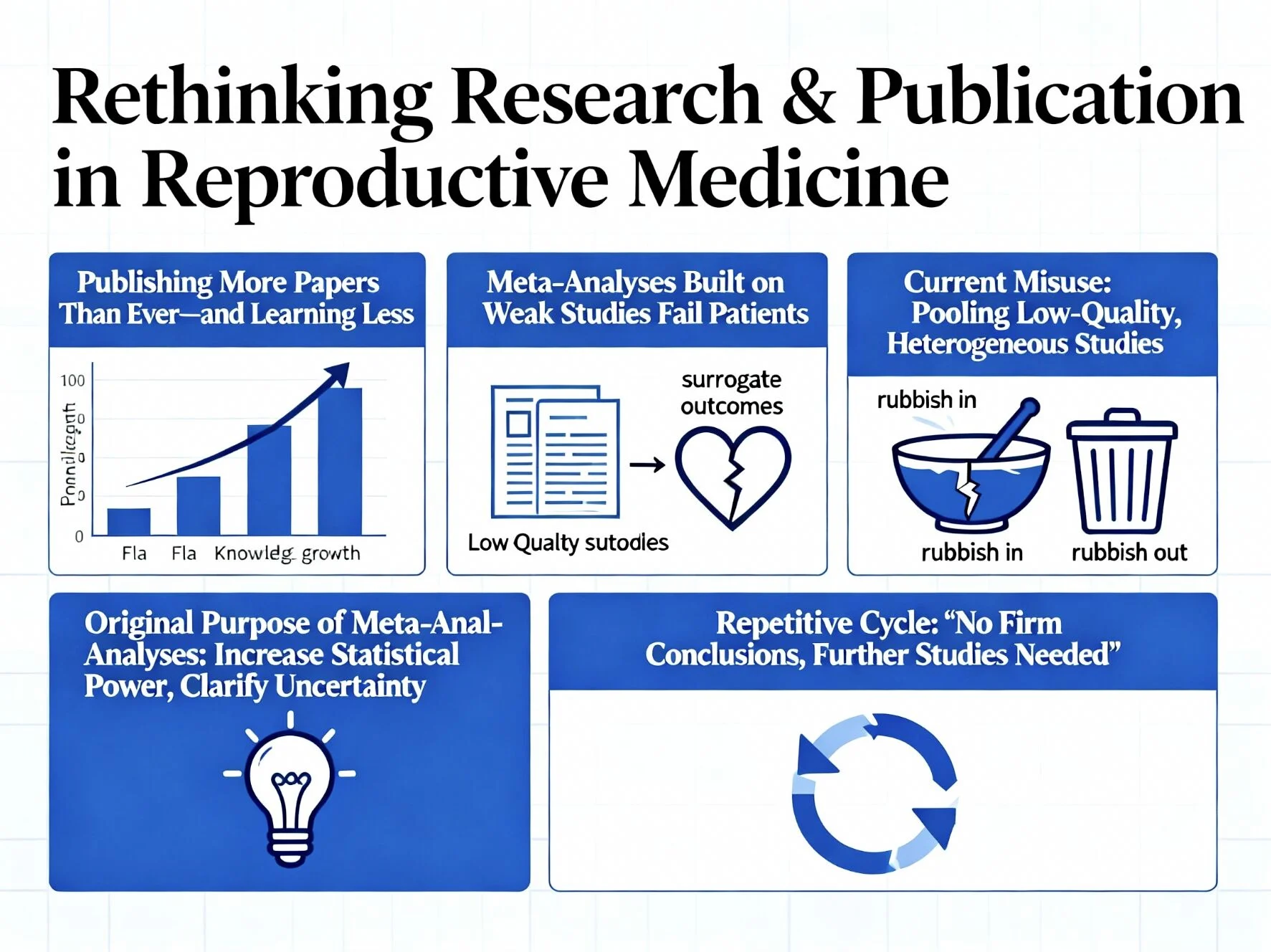
“We are publishing more papers than ever – and learning less from them.
Meta-analyses built on weak studies and surrogate outcomes are failing our patients.
It is time to pause – and seriously rethink – how we conduct and publish research in reproductive medicine.
Meta-analyses were originally designed to increase statistical power and clarify uncertainty. Increasingly, however, they are being applied to bodies of evidence that are fundamentally flawed.
When low-quality, heterogeneous studies are pooled together, the outcome is predictable: rubbish in, rubbish out. The conclusion is almost always the same cliché – ‘due to low quality of evidence, no firm conclusions can be drawn and further studies are needed’ – and the cycle simply repeats.
Many of these analyses are performed by statisticians or epidemiologists who have never managed a patient, counselled a couple, or made real-world clinical decisions based on these data. Methodological elegance cannot compensate for clinical irrelevance.
The problem extends beyond meta-analyses:
- Male infertility intervention studies continue to be published using semen parameters as surrogate outcomes, with no reporting of the only endpoint that truly matters to patients—live birth.
- PGT-A studies frequently report live birth per embryo transfer rather than per started cycle, creating a distorted narrative that ignores attrition, cost, emotional burden, and clinical reality.
- Studies that confuse clinicians, mislead patients, and fail to inform practice are still celebrated as ‘high-quality research’.
This represents a substantial waste of time, money, effort – and, most importantly, patients’ trust.
The uncomfortable truth is that much of what we now read in top journals consists of opinion pieces, invited commentaries, and expert consensus – not because these are superior forms of evidence, but because truly robust, clinically meaningful studies are increasingly rare in our field.
Reproductive medicine does not need more statistically sophisticated noise.
It needs a research revolution – grounded in clinically relevant questions, meaningful endpoints, rigorous study design, and outcomes that matter to patients.
Until then, we should be honest about the limitations of what we publish—and courageous enough to demand better.”
Stay updated on all scientific advances in the field of fertility with Fertility News.
-
Sep 18, 2026, 20:27Hrishikesh Pai: Rethinking Male Infertility
-
Sep 18, 2026, 20:25Eric Verdin: Wrapping Up the Reproductive Aging Summit at the Center for Healthy Aging in Women
-
Sep 18, 2026, 20:21Investigating Pregnancy Outcomes in Women with Idiopathic POI – RBMO
-
Sep 18, 2026, 20:18Sue Ritchie: Why Aren’t We Talking About Male Fertility More?
-
Sep 18, 2026, 20:13Salma Yasin: Every Day of BFS Study Week 2026 Has Been an Exceptional Learning Experience
-
Sep 18, 2026, 20:01Qingcai Wang: Over 35 and Torn Between Trying Longer and Starting IVF?
-
Sep 18, 2026, 19:58Bhumika: Can a Woman Become Pregnant Again While Already Pregnant?
-
Sep 18, 2026, 19:5215 More Experts Join the International Fertility Forum Mumbai 2026
-
Sep 18, 2026, 19:50Curious About What Happens Behind the Scenes in the Labs? – Sims IVF