

Caspian Ostadian: From OPU to ICSI – How Much Rest Time Does an Oocyte Need?
Caspian Ostadian, Embryologist at Mehr Assistant Reproductive Center, shared on LinkedIn:
“From OPU to ICSI: How Much Rest Time Does an Oocyte Need?
Does the timing between oocyte retrieval, denudation, ICSI, and vitrification really matter?
In the IVF laboratory, timing is more than a number on the clock. Oocyte maturity, post-retrieval recovery, culture conditions, and laboratory protocols all influence how we handle oocytes after ovum pick-up (OPU).
Here is a practical overview for clinical embryologists.
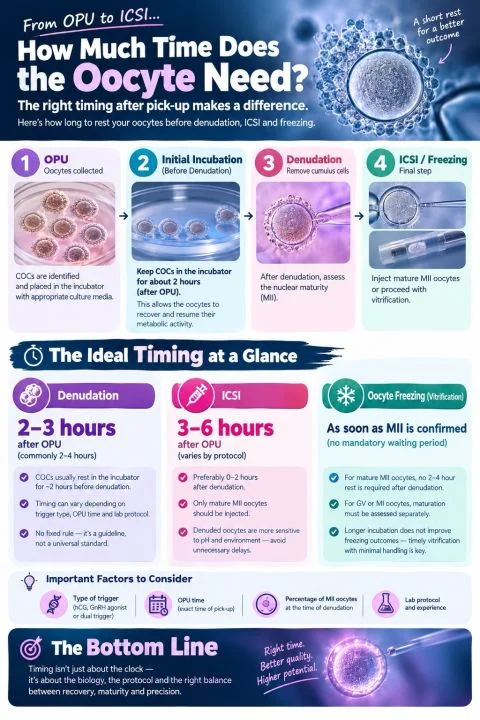
1. Initial Incubation After OPU
Following retrieval, cumulus–oocyte complexes (COCs) are identified and placed in appropriate culture conditions.
- A short period of incubation before denudation is common in many IVF laboratories.
- Approximately 2 hours is a practical starting point in some protocols.
- The optimal interval may vary according to the trigger type, retrieval timing, and laboratory protocol.
2. Denudation
Denudation removes the surrounding cumulus cells to allow assessment of nuclear maturity before ICSI.
- Denudation is commonly performed around 2–4 hours after OPU in many protocols.
- After denudation, identify mature metaphase II (MII) oocytes.
- Minimize unnecessary exposure to suboptimal temperature, pH, and environmental conditions.
3. ICSI
ICSI is performed on mature MII oocytes.
- The overall interval from OPU to ICSI is commonly around 3–6 hours, depending on the laboratory workflow.
- Keep the interval between denudation and injection as short as practical, following the validated laboratory protocol.
- Longer waiting times do not automatically translate into better fertilization or embryo development.
4. Oocyte Vitrification
For mature MII oocytes, there is generally no requirement to wait an additional 2–4 hours solely for recovery before vitrification.
- Confirm maturity and follow the laboratory’s validated vitrification protocol.
- Immature GV or MI oocytes require a different approach if in-vitro maturation is being considered.
- Timely handling, controlled temperature, and precise execution are essential.
What Factors Should Guide Timing?
- Trigger type: hCG, GnRH agonist, or dual trigger
- Exact time of OPU
- Proportion of MII oocytes
- Culture conditions and laboratory workflow
- Evidence-based, validated laboratory protocols
The Bottom Line
There is no single waiting time that is optimal for every oocyte or every IVF laboratory. Timing should balance appropriate handling, oocyte maturity, and laboratory-specific evidence – not simply follow the clock.
What is your laboratory’s standard interval from OPU to denudation and from denudation to ICSI? Have you observed differences in outcomes with different timings?
Let’s exchange evidence-based experience and improve our laboratory practice.”
Other articles featuring Caspian Ostadian on Fertility News.
-
Oct 21, 2026, 17:57Ula Sankowska: What I’ll Bring to ASRM INNOVATE in Baltimore
-
Oct 21, 2026, 17:40Robert Borowczyk: The Invisible Waiting Room
-
Oct 21, 2026, 17:35Fereshteh Safian: Behind the Scenes of Reproductive Medicine
-
Oct 21, 2026, 17:20The Relationship Between Trophectoderm Biopsy and Early Pregnancy Outcomes – RBMO
-
Oct 21, 2026, 17:09Jules McDonald: The Future of Fertility Is Happening in Abu Dhabi
-
Oct 21, 2026, 16:53Ashley Evans: I Never Imagined I’d Be a Fertility Story with a Group of People Whom I Have Never Met…
-
Oct 21, 2026, 16:41Karthik Raj: Asherman’s Syndrome – When the Endometrium Cannot Regenerate Normally
-
Oct 21, 2026, 16:36Katy Encalade: A Few Misconceptions I Think Every Woman Considering Egg Donation Deserves to Understand
-
Oct 21, 2026, 16:21The FeRGI Working Group 2026-2027 – ESHRE SIG Reproductive Genetics