

Dinesh Thomas Cherian: What Fertility Tests Can and Cannot Tell Us
Dinesh Thomas Cherian, Consultant at Welcare Hospital, Vyttila, Ernakulam, shared on LinkedIn:
”Doctor, both our reports were normal. So why are we still not pregnant?
A young couple asked me this recently.
Before marriage, they had done what is becoming increasingly common-a premarital fertility check-up.
His semen analysis was normal.
Her basic evaluation was reassuring.
They married feeling confident. Months passed. No pregnancy.
They repeated the tests.
Still, nothing obviously wrong.
And that conversation reminded me of something we sometimes fail to communicate clearly enough:
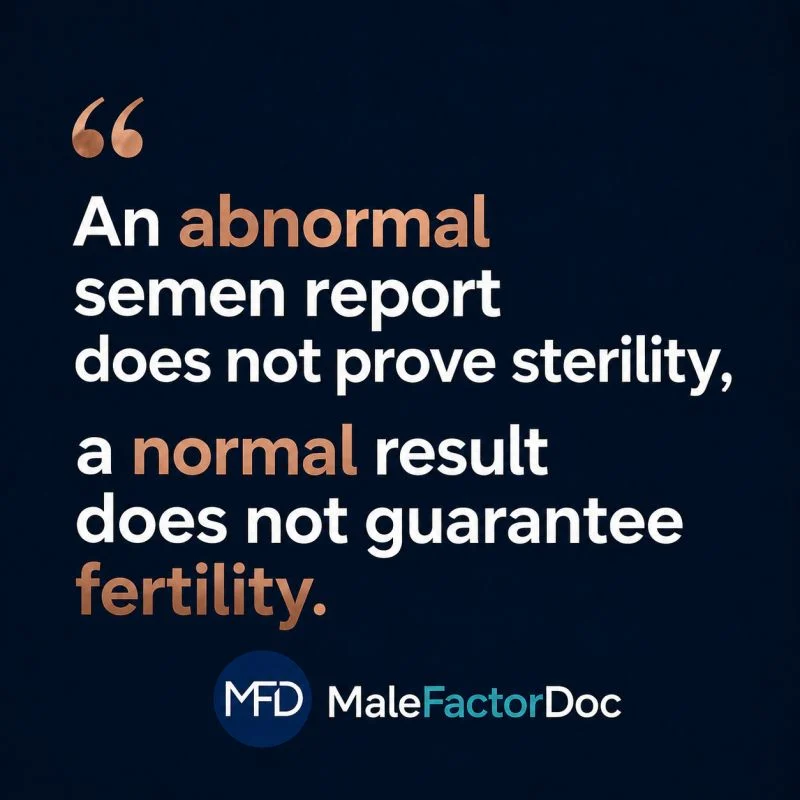
- A normal semen analysis does not guarantee fertility.
- An abnormal semen analysis does not prove sterility.
A semen analysis tells us about the sperm we can count, see, and measure-concentration, motility, and morphology.
It is extraordinarily useful. But fertilisation is far more sophisticated than numbers on a laboratory report.
A spermatozoon is not merely a cell with a tail carrying 23 chromosomes.
It carries DNA, an epigenetic signature and a complex cargo of RNAs. We are increasingly learning that some of these molecular characteristics may contribute to fertilisation, early embryonic development and embryo quality.
The oocyte brings an even more remarkable biological machinery of its own.
And then these two cells meet.
- We can measure semen parameters.
- We can assess ovulation and ovarian reserve.
- We can demonstrate tubal patency.
- We can examine anatomy.
And yet, some couples with apparently reassuring conventional investigations still do not conceive-the clinical reality we call unexplained infertility.
Perhaps one of the most important lessons in reproductive medicine is knowing what our tests can tell us-and what they cannot.
Our understanding of the genetics, epigenetics, and RNA biology of human gametes is advancing rapidly.
But we still cannot reduce human fertility to a perfect laboratory score.
The deeper I go into male fertility, the more humbling reproductive biology becomes.
- We investigate.
- We diagnose what we can.
- We correct what is correctable.
- We use the best evidence available.
But perhaps there is still room for an old-fashioned sentence in modern reproductive medicine:
Pregnancy is not a laboratory value. It remains a remarkable biological event-and, for every couple who achieves it, a gift.
– MaleFactorDoc”
Stay informed with the latest updates in fertility and reproductive medicine on Fertility News.
-
Oct 21, 2026, 17:57Ula Sankowska: What I’ll Bring to ASRM INNOVATE in Baltimore
-
Oct 21, 2026, 17:40Robert Borowczyk: The Invisible Waiting Room
-
Oct 21, 2026, 17:35Fereshteh Safian: Behind the Scenes of Reproductive Medicine
-
Oct 21, 2026, 17:20The Relationship Between Trophectoderm Biopsy and Early Pregnancy Outcomes – RBMO
-
Oct 21, 2026, 17:09Jules McDonald: The Future of Fertility Is Happening in Abu Dhabi
-
Oct 21, 2026, 16:53Ashley Evans: I Never Imagined I’d Be a Fertility Story with a Group of People Whom I Have Never Met…
-
Oct 21, 2026, 16:41Karthik Raj: Asherman’s Syndrome – When the Endometrium Cannot Regenerate Normally
-
Oct 21, 2026, 16:36Katy Encalade: A Few Misconceptions I Think Every Woman Considering Egg Donation Deserves to Understand
-
Oct 21, 2026, 16:21The FeRGI Working Group 2026-2027 – ESHRE SIG Reproductive Genetics