
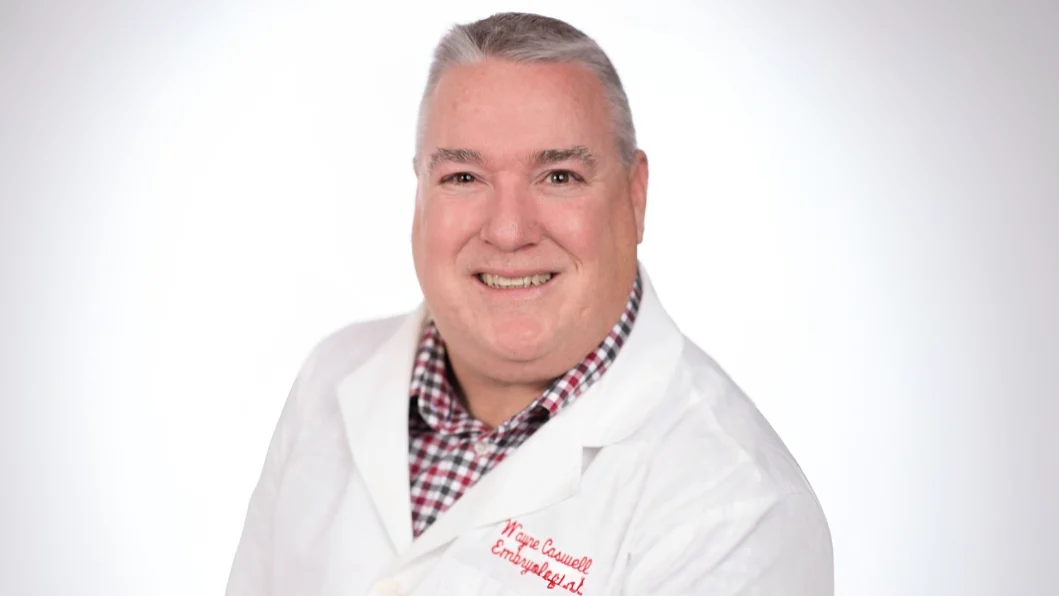
Wayne Caswell։ How Many Donor Eggs Does It Take to Have a Chance at a Baby?
Wayne Caswell, Vice President of Laboratory Services at Fairfax EggBank, shared on LinkedIn։
“How Many Donor Eggs Does It Take? Walking Patients Through the Numbers․
Managing the expectations of intended parents is critical in our field. When trying to explain how many frozen donor eggs it takes to have a chance at a baby, we all know that the honest answer is that not every egg becomes an embryo. It’s our job as clinicians to reassure our intended parents and patients that this is biology, not failure, and succinctly break down why eggs come in cohorts:
- Not every egg survives warming. At a strong program, roughly 90- 93% of frozen donor eggs survive the thaw. Fairfax EggBank’s post-warm survival has consistently run around 90- 93%.
- Not every surviving egg fertilizes. About 75% of surviving eggs typically fertilize normally after sperm is introduced.
- Not every fertilized egg becomes a usable embryo. Roughly half of fertilized eggs develop into a viable blastocyst (the stage that can actually be transferred, biopsied, or frozen).
- This is why eggs are sold in cohorts, not one at a time. A group of eggs accounts for natural drop off so you have a realistic chance at a usable embryo.
- Our blastocyst guarantee exists because of this math. Fairfax EggBank guarantees at least one blastocyst with each paid cohort, so the risk of biology doesn’t fall entirely on you.
Before the numbers: What you’re really asking․
If you’re reading this, you likely interface with patients who are constantly handed jumbles of numbers: success rates, survival rates, cohort sizes. Often, they have all of these thrown at them without anyone stopping to explain what they mean and how they fit together. Most importantly, underneath the spreadsheet math is a much more important question: Is this going to work for them?
We know that arriving at donor eggs is rarely the first chapter of anyone’s story. Our patients all have unique stories and travel long, winding roads to land in our clinics. So, in general, before diving into the numbers with them, one thing I always think is worth saying plainly is this: the attrition that you are about to walk them through is normal.
Let them know that while we track this natural drop-off at every stage to identify unusual situations and anomalies, generally speaking, we do expect the number of eggs to shrink at each step, and it does not mean something went wrong. It means biology is doing what biology does, and a good program is built to expect it and still work toward positive outcomes.
I personally have spent my career in the embryology laboratory, starting in an IVF clinic in 1994 and later training at Eastern Virginia Medical School, part of the Jones Institute, where the first IVF baby in the United States was born.
For more than a decade my focus has been frozen donor eggs specifically, optimizing the protocols, tightening the quality, and asking the same question every day: how do we get better? Part of getting better is being honest with intended parents about the numbers.
Here is how my team and I explain the natural attrition of a cohort of donor eggs so that our intended parents can fully understand what to expect and how to make decisions that are best for them and their families moving forward:
The egg-to-embryo funnel, one stage at a time
Think of a cohort of donor eggs as moving through a funnel. It starts wide and narrows at each step. Understanding each step is the single best way to set realistic expectations and to see why the eggs that make it through are the ones that count.
- Stage 1 – Warming (survival): ~90-93%
Frozen donor eggs are preserved through a process called vitrification, an ultra-rapid freezing method that replaces cell water with protective fluid. When your clinic is ready, the eggs are warmed. Not every egg survives that transition, but at a high-quality program; survival runs high.
At Fairfax EggBank, our post-warm survival rate has consistently been around 90- 93%. That’s consistent with the published literature: a large six-year study of donor-egg vitrification reported a 90.4% oocyte survival rate.
Survival matters, but it’s only the first checkpoint, not the finish line. A high survival number is necessary but not sufficient. An egg with an intact membrane after warming still has to fertilize and develop. That’s why we keep going, tracking outcomes well beyond survival.
- Stage 2 – Fertilization: ~about 75%
Once eggs survive warming, sperm is introduced via ICSI, where a single sperm is injected into each egg. Normal fertilization happens in roughly 75% of surviving eggs.
Some attrition here is expected and biological. An egg may not fertilize normally, or may show an abnormal fertilization pattern that can’t be used. Published donor-egg series report fertilization rates in a similar range, generally around 75 – 85%.
- Stage 3 – Blastocyst development: ~about 50% of fertilized eggs
This is the stage where the most change occurs, and it’s the one intended parents are least prepared for. Of the eggs that fertilize, we expect roughly half to develop into a viable, high-quality blastocyst, or an embryo advanced enough to be transferred, biopsied for genetic testing, or frozen for later.
The others simply stop developing along the way. This is the embryo essentially self-selecting, and it happens in every IVF cycle, with donor eggs and with a patient’s own eggs. We monitor blastocyst development as one of our key performance indicators, because it’s the outcome most closely tied to what you actually came for: a chance at a transfer.
Putting it together․
Percentages are abstract. Here’s what the funnel looks like with real numbers. Imagine a cohort of 6 frozen donor eggs (a common cohort size):
- 6 eggs warmed – about 5- 6 survive (≈91%)
- 5- 6 fertilized – about 4 fertilize normally (≈75%)
- 4 fertilized eggs – about 2 reach usable blastocyst (≈50%)
So a cohort of 6 eggs might reasonably yield around 2 usable blastocysts. Scaled up for intuition: out of every 100 donor eggs, roughly 91 survive, about 68 fertilize, and about 34 become usable blastocysts.
A few honest caveats. These are illustrative averages, not promises. Your actual results depend on the specific donor, the sperm source, and the receiving laboratory’s technique. Male-factor infertility, for example, can lower fertilization. It’s also important to keep in mind that while a healthy blastocyst gives you the opportunity for a transfer and a pregnancy (the highest mark of success we can deliver to you in a lab setting), it’s not the same as a guaranteed baby. As one large study put it, the real-world ‘oocyte-to-baby’ rate across all eggs consumed was about 6.5%, which is exactly why this process does not focus on one egg at a time.
Why donor eggs come in cohorts, not individually
Once you understand the funnel, you understand the cohort model.
Patients sometimes ask me why frozen donor eggs must always come in groups. The reason is the attrition you just read about. We’d love a 100% survival rate, a 100% fertilization rate, and every fertilized egg becoming a beautiful blastocyst… but that’s not biology. There’s always some drop-off at each stage.
A cohort is sized to absorb that natural attrition so that you have a genuine chance at reaching a usable embryo. Providing you a single egg would set almost everyone up for disappointment, but a thoughtfully sized cohort helps the math work in your favor.
It also reframes how to think about cohort size. If your goal is one child, you need enough eggs to survive the funnel once. If you hope for more than one child, or want embryos in reserve, a larger cohort raises the odds of having more than one usable blastocyst. This is a conversation worth having explicitly with your clinic and your egg bank before you choose.
The Blastocyst Guarantee: why it exists, and what it really means
Here’s the part that should make the funnel feel less frightening. Because attrition is real and predictable, a serious egg bank shouldn’t ask you to carry all of that biological risk alone. That’s the entire reason a blastocyst guarantee exists.
Notice what is guaranteed. Patients don’t come to us for a survival rate. They don’t come to see how many eggs fertilize. What they want is the ability to get to a transfer, and that requires a quality embryo. That’s why Fairfax EggBank offers a Blastocyst Guarantee with every paid cohort: at least one blastocyst-stage embryo usable for transfer, biopsy, or cryopreservation.
It’s deliberately tied to the outcome that aligns with your real goal (a chance at pregnancy), rather than to an earlier checkpoint that sounds reassuring but doesn’t actually get you there.
This is also why the distinction between a survival guarantee and a blastocyst guarantee matters when you compare banks. Survival is only one point of attrition in the funnel above.
A guarantee that stops at survival leaves the two biggest drop-offs of a) fertilization, and b) blastocyst development entirely on you. When you’re evaluating any program, ask exactly what the guarantee covers, what conditions would void it, and who reviews a cohort that underperforms.
‘Frozen means lower odds’: an outdated belief
Many intended parents arrive worried that frozen donor eggs are a compromise compared with fresh. I understand the instinct, and there was a point in time when I might have agreed. Ten to fifteen years ago, I probably would have told you that fresh donation was the better option.
But technology has changed. Vitrification has evolved to the point where frozen eggs are just as efficient as fresh, and current evidence backs this up: professional guidelines and recent studies find comparable fertilization, blastocyst, and live-birth outcomes between fresh and vitrified donor eggs. Frozen eggs also carry real advantages for you.
They’re already screened, retrieved, and frozen, so you can choose your donor and move forward on your own timeline. With a fresh cycle, you’re waiting on a live retrieval and things can go wrong: the retrieval may yield fewer eggs than hoped, or a donor could have a medication error or an unforeseen problem. With frozen, you know what you’re getting, it’s available when you’re ready, and it stands behind a guarantee.
What actually protects your numbers
The funnel is biology, but the width of that funnel isn’t left to chance. This is where the quality of your egg bank does its most important work, and why it’s so important that you feel empowered with the right information to ask questions.
Quality is never an accident. It’s deliberate.
Giving a laboratory a good protocol isn’t enough. The difference between good and great is in the details, and uncontrolled variability (in airflow, temperature, timing, etc.) is the enemy of quality. That philosophy shows up in things you’ll never see: how eggs are collected, processed, frozen, handled, and shipped. Everything Fairfax ships travels under continuous temperature monitoring for the entire journey, because a break in that cold chain can cost you at every stage of the funnel.
Quality also shows up in how an egg bank works with the clinic that warms your eggs. The receiving lab performs the warming, and warming technique is one of the biggest levers on your survival and development numbers.
That’s why we work closely with our clinics, run temperature audits, and feed outcome data back so they can improve. Their success and your success are the same thing. When you compare programs, it’s fair to ask: How involved is the egg bank in the science after the eggs leave the building?
Conclusion: The number that matters most is the one you leave with
Even for us clinicians, it’s easy to get lost in survival rates and fertilization percentages. But the funnel exists to lead to one thing: an embryo and a real chance at the family our patients are working toward. Understanding and explaining the math isn’t meant to discourage them. It’s meant to help them see why a well-run program, a sensibly sized cohort, and a guarantee tied to the right outcome are worth looking for.
Our team at Fairfax EggBank has helped more than 15,000 families take this step. Rigorous survival and development standards, continuous cold-chain monitoring, close partnership with your clinic, and a written Blastocyst Guarantee is built into how we work. We’d be honored to help you understand your own numbers.
Questions or thoughts for conversation? I’m always happy to discuss.”
References:
Title: Six years’ experience in ovum donation using vitrified oocytes: report of cumulative outcomes, impact of storage time, and development of a predictive model for oocyte survival rate
Authors: Ana Cobo, Nicolás Garrido, Antonio Pellicer, José Remohí
You can read the Full Article in Fertility and Sterility.
Title: Evidence-based outcomes after oocyte cryopreservation for donor oocyte in vitro fertilization and planned oocyte cryopreservation: a guideline
Authors: The Practice Committee of the American Society for Reproductive Medicine
You can read the Full Article in Fertility and Sterility.
Stay informed with the latest updates in fertility and reproductive medicine on Fertility News.
-
Sep 15, 2026, 18:18A PCOS Diagnosis Can Stay in the Background of Every Fertility Conversation – Banker IVF and Women’s Hospital
-
Sep 15, 2026, 18:15The Difference Between Ovulation Induction and Ovarian Stimulation – Fertility Plus
-
Sep 15, 2026, 18:13Ritu Anand: What Would I Tell an IVF Couple in the 1980s?
-
Sep 15, 2026, 18:11STP Curriculum Feedback Survey – The Association of Reproductive and Clinical Scientists
-
Sep 15, 2026, 18:09Khushi Mishra: ICSI – Where Precision Meets the Possibility of Life
-
Sep 15, 2026, 18:06Khalil Faaed: The Future of niPGT-A Is Not Just Non-Invasive…
-
Sep 15, 2026, 18:04Anuradha Housnur: ICSI Is Not About Injecting the Sperm…
-
Sep 15, 2026, 18:02Snehal Kaware: Can an Oocyte With a Vacuole Still Fertilize?
-
Sep 15, 2026, 17:59Kanishka Gaur: Amenorrhea Is a Symptom, Not a Diagnosis