
Esraa Atef: Understanding Oocyte Morphology and ICSI Outcomes
Esraa Atef, Embryologist at City Hospital, shared a post on LinkedIn:
“Understanding Oocyte Morphology in ICSI Failure
Human oocytes show wide morphological variation, but how much do these features really explain fertilization failure?
A recent study analyzed 142 human oocytes that failed to cleave after ICSI, focusing on detailed morphometric and cytoplasmic characteristics such as:
- Oocyte cytoplasmic diameter
- Zona pellucida thickness
- Perivitelline space (PVS) size
- First polar body (PBI) size
- Cytoplasmic granularity patterns and abnormalities (refractile bodies, sER aggregates, vacuoles)
Key findings:
- The majority of non-cleaved oocytes displayed morphological features commonly seen in the general oocyte population.
- Cytoplasmic granularity patterns varied, with fine and dispersed granulation being the most frequent.
- A significant inverse correlation was observed between oocyte cytoplasmic diameter and PVS size.
- Importantly, morphology alone was not sufficient to explain cleavage failure after ICSI.
Takeaway:
While oocyte morphology remains an essential assessment tool in IVF labs, fertilization and early embryo development depend on more complex molecular and cellular mechanisms beyond what we can see under the microscope.
Paper: Morphologic Features and Morphometric Measurements of Human Oocytes That Failed to Cleave after Intracytoplasmic Sperm Injection(ICSI)
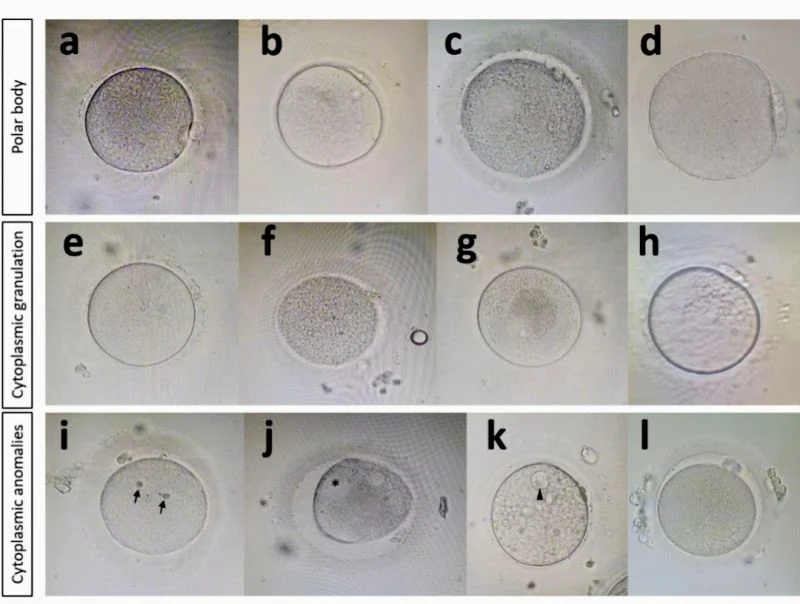
This figure shows: Polar body variations, including regular polar body (PB) (a), fragmented PB (b), double polar bodies (c), and giant PB (d); cytoplasmic granulation patterns: fine (e), dispersed (f), central (g), and uneven (h); cytoplasmic abnormalities: refractile bodies (arrows) (i), smooth endoplasmic reticulum (sER) aggregates (asterisks) (j), vacuoles (arrow head) (k), and dark cytoplasm (l).”
Stay updated on all scientific advances in the field of fertility with Fertility News.
-
Oct 11, 2025, 06:44The Global IVF Market Is Set to Reach $65B by 2032 – Meddilink
-
Mar 3, 2026, 00:23Final Call for Review of Updated ESHRE IVF Laboratory Recommendations – ESHRE
-
Mar 3, 2026, 00:15Abstract Submissions Are Now Open for ASM 2026! – BSGI
-
Mar 2, 2026, 14:06Ever Wondered How Ovulation Works? Let’s Break It Down! – Fertility Plus
-
Mar 2, 2026, 13:48Join RBMO Webinar on Global Declining Fertility Rates – RBMO
-
Mar 2, 2026, 13:39Governance of Polygenic Embryo Screening – Fertility and Sterility
-
Mar 2, 2026, 13:26AJOG MFM February 2026 Podcast Episode Is Out!
-
Mar 2, 2026, 13:21Yousef Zakharia Leads Clinical Research Aimed at Genitourinary Cancers – Mayo Clinic
-
Mar 1, 2026, 16:41Exploring Frozen and Fresh Embryo Transfer Risks – Fertility and Sterility
-
Mar 1, 2026, 16:40Foraviset Welcomes Prof. Tasuku Harada to Advisory Board – Foraviset