
Favour Ayomi: The Questions That Changed Reproductive Science
Favour Ayomi, Trainee Embryologist, shared on LinkedIn:
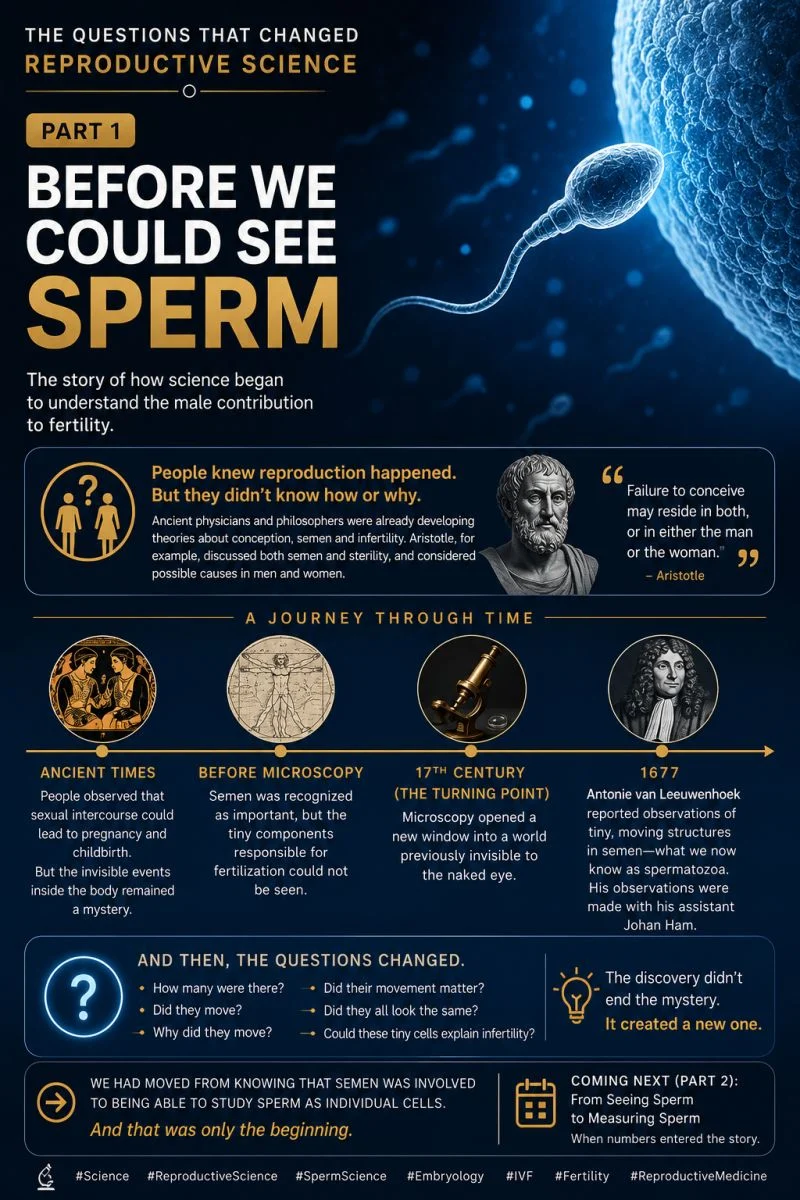
“The Questions That Changed Reproductive Science
Part 1 – Before we could see sperm
For thousands of years, humans knew something remarkable:
Sex could lead to pregnancy.
They could observe the beginning and the end of the process.
- But what happened in between?
- What exactly did the man contribute?
- What did the woman contribute?
- And what was happening inside the body that eventually resulted in the formation of a baby?
These questions are not new.
Ancient physicians and philosophers were already developing theories about conception, semen and infertility. Aristotle, for example, discussed both semen and sterility, and considered possible causes of infertility in men and women.
But there was a problem.
The most important parts of reproduction were invisible to the naked eye.
- Scientists could observe pregnancy.
- They could observe childbirth.
- They could observe semen.
- But they couldn’t yet see the tiny cells involved in fertilization.
Then, in the 17th century, microscopy began opening a completely new world.
And in 1677, Antonie van Leeuwenhoek reported observations of tiny, moving structures in semen – what we now know as spermatozoa. His observations were made with his assistant Johan Ham, who had first brought the semen sample to him.
Suddenly, something that had always been invisible could be observed.
Sperm could be seen.
And once scientists could see them, the questions changed.
- How many were there?
- Did they move?
- Why did they move?
- Did their movement matter?
- Did they all look the same?
Could the characteristics of these tiny cells explain why some couples conceived while others struggled to?
The discovery didn’t end the mystery.
It created a new one.
We had moved from simply knowing that semen was involved in reproduction to being able to study sperm as individual cells.
And that was only the beginning.
The next question:
If we can see sperm, can we measure them – and can those measurements tell us something about fertility?
To be continued…”
Stay informed with the latest updates in fertility and reproductive medicine on Fertility News.
-
Aug 23, 2026, 17:19Oluyemisi Famuyiwa: Financing Your Fertility Treatment
-
Aug 23, 2026, 16:54Chang-Hoon Cho: A Comprehensive Immune Atlas of the Human Endometrium
-
Aug 23, 2026, 16:42Sharing Shannon’s Story with Preeclampsia This Story Saturday – Preeclampsia Foundation
-
Aug 23, 2026, 16:36Sarah Lewen: The More Capable the Machines Become, the More Human Connection Matters
-
Aug 23, 2026, 16:31Chandana A։ Why Good-Quality Embryos Sometimes Don’t Implant
-
Aug 23, 2026, 16:28Negin Asadi։ How Does the Blastocyst Attach to the Uterus?
-
Aug 23, 2026, 16:22Christopher Robinson։ Ultrasound Images of Scar and Cesarean Scar Defects
-
Aug 23, 2026, 16:17Somya Jha։ ICSI – 1 Sperm, 1 Egg, 1 Tiny Needle
-
Aug 23, 2026, 16:09Rachel Gerber Kule: Patients Don’t Have to Be Passive Passengers in Their Own Care