

Somil Singhal։ How Does the Gestational Surrogacy Process Work?
Somil Singhal, Medical Doctor at AIIMS (All India Institute of Medical Sciences, New Delhi), shared on LinkedIn:
“How Does the Gestational Surrogacy Process Work?
It is necessary to obtain the necessary legal documentation to start treatment. Once all legalities are in place, one can begin the process.
Surrogacy is recommended when carrying a pregnancy is not medically safe or possible.
Common reasons include uterine factor infertility, recurrent pregnancy loss, certain medical conditions, or prior cancer treatments.
In some cases, surrogacy is also part of the family-building journey for male same-sex couples or single intended parents.
It is necessary to understand whether surrogacy is an appropriate option based on your medical history and goals.
Surrogacy success rates vary based on factors such as embryo quality, use of genetic testing, and the surrogate’s overall health.
Because gestational carriers are carefully screened and the uterus is often healthy, success rates can be favorable compared to other fertility treatments.
It is important to discuss expected success rates based on a specific treatment plan.
An embryo created is transferred into the surrogate’s during a carefully timed medical procedure. Before transfer, the surrogate undergoes medical screening and cycle preparation to help support implantation and a healthy pregnancy.
The embryo transferred to the surrogate is created using an egg from an intended parent or an egg donor, along with sperm from an intended parent or sperm donor. The surrogate carries the pregnancy but has no genetic connection to the baby.
The egg used in surrogacy depends on the intended parents’ family-building plan. In some cases, the egg comes from one of the intended parents. In others, donor eggs are used. Surrogacy can be combined with donor eggs, donor sperm, or both. This is common for same-sex male couples, single parents, or intended parents facing specific fertility challenges.
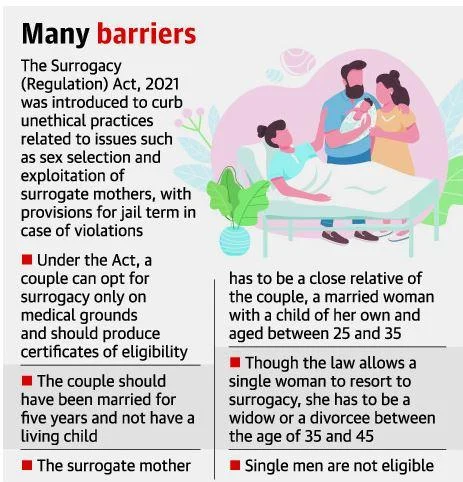
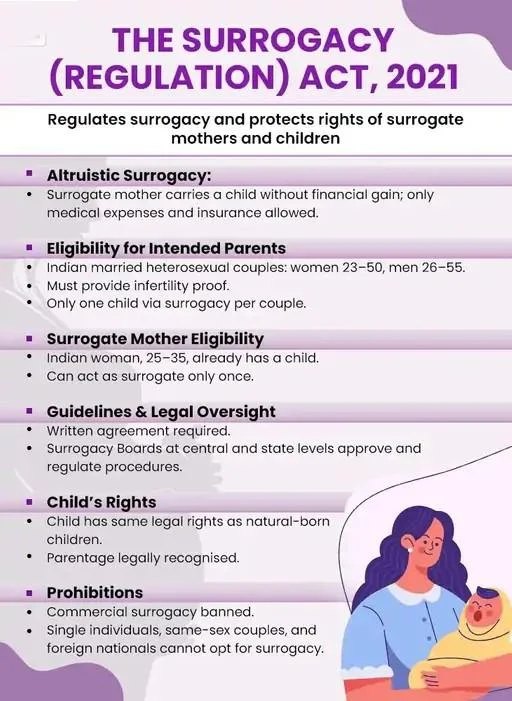
Who Can Do Surrogacy (Eligibility As Per Surrogacy Law in India 2026)
This is the most controversial part of the law.
Allowed Categories:
1. Married Indian Couples
Must be legally married
Marriage duration: usually a minimum of 5 years
Must prove infertility
Age:
Wife: approx. 23 – 50 years
Husband: approx. 26 – 55 years
2. Single Women (Limited Category)
Only: Widow
Divorced woman
Age: 35 – 45 years
Not Allowed:
- Live in couples
- Unmarried couples
- Same sex couples
- Single men
Major Legal Requirements as per recent surrogacy law in India.
To do surrogacy legally
1. Certificate of Infertility
Issued by a medical authority
Proves that the couple cannot conceive naturally
2. Certificate of Eligibility
Confirms the couple meets all legal conditions
3. Court Order (Parentage)
Confirms the child will legally belong to the intended parents
4. Insurance for Surrogate
Important Updates in Surrogacy Law
Even though the main law is from 2021, some developments matter:
1. Donor Gametes Allowed (Recent Change)
Now allowed in specific medical cases
2. Supreme Court Flexibility
Couples who started earlier were given relief from age rules
This shows: law is strict, but courts are slowly humanising it.
8 Rights of the Child Born Through Surrogacy
- Child is considered a biological child of the intended parents
- Has full legal rights (inheritance, identity)
- No claim by surrogate mother
- This avoids confusion and legal disputes.
Designed to:
Prevent exploitation
Protect women
Regulate the fertility industry
Laws Made
- Commercial surrogacy is completely banned
- No, unmarried and live-in couples are not allowed under current law.
- Only single women (widow/divorcee) are allowed.
- Single men are not permitted.
- Only medical expenses and insurance are allowed.
- Any extra payment is illegal.
- To prevent exploitation of poor women and stop unethical practices in the fertility industry.
Once all requirements are met, the protocols must be followed.
Basic Infertility Evaluation Fertility Tests
Physical exam including a pelvic ultrasound. Ultrasounds can help to discover abnormalities with the uterus, fallopian tubes, and/or ovaries. Sometimes, evidence of pelvic scarring, such as when an ovary appears to be stuck to the uterus.
This exam gives information regarding the potential for adequate ovarian stimulation with medications by counting antral follicles.
Assessment of ovarian reserve
This is an important assessment of a woman’s remaining egg supply. It is done with blood testing and an ultrasound and to evaluate FSH, LH, estradiol, and AMH hormone levels.
Depending on the individual couple’s situation, various blood tests on either the female or the male partner may be needed. Blood tests that might be needed include
- day 3 follicle-stimulating hormone (FSH),
- luteinizing hormone (LH),
- estradiol (E2),
- AMH,
- prolactin,
- testosterone (T),
- progesterone (P4),
- 17-hydroxyprogesterone (17-OHP),
- thyroxine (T4), and
- thyroid-stimulating hormone (TSH).
If there is a history of recurrent miscarriages (2 or more), a lupus anticoagulant (LAC) and anti-cardiolipin antibody (ACL) test are often done.
Immunological testing has not been proven to have any value in infertility patients without a history of 2 or more miscarriages.
HSG is done in order to assess the anatomy of the endometrial cavity of the uterus (normalcy of uterine cavity) and the fallopian tubes (tubal patency).
The HSG is usually scheduled between days 6 and 13 of the cycle after bleeding and before ovulation.
Advantages of Using Frozen Donor Eggs
The process involved stimulating the egg donor’s ovaries to produce multiple eggs. The eggs were then retrieved and fertilized using sperm from the male intended parent or a sperm donor.
The resulting fresh embryos would then be quickly transferred to the recipient female.
Any remaining embryos would be frozen for future use.
Although fresh egg donation is still a popular option for many recipients, more and more patients are turning to frozen donor eggs as an alternative option.
Pros and Cons of Fresh vs. Frozen Donor Eggs
As egg freezing and thawing technologies continue to improve over time, there are some notable advantages when considering frozen donor eggs for embryo creation:
There is no need to synchronize the egg donor’s and recipient’s menstrual cycles.
Because ovarian stimulation and retrieval have already been done, you know how many eggs are available before beginning a cycle.
There can be a shorter time frame from choosing a donor until having an embryo transfer when eggs are already frozen.
Costs per treatment cycle are reduced using frozen donor eggs compared to fresh.”
Proceed to the video attached to the post.
Other articles featuring Somil Singhal on Fertility News.
-
Sep 17, 2026, 19:28Svitlana Yashchenok: Who Is Really Choosing Your Embryo?
-
Sep 17, 2026, 19:20Having PMOS Does Not Mean You Can’t Become Pregnant – Spring Fertility
-
Sep 17, 2026, 19:13Lucy Froese: We Hear Fertility Stories Looking Backwards, But You Have to Live Yours Forward
-
Sep 17, 2026, 19:03Anna Figiel: Fertility Is Biological, But the Decisions Around It Are Not…
-
Sep 17, 2026, 18:49IFFS and ISA Joint Practice Guideline on Implementing Balanced Sexual and Reproductive Health
-
Sep 17, 2026, 18:30RBMO Live Episode 17: The Sperm Standards Session
-
Sep 17, 2026, 18:24Lata Sabarwal: What Happens to Fertility After 35?
-
Sep 17, 2026, 18:07Albert Irkaliev: Have We Underestimated the Corpus Luteum in Frozen Embryo Transfer?
-
Sep 17, 2026, 17:55Salma Yasin: A Great Pleasure to Attend BFS Study Week with Dr. Ippokratis Sarris