
Khalil Faaed: Beyond ROS – The Antioxidant Revolution in IVF
Khalil Faaed, Embryologist at Modern IVF Center, shared on LinkedIn:
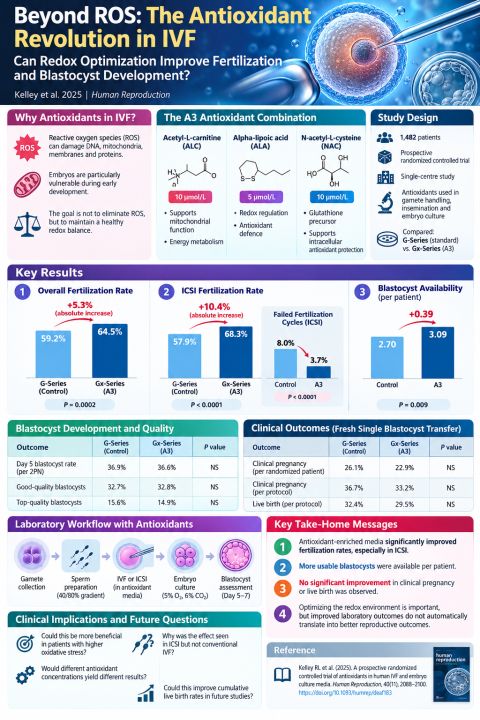
“Beyond ROS: The Antioxidant Revolution in IVF: Can Redox Optimization Improve Fertilization and Blastocyst Development?
Can modifying the oxidative environment of the IVF laboratory improve fertilization outcomes?
A fascinating randomized controlled trial published in Human Reproduction (2025) provides new insights into the potential role of antioxidant-enriched culture media in assisted reproductive technology.
The study, involving 1,482 patients, investigated whether incorporating three antioxidants into IVF laboratory media could improve fertilization and subsequent embryonic development.
What Did the Researchers Discover?
The findings were particularly interesting:
1. Improved fertilization rate
The fertilization rate increased from 59.2% in the control group to 64.5% in the antioxidant group.
2. A remarkable finding in ICSI cycles
ICSI fertilization increased from 57.9% to 68.3% with antioxidant-enriched media.
Additionally, cycles with failed fertilization decreased from 8.0% to 3.7%.
3. Increased blastocyst availability
The mean number of utilized blastocysts per patient increased from 2.70 to 3.09.
However, the blastocyst development rate per fertilized oocyte and the proportion of good-quality blastocysts did not significantly improve. But٫ Did improved fertilization translate into better pregnancy outcomes?
Not in this trial.
The researchers found no statistically significant improvement in clinical pregnancy following fresh blastocyst transfer or live birth rates.
This distinction is essential: improving laboratory performance does not automatically translate into improved reproductive outcomes.
What Does This Mean for Clinical Embryologists?
This research highlights the importance of redox homeostasis in the IVF laboratory.
Rather than considering ROS exclusively as harmful molecules, we should recognize that physiological ROS participate in important cellular signalling pathways. The objective is not to eliminate ROS, but to maintain an appropriate balance between oxidative activity and antioxidant defence.
It also raises important questions:
- Could antioxidant supplementation have a greater impact in patients with increased oxidative stress?
- Why was the improvement observed in ICSI but not conventional IVF?
- Could different antioxidant concentrations influence oocyte competence and fertilization?
- Will future studies demonstrate an improvement in cumulative live birth rates?
The future of embryo culture may involve more than providing essential nutrients and maintaining optimal physical conditions. Understanding and optimizing the biochemical environment, including redox balance, could become another important aspect of IVF laboratory development.
However, robust evidence of improved clinical outcomes must remain the ultimate standard.”
Other articles featuring Khalil Faaed on Fertility News.
-
Oct 31, 2026, 17:46Tracey Bambrough: World Fertility Day – One World, One in 6, One Conversation
-
Oct 31, 2026, 17:29Emad Sedeek: Embryo Transfer – ESHRE IVF Laboratory Guidelines 2026 Updates, Part 3
-
Oct 31, 2026, 17:22Brian A. Levine: Hip-Hop and IVF Are the Same Age
-
Oct 31, 2026, 17:16Alison Campbell: Excited to Announce the EFRE-ALPHA Embryology Masterclass Webinar No. 3
-
Oct 31, 2026, 17:09Khaled Abu Ali: Building the IVF Unit at American Hospital Dubai
-
Oct 31, 2026, 17:05Hosting a Genetics and Fertility Educational Dinner for Local GPs – Monash IVF Group
-
Oct 31, 2026, 17:01Ahmed Gibreel: IVF After 45 – What Does The Evidence Actually Tell Us?
-
Oct 31, 2026, 16:49Emily Kostina: How and Why Does the Placenta Develop, and What It Does During Pregnancy?
-
Oct 31, 2026, 16:45Hosting a Webinar for HR, Benefits, and People Leaders This Fertility Awareness Week – Hertility