

Mazen Al-Obaidi: How the Placenta Talks to the Baby’s Brain
Mazen Al-Obaidi, Assistant Professor in Biomedical Sciences at University of Technology and Applied Sciences, shared a post on LinkedIn:
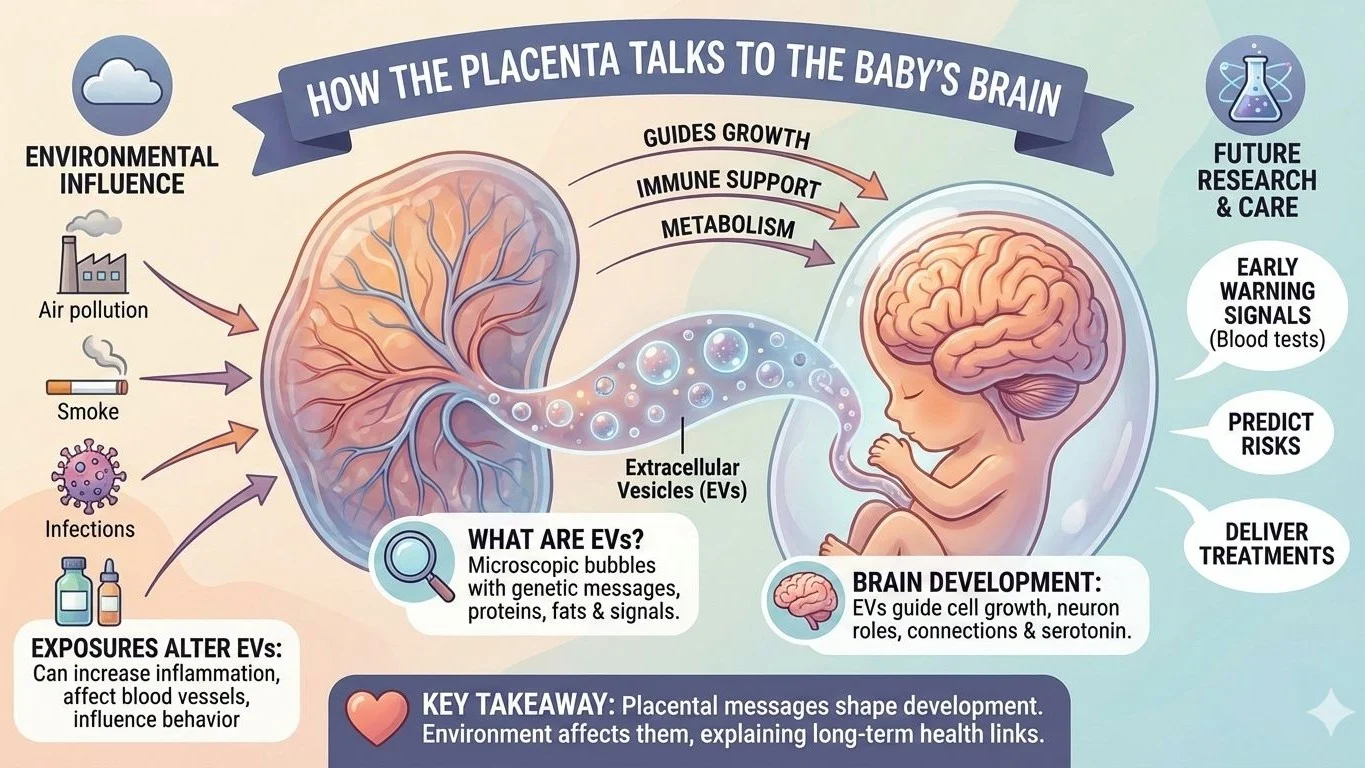
“How the Placenta Talks to the Baby’s Brain
During pregnancy, the placenta is not just a bridge for nutrients and oxygen—it also sends tiny biological messages to the baby and the mother.
These messages are carried in very small particles called extracellular vesicles (EVs).
What are placental extracellular vesicles?
- EVs are microscopic bubbles released mainly from placental cells.
- They carry important information such as genetic messages, proteins, fats, and chemical signals.
- These vesicles travel through the blood and can reach many organs, including the baby’s brain.
Why are they important?
- EVs help the mother’s body accept and support the pregnancy.
- They guide the baby’s growth and organ development, including the heart, lungs, kidneys, and brain.
- They help control how the baby’s immune system and metabolism develop.
EVs and brain development
- Some placental EVs can cross into the baby’s brain.
- They influence how brain cells grow, decide their roles (neurons or support cells), and form connections.
- Certain EVs even carry serotonin, a chemical important for brain development and mood regulation later in life.
How the environment affects these messages?
Things a mother is exposed to during pregnancy can change these placental messages, such as:
- Air pollution
- Infections
- Cigarette smoke
- Chemical pollutants
These exposures may alter EVs in ways that:
- Increase inflammation
- Affect blood vessel formation
- Influence brain development and behavior in childhood
- In some cases, EVs may even try to protect the baby from harmful exposures—but sometimes the changes can be harmful.
Why this research matters?
- EVs could become early warning signals, helping doctors detect pregnancy problems before symptoms appear.
- A simple blood test might one day help predict risks to a baby’s brain development.
- Scientists are also exploring whether EVs could be used to deliver treatments safely to the fetus.
What’s next?
- More research is needed using human-based models to confirm findings.
- Scientists want to better understand which messages help and which harm the developing baby.
- Standard methods are needed before EVs can be used in clinics.
Key takeaway
The placenta sends powerful microscopic messages that help shape a baby’s development. These messages can be influenced by the environment, offering a scientific explanation for how pregnancy conditions affect long-term child health—especially brain development.
Source.”
Title: Placenta-derived extracellular vesicles in fetal health: emerging insights into brain development and environmental interactions
Authors: Ethan Lewis, So Jeong Lee, Hae-Ryung Park
Stay updated on all scientific advances in the field of fertility with Fertility News.
-
Oct 11, 2025, 06:44The Global IVF Market Is Set to Reach $65B by 2032 – Meddilink
-
Mar 16, 2026, 13:30Simon Meagher and Rabih Chaoui Discuss Fetal Heart Scanning in the Latest ISUOG Podcast – ISUOG
-
Mar 16, 2026, 12:58Exploring the Link Between Adenomyosis and Proliferative Endometrial Disorders – Fertility and Sterility
-
Mar 16, 2026, 12:55Nicola Pozzi: A New Mechanism to Reduce Thrombus Formation Without Increasing Bleeding Risk
-
Mar 16, 2026, 12:44Endometriosis Awareness Month Virtual Issue! – ISUOG
-
Mar 16, 2026, 12:30Jeanne Conry: When the Government Intervenes, Women Die
-
Mar 16, 2026, 12:23Magdalena Simonis Highlights the Need to Change the Rhetoric on Endometriosis
-
Mar 16, 2026, 12:00Julia Chain Highlights Fertility Preservation as Part of Women’s Health Campaign – HFEA
-
Mar 15, 2026, 15:26Watching Life Begin: Scientists Track Embryo Implantation in Real Time! – Science Magazine
-
Mar 15, 2026, 15:03Reem Abu-Rustum Spotlights Fetal Situs in New ISUOG Quiz – ISUOG