
Unraveling Immune Mechanisms in Reproductive Health – Reproduction and Fertility
Reproduction and Fertility shared a post on LinkedIn:
“Day 2 of RaFJC – Immune Adaptation from Conception to Pregnancy
After exploring how ovulation itself is an immune‑regulated event, with inflammatory mediators shaping oocyte release and follicle competence, today we move forward in the reproductive timeline: conception and implantation: immune cross-talk determines whether the embryo is accepted or rejected.
Immune and Inflammatory Responses at Implantation
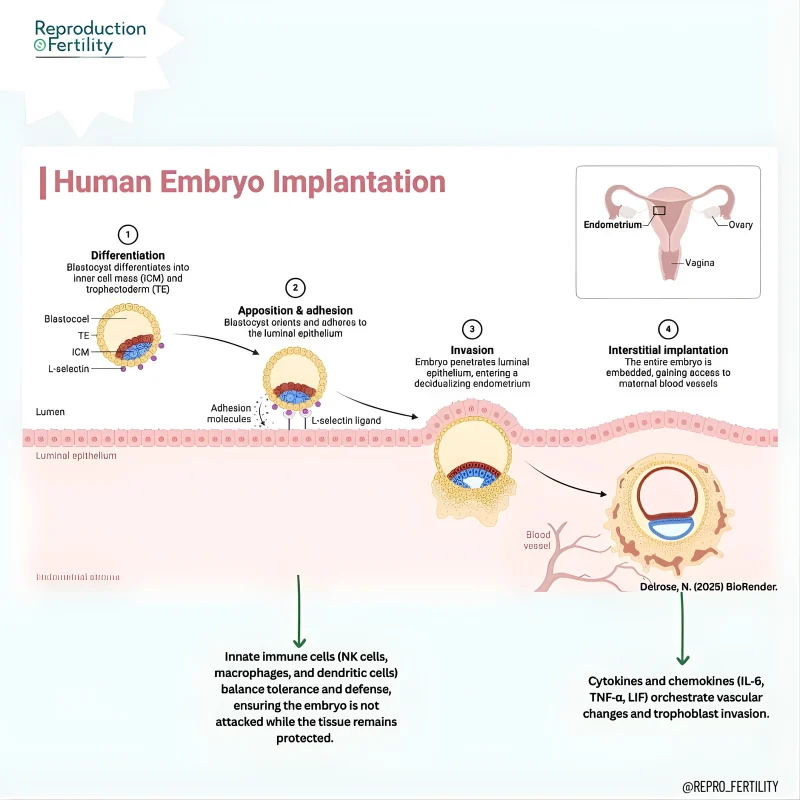
- During differentiation, the blastocyst expresses L-selectins (a cell adhesion molecule that facilitates the initial ‘tethering’ and ‘rolling’ of leukocytes. L-selectins interact with L-selectin ligands, which are expressed mainly on pinopodes during the implantation window.
- During apposition and the adhesion phase, the blastocyst promotes cleavage of Mucin-1, which drives the implantation window and ensures successful attachment. Cytokines such as Leukemia inhibitory factor (LIF) play an important role during human implantation by supporting the embryo-endometrial interactions.
- During the invasion phase, the trophoblast cells penetrate the endometrial epithelium into the stroma. The extra-villous trophoblast cells proliferate and differentiate into inner cytotrophoblast and outer syncytiotrophoblast.
- When implantation begins, the embryo breaches the luminal epithelium, and the surrounding stromal cells transform into decidual cells. Immune cells, such as macrophages and uterine natural killer (uNK) cells, play an important role during decidualization by promoting an environment conducive to successful implantation.
Dysregulation of these pathways is linked to implantation failure, recurrent miscarriage, and pregnancy complications.
Implantation is not passive! It’s an immune dialogue between the embryo and the endometrium. Understanding this dialogue is critical for improving fertility treatments and predicting pregnancy outcomes.
What immune mechanisms at implantation deserve more attention in reproductive medicine? How can we better translate these findings into clinical practice? We would love to hear your thoughts in the comments.
Are you interested in this topic? Explore our next Serial Collection: Immune Regulation and Inflammatory Mechanisms in Reproductive Health and Disease, and submit your article to be a part of it.
Tomorrow we’ll be extending this discussion into pregnancy and delivery, highlighting maternal immune adaptations – stay tuned!”
Stay updated on all scientific advances in the field of fertility with Fertility News.
-
Oct 11, 2025, 06:44The Global IVF Market Is Set to Reach $65B by 2032 – Meddilink
-
Mar 16, 2026, 13:30Simon Meagher and Rabih Chaoui Discuss Fetal Heart Scanning in the Latest ISUOG Podcast – ISUOG
-
Mar 16, 2026, 12:58Exploring the Link Between Adenomyosis and Proliferative Endometrial Disorders – Fertility and Sterility
-
Mar 16, 2026, 12:55Nicola Pozzi: A New Mechanism to Reduce Thrombus Formation Without Increasing Bleeding Risk
-
Mar 16, 2026, 12:44Endometriosis Awareness Month Virtual Issue! – ISUOG
-
Mar 16, 2026, 12:30Jeanne Conry: When the Government Intervenes, Women Die
-
Mar 16, 2026, 12:23Magdalena Simonis Highlights the Need to Change the Rhetoric on Endometriosis
-
Mar 16, 2026, 12:00Julia Chain Highlights Fertility Preservation as Part of Women’s Health Campaign – HFEA
-
Mar 15, 2026, 15:26Watching Life Begin: Scientists Track Embryo Implantation in Real Time! – Science Magazine
-
Mar 15, 2026, 15:03Reem Abu-Rustum Spotlights Fetal Situs in New ISUOG Quiz – ISUOG