

Robin Hadley։ Workplace Often Becomes an Alienating Space for Those Undergoing Fertility Treatment…
Robin Hadley, Associate Lecturer and researcher at The Manchester Metropolitan University, shared a post on LinkedIn about a paper he co-authored with colleagues published in Frontiers in Sociology:
“Our free-to-download Frontiers in Sociology article is based on a study that explored the intricate connection between people’s diverse fertility journeys, particularly those involving Assisted Reproductive Technology (ART), and their workplace experiences. It reveals the structural and personal tensions, ambiguities, and ambivalence surrounding reproduction and non-reproduction in professional settings.
Through detailed interviews with 80 individuals (67 women and 13 men), this study found that the workplace often becomes an alienating space for those undergoing fertility treatment, where they can face scrutiny and judgment. The participants highlighted the challenges related to showing their fertility struggles, the support they wanted versus what they received, and the impact of these experiences on their lives.
A central outcome of this research is the development of a new concept called ‘reproductive capital’ (RC). RC stands for an individual’s resources and abilities related to reproduction, encompassing biological factors such as fertility, as well as social, cultural, and economic resources that either enable or restrict reproductive choices and outcomes.
This study critically examines how RC interacts with other forms of capital (such as aging, biological, cultural, economic, social, and symbolic capital), influencing an individual’s status and experiences, especially within the workplace.
Ultimately, this study sheds light on how workplace dynamics and individual behaviours are shaped by these intersecting forms of capital, emphasising the need for more inclusive policies and cultural changes to better recognise and support diverse reproductive journeys.”
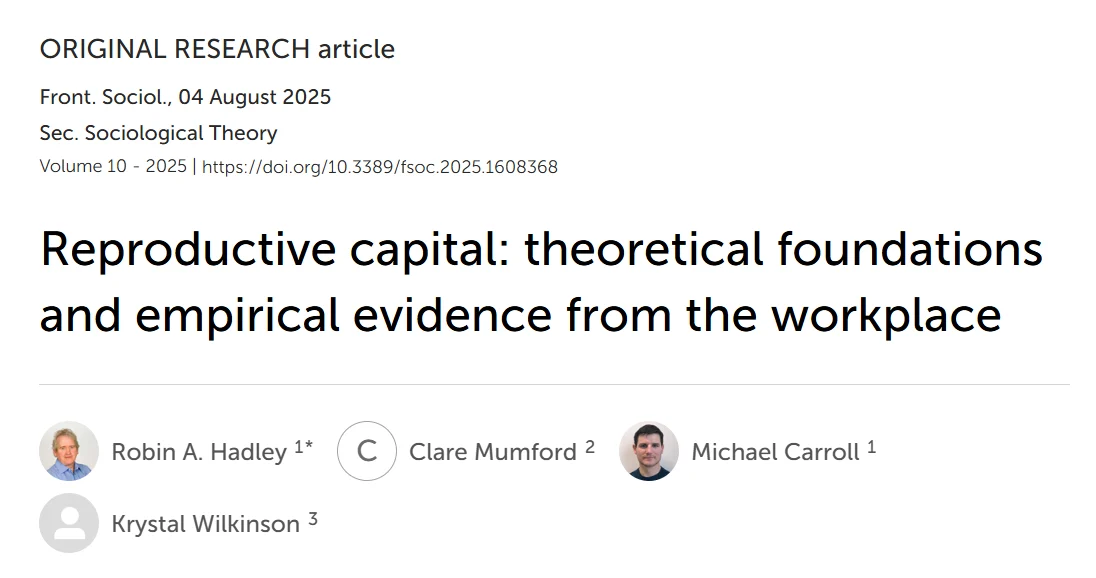
Title: Reproductive capital: theoretical foundations and empirical evidence from the workplace.
Authors: Robin A. Hadley, Clare Mumford, Michael Carroll, Krystal Wilkinson.
You can read the Full Article in Frontiers in Sociology.
Stay informed with the latest updates in fertility and reproductive medicine on Fertility News.
-
Nov 2, 2026, 17:08Elena Milner: The 2nd Class of the School of Embryology Is Already in Full Swing
-
Nov 2, 2026, 17:05November Is National Diabetes Month – PCOS Awareness Association
-
Nov 2, 2026, 17:04Thanos Papathanasiou: Are We Preparing Patients for the IVF Cycle, or for the IVF Journey?
-
Nov 2, 2026, 17:02Anna Morales: Why Is It So Hard to Build in Women’s Health?
-
Nov 2, 2026, 16:59Rickard Ericsson: Honored to Take on the Role of Interim CEO of the Vitrolife Group
-
Nov 2, 2026, 16:56Mohammed Nasur: 1 Small Simulation, A Bigger Purpose
-
Nov 2, 2026, 16:54Carlos Guerrero: Presenting Our Latest Research on AI and Embryo Assessment at ASRM 2026
-
Nov 2, 2026, 16:52Sarah Lewen: My 1st ASRM Is Officially Complete
-
Nov 2, 2026, 16:49Jemma Garratt: Taking on the Role of Kind IVF and Data Science Manager at London Women’s Clinic