
Yannick Hurni: Navigating Confounding in Target Trial Emulation Studies
Yannick Hurni, Clinical and Research Fellow in Gynecologic Surgery at Dexeus University Hospital, shared a post on LinkedIn:
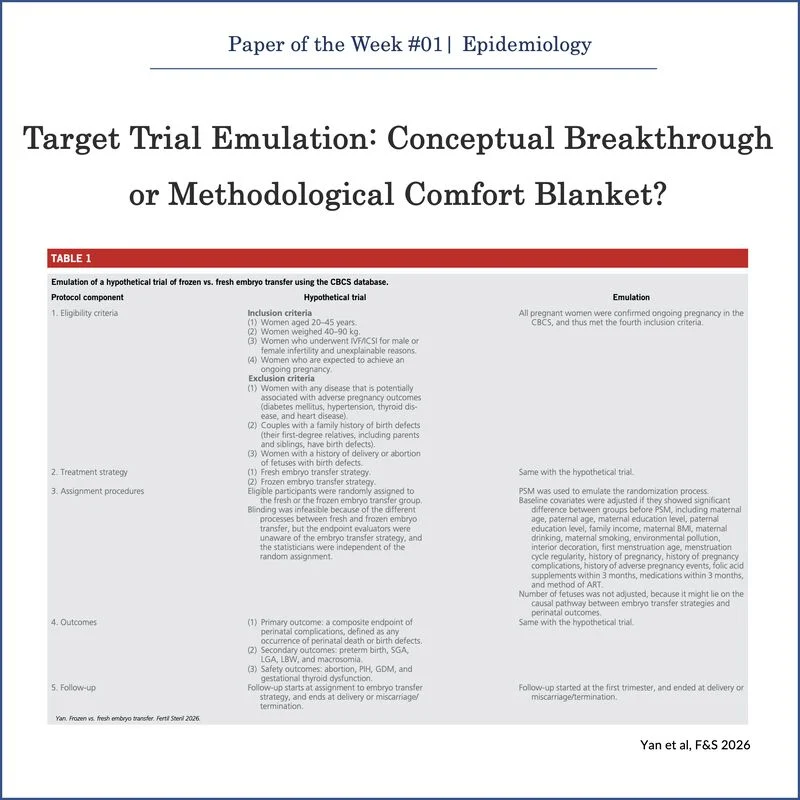
“Target Trial Emulation: Conceptual Breakthrough or Methodological Comfort Blanket?
Target Trial Emulation (TTE) has quickly become one of the most fashionable frameworks in clinical epidemiology. And intellectually, it is powerful. It forces us to structure observational analyses as if we were designing an ideal RCT – eligibility criteria, treatment strategies, randomization, follow-up, analysis plan – all prespecified and transparent.
In theory, that rigor allows us to focus on what really matters: controlling for confounding.
And that is exactly where the real construction begins.
Once we move beyond true randomization, the credibility of a TTE depends entirely on how we emulate treatment assignment. That step is not cosmetic – it is the core of the causal claim.
In a recent TTE-based study published in Fertility and Sterility, treatment assignment was emulated using propensity score matching (PSM).
A legitimate choice – in principle. But everything hinges on:
- How covariates were selected (causal reasoning vs statistical significance?)
- Whether all plausible determinants of treatment allocation were included
- How matching was performed (caliper? replacement?)
- How balance was assessed (SMDs or p-values?)
This is the part that ‘mimics’ randomization. This is where we attempt to control for known confounders — since unknown ones are, by definition, uncontrollable.
If we cannot eliminate unknown confounding, then known confounders must be handled with maximal rigor.
My concern is that TTE risks becoming a methodological label rather than a methodological discipline. The structure is invoked, but the exchangeability construction – the most delicate step – is not always treated with the precision it demands.
TTE is not about giving observational data an RCT-shaped outline.
It is about engineering causal comparability.
So the question is not whether we are doing Target Trial Emulation.
The question is:
Are we truly building the target trial – or merely simulating its appearance?”
Stay updated on all scientific advances in the field of fertility with Fertility News.
-
Apr 3, 2026, 12:57Sergei Gorlovetsky: The Invisible Work Breaking Fertility Clinics
-
Apr 3, 2026, 12:50Ting Yuan: Rethinking Oocyte Quality Through Reproducible Patterns
-
Apr 3, 2026, 12:36Asma Khalil: An Incredibly Powerful Podcast Brings Attention to Women’s Fertility Challenges
-
Apr 3, 2026, 12:29Angela Koech: Every 30 Seconds, Africa Loses a Baby to a Preventable Stillbirth
-
Apr 3, 2026, 12:17Sergei Gorlovetsky: AI Support Expands Guidance for IVF Patients at Home
-
Apr 3, 2026, 12:06Thin Womb Lining Doesn’t Have to End Your IVF Dreams – Fertility Plus
-
Apr 3, 2026, 12:04Updated NICE IVF Guidance Contrasts with Declining NHS Support – HFEA
-
Apr 3, 2026, 11:59IVF Remains Safe for Women With a History of Cancer – ESHRE
-
Apr 3, 2026, 11:56Vitamin D Binding Protein and Reproductive Outcomes – Fertility and Sterility