
Akinrolayo Faith: Inside the IVF Laboratory – Day 4
Akinrolayo Faith, Junior Embryologist at Present Help Fertility Clinic, shared on LinkedIn:
“Inside The IVF Laboratory – Day 4
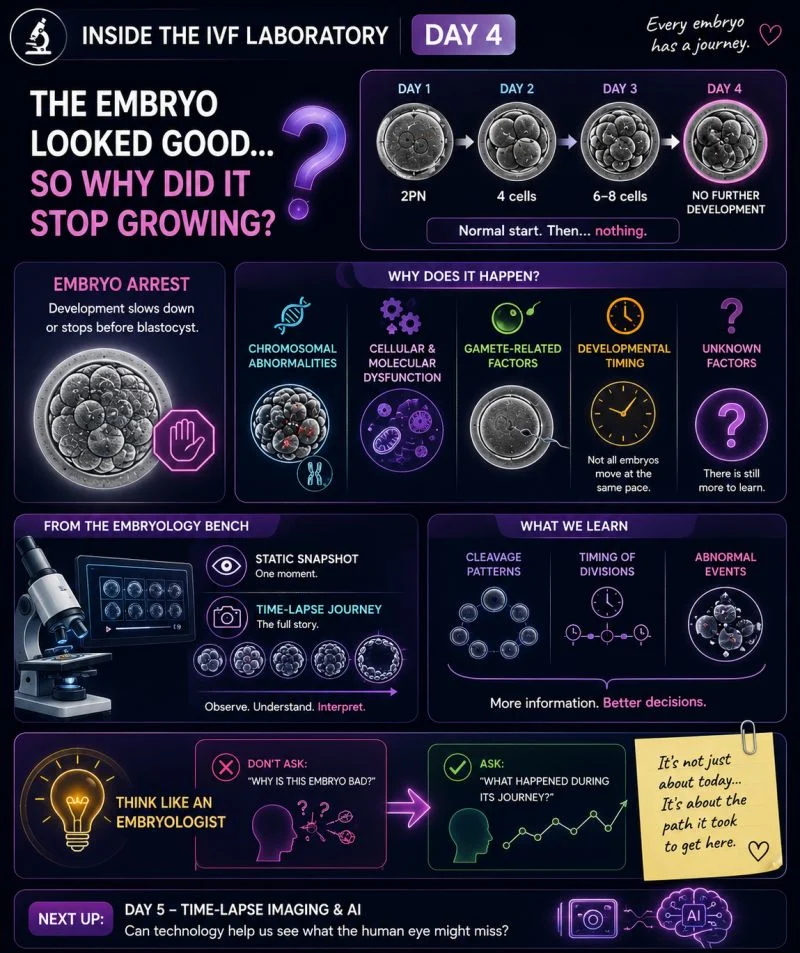
The Embryo Looked Good… So Why Did It Stop Growing?
You check the embryo.
The cells look organized.
The morphology isn’t alarming.
Development appears to be progressing.
Then you check again.
No further development.
This is one of the most frustrating observations in the IVF laboratory:
Embryo arrest.
An embryo can begin development normally and then slow down or stop dividing before reaching the blastocyst stage.
But why?
Possible biological contributors include:
- Chromosomal abnormalities
Some embryos carry aneuploidies that can interfere with continued development. - Cellular and molecular dysfunction
Errors involving cell division, DNA replication, metabolism and gene regulation can affect developmental competence. - Gamete-related factors
Both oocyte and sperm quality contribute to embryo developmental potential. - Developmental timing
Embryos do not all progress at exactly the same pace, so delayed development should be interpreted carefully rather than immediately labelled as arrest.
From the embryology bench
One lesson experience teaches you quickly:
‘Not developing yet’ is not always the same as ‘not developing.’
That distinction matters.
With static observations, we see individual snapshots.
With time-lapse imaging, we can observe the developmental trajectory — cleavage patterns, timing of divisions, abnormal events, and progression toward blastulation.
Research has shown that abnormal cleavage patterns and developmental kinetics can provide additional information about embryo competence, although no single time-lapse parameter can guarantee implantation or live birth.
Think Like an Embryologist
Don’t immediately ask:
‘Why is this embryo bad?’
Ask:
‘What happened during its developmental journey?’
That shift encourages evidence-based observation rather than simply judging appearance.
Because sometimes the most important information isn’t what the embryo looks like today…
It’s what happened between yesterday and today.”
You can also read the 1st, the 2nd, and the 3rd parts of this article on Fertility News.
-
Oct 18, 2026, 18:01Ting Yuan: Attending a Locally Organised Reproductive Medicine Conference in Malaysia with My Team
-
Oct 18, 2026, 17:55Khalil Faaed: Ovarian Rejuvenation with PRP
-
Oct 18, 2026, 17:49UCLA Law Center on Reproductive Health, Law, and Policy Hosts Panel on Menopause and Women’s Health Equity
-
Oct 18, 2026, 17:41Arora Suhani Gagan: Everyone Was Discussing Her Pregnancy, but Nobody Asked What She Wanted
-
Oct 18, 2026, 17:07Robert Borowczyk: Fertility Questions Need Different Answers
-
Oct 18, 2026, 17:05Farah Yasin: Another Successful ART Fertility Clinics Conference in Abu Dhabi
-
Oct 18, 2026, 17:01Hilary Friedlander: Excited to Offer NeedleFree IVF at Atlantic Fertility
-
Oct 18, 2026, 16:59Rabih Chaoui: New Edition of “First Trimester Ultrasound Diagnosis of Fetal Abnormalities”
-
Oct 18, 2026, 16:56Arsiak Vartenian: My Daughter Was Born Through Surrogacy, and That Is a Story Worth Telling