

Carlos Alberto Hernández Nieto: Does PGT-A Shorten the Path to a Live Birth for Donor Egg Recipients?
Carlos Alberto Hernández Nieto, Reproductive Endocrinologist – Physician and Associate Director of Clinical Research at Reproductive Medicine Associates of New York, shared on LinkedIn about a paper he co-authored with colleagues published in Fertility and Sterility:
”Does PGT-A shorten the path to a live birth for donor egg recipients?
In our latest study in Fertility and Sterility, the answer appears to be no.
We looked at 629 recipients who underwent 927 single embryo transfers, comparing those who used PGT-A with those who didn’t.
The median number of transfers needed to reach a first live birth was one in both groups. Time from first transfer to live birth was similar, and so were live birth rates on the first transfer (about 70% either way) and spontaneous abortion rates.
Donor oocytes come from young donors, and while roughly a quarter of the resulting embryos are expected to be aneuploid, plenty of other factors can lead to a failed transfer.
Screening for aneuploidy alone doesn’t seem to change the overall trajectory much in this population. For recipients, this means that skipping PGT-A, and the added cost that comes with it, doesn’t appear to affect the number of transfers or the time to a baby.
For those who choose PGT-A, it doesn’t prolong the timeline either.
Counseling should still be individualized, particularly in cases like an older designated donor, and we’d love to see future work look at the number of transfers needed to complete a family.
Thank you to the amazing team at RMA of New York and Icahn School of Medicine at Mount Sinai for their work on this analysis, and especially to the first author, Michelle Bayefsky.”
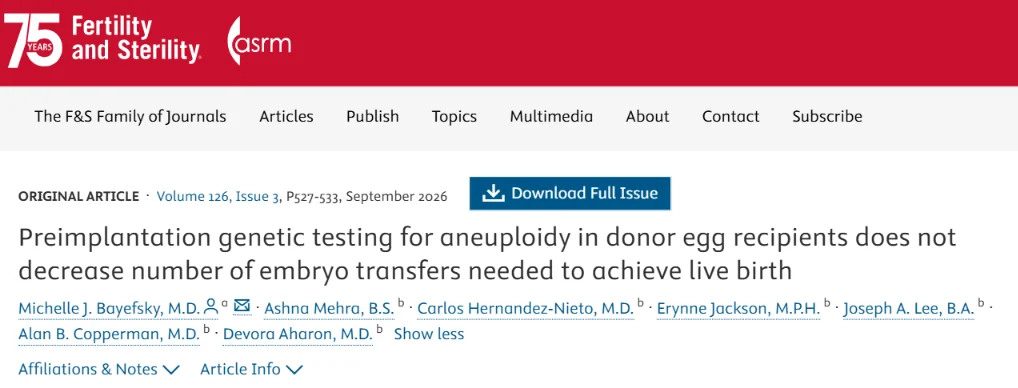
Title: Preimplantation genetic testing for aneuploidy in donor egg recipients does not decrease number of embryo transfers needed to achieve live birth
Authors: Michelle J. Bayefsky, Ashna Mehra, Carlos Hernandez-Nieto, Erynne Jackson, Joseph A. Lee, Alan B. Copperman, Devora Aharon
You can read the Full Article in Fertility and Sterility.
Stay informed with the latest updates in fertility and reproductive medicine on Fertility News.
-
Oct 20, 2026, 17:03Bhargavi K.: Sometimes, the Most Interesting Part of Embryology Isn’t Finding an Answer
-
Oct 20, 2026, 17:00Jennifer Straub: Excited to Officially Join Pozitivf Fertility as Chief Operating Officer
-
Oct 20, 2026, 16:57Jordan Abdi: Looking Forward to Co-Hosting the “Rules of Reproduction”
-
Oct 20, 2026, 16:51Andria Besser: Hard to Believe This Is My Last Week at NYU Fertility Center
-
Oct 20, 2026, 16:48Michael Alper: Continuing to Care for Our Patients as Everleap Fertility
-
Oct 20, 2026, 16:43Ankita Sethi: An Insightful Afternoon at First IVF, Abu Dhabi
-
Oct 20, 2026, 16:41Michael Schindler: Our Answer at MedITEX IVF – The Patient and Lab System Is the Integration Layer
-
Oct 20, 2026, 16:35Marcos Meseguer Escrivá: What Happens When We Shorten the Blastocyst Warming Protocol?
-
Oct 20, 2026, 16:30Proud to Be Part of ASRM 2026 Scientific Congress and Expo – MEFS