

Connie Stark: The Fertility Industry Solved the Invoice – It Never Solved the Exit…
Connie Stark, Director of Fertility Coaching Strategy at Robyn, shared on LinkedIn:
“Six studies. Three decades. One answer nobody has built for. I spent my career watching and listening at the side of funded, insured patients as they walked away from fertility treatment, and the research confirms what I knew from the patient’s side of the table all along. The industry solved the invoice. The exit is still waiting.
The industry solved the invoice. It never solved the exit.
The fertility industry has spent the last two years solving affordability, and the companies leading it deserve real credit.
- Kindbody: clear pricing, embedded financing.
- Gaia: a free second cycle if the first fails.
- Sunfish: flat-fee packaging backed by a money-back guarantee.
Three different bets. Same instinct. The right one. A 22-country study presented at ESHRE’s 42nd Annual Meeting in July 2026 proves the instinct correct: halving out-of-pocket cost was associated with a 2.67-fold increase in births. That is exactly why capital moves here first.
But every fertility clinic in America can now quote you the price of a cycle. Almost none can tell you why a fully insured, fully funded patient still walks away before finishing treatment. The industry has answered who can afford the full path to a baby. It has never answered why a patient who is already covered, already paying, already sitting in the waiting room, still stops before it is finished. That answer already exists. It has existed for nearly thirty years. Nobody has built for it.
Start with Sweden. Between 1996 and 1997, researchers at Sahlgrenska University Hospital followed 974 couples through IVF, most offered three completed cycles free of charge. Of the couples who did not achieve a live birth, more than half discontinued before using the free cycles they had left.
The leading reason, published in Fertility and Sterility in 2004: psychological burden, at 26 percent, ahead of poor prognosis and far ahead of physical burden. Free treatment. No invoice at all. They still walked away, and stress was the number one reason. Those patients were in treatment during the same years I was standing at patients’ sides watching the same thing.
In 2009, Fertility and Sterility published research on why insured U.S. patients drop out of IVF, and found a significant number leave of their own volition, not for financial reasons. A companion Australian study offered patients six free IVF cycles. The average patient still stopped after 3.1 cycles. Their own words for why: I had had enough. Emotional cost. Could not cope with more treatment.
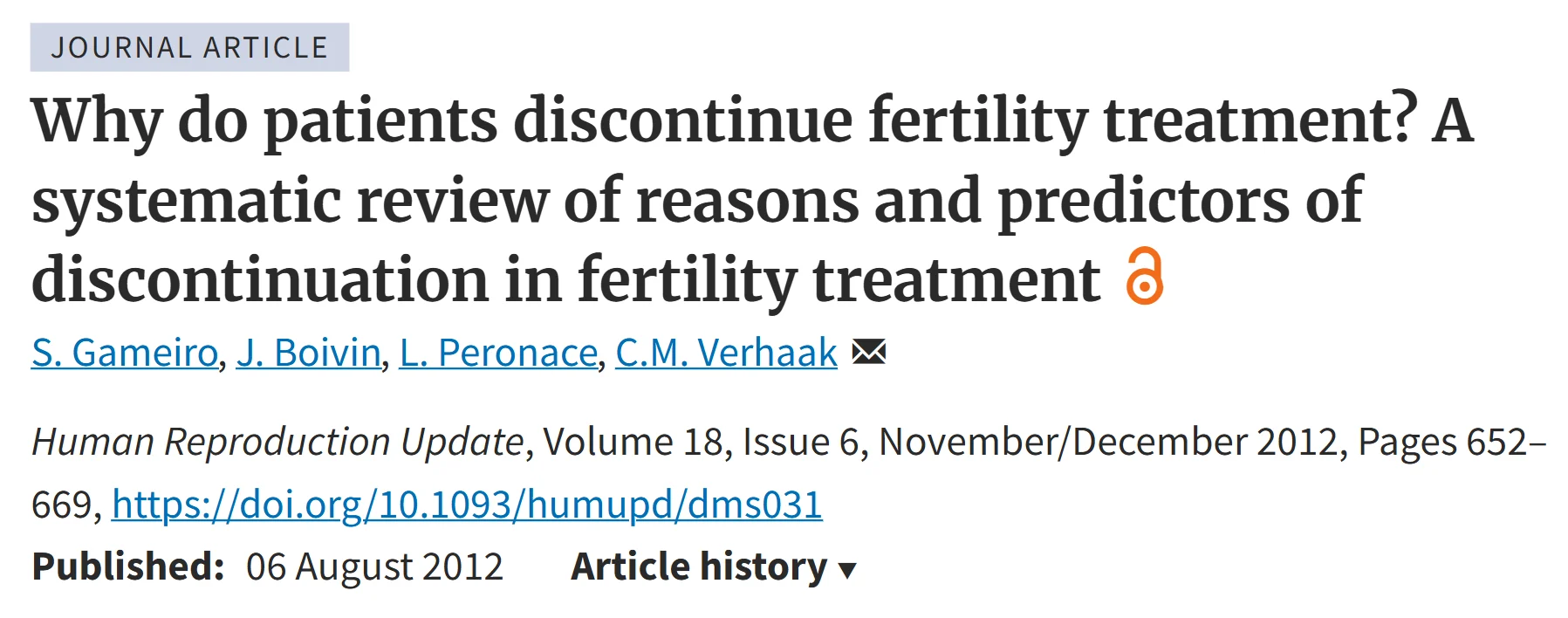
In 2012, a systematic review spanning over 21,000 patients across 22 studies broke discontinuation down into six categories: treatment rejection, clinic-related problems, organizational issues, alongside psychological and relational burden. It never asked what was underneath any of them.
That gap is the one I know from the inside. I have spent my career knowing what needed to be done, from personalized care protocols inside the clinics where I worked, to founding my own fertility coaching business, to scaling that work into a platform that served aspiring parents by the thousands. Across all of it, the same pattern repeated. On paper, financial burden looked like the reason someone stopped.
In the actual conversation with that person, it was almost always something else: grief, exhaustion, a loss of trust in the process itself. No form was ever built to capture that, and a better form will not fix it either. A patient does not disclose grief to a checkbox, no matter how well the checkbox is worded. She tells it to a person who knows how to listen for it.
I have watched technology close that same gap in real time: faster answers, faster information, real gaps closing as they happen. But every gap it closes at scale opens smaller ones underneath, the moment that still needs a human, the thing no model catches. That is where I work, not instead of the technology, but alongside it. I want to stand beside the financial solutions this field has already built, and push access higher still, by finally answering the ask underneath the invoice.
No study proved this gap to me. I stood beside every aspiring parent I worked with for over thirty years, long before anyone gave the gap a name. I closed it one client at a time. That is what makes this real. Not a citation. Thirty years at the table.
In 2018, Alice Domar’s research followed 312 insured women who had completed at least one IVF cycle without a live birth, then stopped. Forty percent said it was the stress. Not the money. The stress alone outranked the financial reasons combined. Her data gave language to what I had already spent decades standing beside, patient after patient. I saw it, heard it, and now the research validates it.
Two years after her study was published, Griffin Jones and I discussed that same reality on his podcast, Inside Reproductive Health in 2020. Even in mandated states, we discussed a large share of patients still stop treatment, and it is rarely just the money. I had thirty years of watching it happen. The money and the human support have to move together. One without the other still loses the patient.
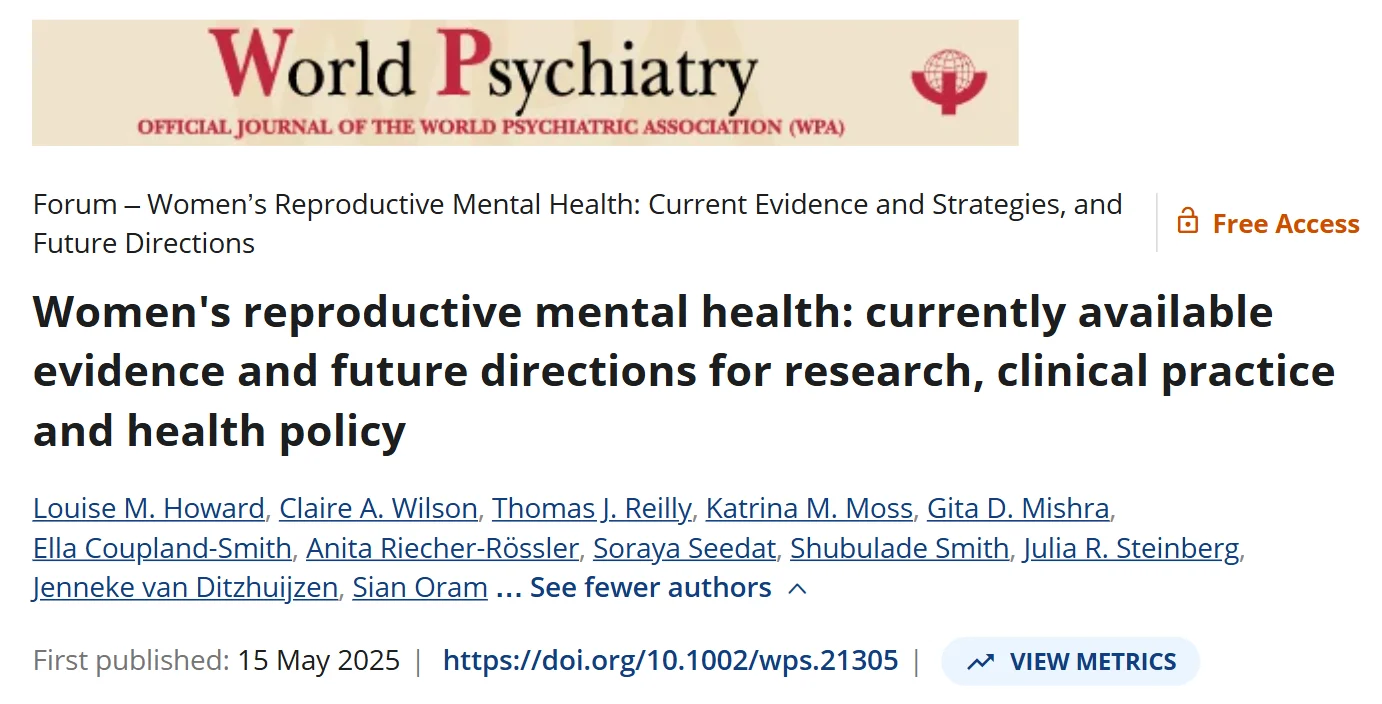
In 2025, a review published in World Psychiatry, spanning menstruation, infertility, and menopause across women’s reproductive health broadly, confirmed the same pattern outside fertility alone. High psychological burden is a common reason for stopping treatment, even where there is a good medical prognosis and financial capability for further cycles.
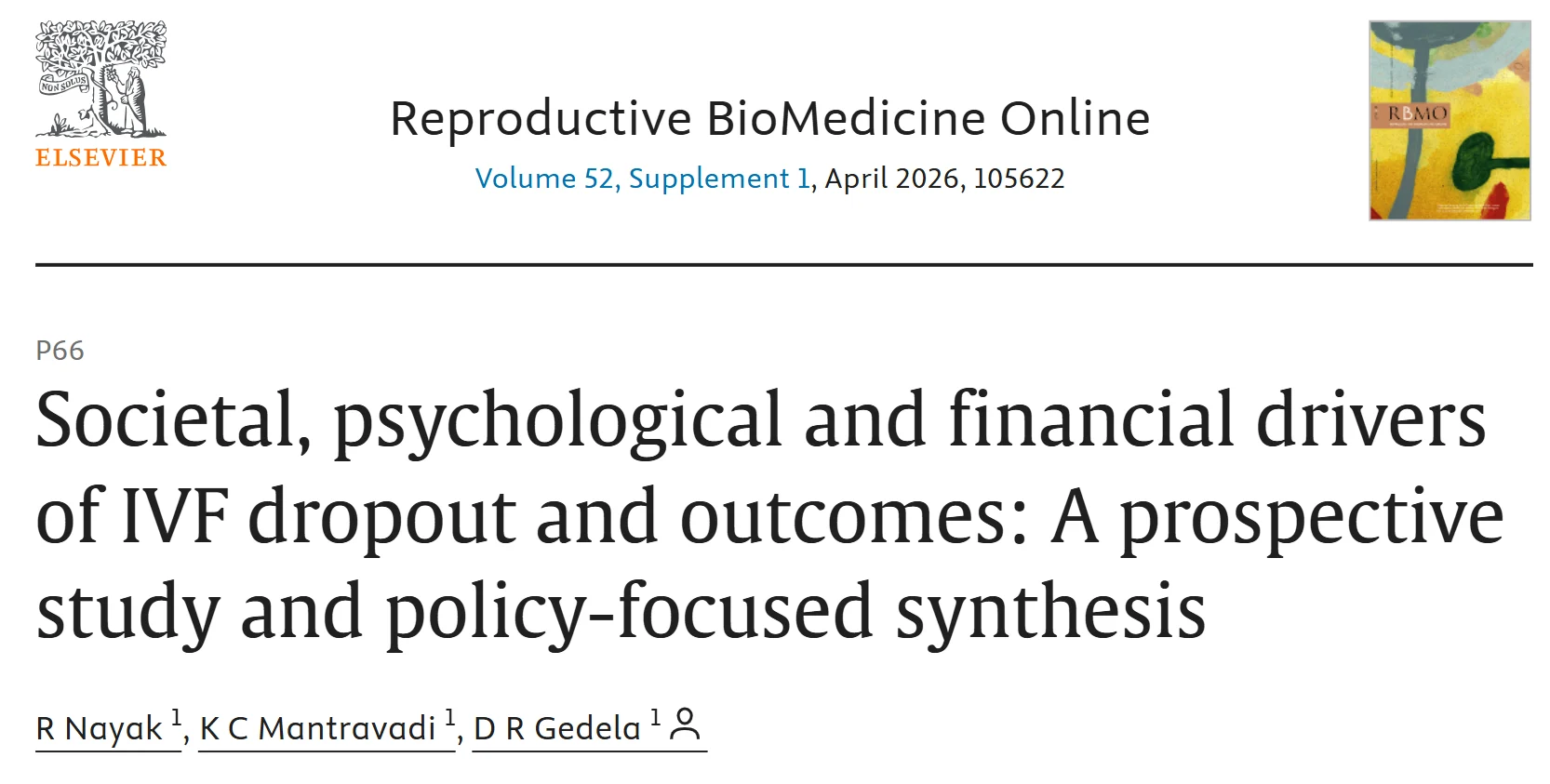
This year, in March 2026, a prospective study of 303 IVF patients found the clearest evidence yet. After accounting for insurance status and family pressure separately, a positive screen for anxiety or depression was the single strongest independent predictor of who walked away.
Six independent studies. Patients spanning three decades, from Sweden in 1996 to a prospective cohort this year. I named this pattern publicly in 2020; two studies have confirmed it since, and I stood beside the patients living it, knowing the truth before I had the data to prove it. Access and continuation are not two problems. They are one. The leaders willing to fund both, the invoice and the harder answer beneath it, are the ones who will define what this field looks like next.
Sources (all independently verified).
1. Title: Why do couples discontinue in vitro fertilization treatment? A cohort study
Authors: Catharina Olivius, Barbro Friden, Gunilla Borg, Christina Bergh
You can read the Full Article in Fertility and Sterility.

2. Title: A prospective investigation into the reasons why insured United States patients drop out of in vitro fertilization treatment
Authors: Alice D. Domar, Kristin Smith, Lisa Conboy, Marie Iannone, Michael Alper
You can read the Full Article in Fertility and Sterility.

3. Title: Why do patients discontinue fertility treatment? A systematic review of reasons and predictors of discontinuation in fertility treatment
Authors: S. Gameiro, J. Boivin, L. Peronace, C.M. Verhaak
You can read the Full Article in Human Reproduction Update.
4. Title: Burden of care is the primary reason why insured women terminate in vitro fertilization treatment
Authors: Alice D Domar, Kristin Rooney, Michele R Hacker, Denny Sakkas, Laura E Dodge
You can read the Full Article in Fertility and Sterility.

6. Title: Women’s reproductive mental health: currently available evidence and future directions for research, clinical practice and health policy
Authors: Louise M. Howard, Claire A. Wilson, Thomas J. Reilly, Katrina M. Moss, Gita D. Mishra, Ella Coupland-Smith, Anita Riecher-Rössler, Soraya Seedat, Shubulade Smith, Julia R. Steinberg, Jenneke van Ditzhuijzen, Sian Oram
You can read the Full Article in World Psychiatry.
7. Title: Societal, psychological and financial drivers of IVF dropout and outcomes: A prospective study and policy-focused synthesis
Authors: R Nayak, K C Mantravadi, D R Gedela
You can read the Full Article in Reproductive BioMedicine Online.
8. Kuku S, et al., Human Reproduction, 2026, ESHRE 42nd Annual Meeting
9. State of Patient Finance: Mid-2026, Fertility Bridge
By Connie Stark, BHA, RNC, PCC.”
Other articles featuring Connie Stark on Fertility News.
-
Aug 15, 2026, 14:51Diana Kayal: 1 of 9 Myths I Correct Most Often in My Clinic – and the One That Costs People the Most
-
Aug 15, 2026, 13:27Precious Chukwuemeka: IVF Improves the Chances of Pregnancy, but It Doesn’t Guarantee a Baby
-
Aug 15, 2026, 13:15Pratik Raj: Surgical Sperm Retrieval Techniques Used In Azoospermia And Severe Male-Factor Infertility
-
Aug 15, 2026, 12:36Aumatma Simmons: Heat Exposure and Male Fertility – A Factor Often Overlooked
-
Aug 15, 2026, 12:25Christina Walker: Genomics and Women’s Health – From Genetic Risk to Personalized Care
-
Aug 15, 2026, 12:12Devyanshi Dixit: The Future of IVF – What Will Change in The Next 5 Years?
-
Aug 15, 2026, 11:59Tom Bourne: Ultrasound Can Reliably Assess Adnexal Lesions In Pregnancy
-
Aug 15, 2026, 11:06Lowell Ku: Let’s Talk About One of the Biggest Concerns About Fertility Treatment – The Cost
-
Aug 15, 2026, 11:03Lucy Froese։ I See Many Women Begin IVF on a Wing and a Prayer…