

Giulia Zamagni: Critical Gaps in Machine Learning Models for Fetal Growth Restriction
Giulia Zamagni, PhD Candidate in Applied data Science and Artificial Intelligence at Università degli Studi di Trieste, shared a post on LinkedIn about a paper published in American Journal of Obstetrics and Gynecology MFM:
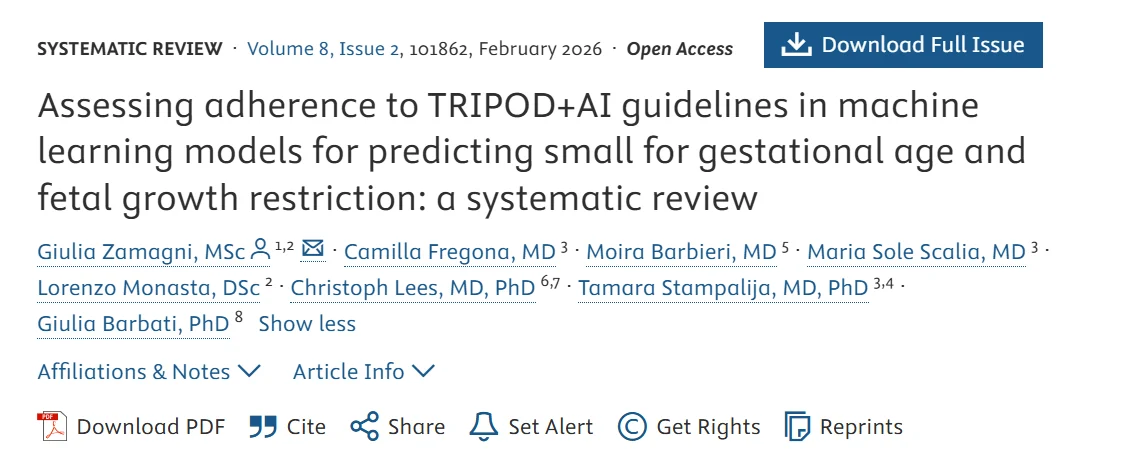
“I’m happy to share our latest work, published in American Journal of Obstetrics and Gynecology MFM: ‘Assessing Adherence to TRIPOD+AI Guidelines in Machine Learning Models for Predicting Small for Gestational Age and Fetal Growth Restriction: A Systematic Review’.
What did we find?
Despite the growing enthusiasm for machine learning in perinatal medicine, our systematic review reveals several critical gaps that limit clinical applicability:
Not a single model evaluated performance across clinically relevant subgroups. This means we have no idea whether these models behave differently – and potentially inequitably – for different populations.
Only 15% of studies evaluated calibration.
This is perhaps the most alarming finding.
In clinical prediction models, calibration is essential: predicted risks directly inform decisions such as surveillance intensity, timing of delivery, or need for intervention.
A model that is well-discriminating but poorly calibrated can overestimate or underestimate risks, leading to unnecessary interventions or missed opportunities for timely care. Yet, calibration was almost entirely overlooked.
Why this matters
Developing ML for healthcare must be more than a technical exercise: it requires robust methodology and thoughtful evaluation to truly support patient care.”
Title: Assessing adherence to TRIPOD+AI guidelines in machine learning models for predicting small for gestational age and fetal growth restriction: a systematic review
Authors: Giulia Zamagni, Camilla Fregona, Moira Barbieri, Maria Sole Scalia, Lorenzo Monasta, Christoph Lees, Tamara Stampalija, Giulia Barbati
Read the full article.
Stay updated on all scientific advances in the field of fertility with Fertility News.
-
Sep 13, 2026, 15:11Sachintha Alwis: From Impaired Sperm Motility to Microrobotics
-
Sep 13, 2026, 15:08Laurence Orbuch: Before Endometriosis Surgery, Ask…
-
Sep 13, 2026, 15:05Ademola Ayodele: IUI, IVF or Egg Freezing – Which One Is Right for You?
-
Sep 13, 2026, 14:59Fiona Pathiraja-Møller: Tennis Players No Longer Have to Choose Between Career and Family
-
Sep 13, 2026, 14:571-Day Virtual Experience for People Impacted by PMOS – PCOS Awareness Association
-
Sep 13, 2026, 14:53Ozor Victor: Behind Every Embryo Is a Story of Science, Precision, and Hope
-
Sep 13, 2026, 14:50Diana Kayal: What They Don’t Tell You About IVF
-
Sep 13, 2026, 14:44Vikram Sinai Talaulikar: A Heartfelt Thank You to All Who Donated and Supported “Menopause and Cancer”
-
Sep 13, 2026, 14:41Nicole McPherson: Changing IVF Practices Is Hard – Integration Needs to Be Easy