

Fewer Cells for PGT-A Testing Can Be Just as Reliable and Gentler on Your Future Baby – Fertility Plus
Fertility Plus shared a post on LinkedIn:
“Less Is More in Embryo Biopsy: New Study Shows Fewer Cells for PGT-A Testing Can Be Just as Reliable – and Gentler on Your Future Baby!
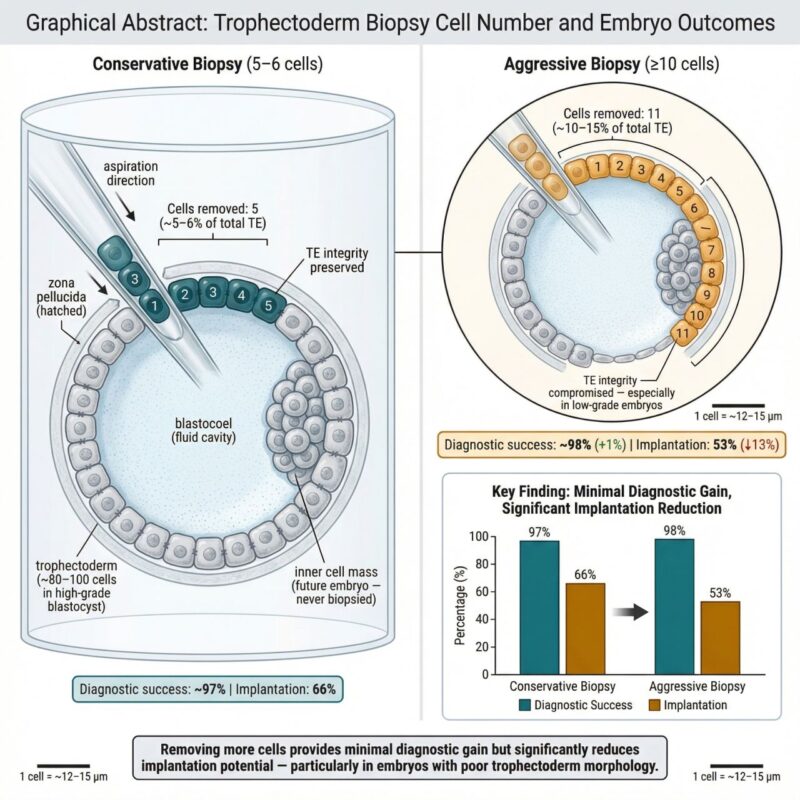
When doctors do PGT-A genetic testing on IVF embryos, they carefully remove a small number of cells from the outer layer (called the trophectoderm) at the blastocyst stage. This layer will later become the placenta, while the inner cells form the baby.
For years, embryologists have wondered: do we need to take more cells to get a clear, reliable test result, or could taking fewer actually be better for the embryo?
A recent study looked at real IVF cycles and grouped embryos by how many cells were taken during biopsy – from as few as 2–4 up to 7 or more. After carefully accounting for factors like the mother’s age and embryo quality, the researchers found something reassuring: the rate of test failures (no clear result) was basically the same no matter how many cells were removed.
Earlier research also shows that once you reach about 5–8 cells, the test is already highly accurate, with little extra benefit from taking more. At the same time, larger biopsies (around 10 cells) have been linked to lower implantation chances in some studies, especially for embryos with slightly weaker outer layers.
The big takeaway? Clinics may not need to remove as many cells as they sometimes do. A moderate, careful biopsy seems to give trustworthy genetic information while causing less potential harm to the embryo. This supports creating clear, standardized rules for biopsies that put embryo safety first – helping more families achieve healthy pregnancies.
Impact of the number of trophectoderm cells biopsied on the quality of preimplantation genetic testing for aneuploidy. Reproductive BioMedicine Online, 2025; in press. DOI: 10.1016/j.rbmo.2025.105407 (Kung et al.).
For any inquiries or questions, please email.”
Stay updated on all scientific advances in the field of fertility with Fertility News.
-
Sep 13, 2026, 15:11Sachintha Alwis: From Impaired Sperm Motility to Microrobotics
-
Sep 13, 2026, 15:08Laurence Orbuch: Before Endometriosis Surgery, Ask…
-
Sep 13, 2026, 15:05Ademola Ayodele: IUI, IVF or Egg Freezing – Which One Is Right for You?
-
Sep 13, 2026, 14:59Fiona Pathiraja-Møller: Tennis Players No Longer Have to Choose Between Career and Family
-
Sep 13, 2026, 14:571-Day Virtual Experience for People Impacted by PMOS – PCOS Awareness Association
-
Sep 13, 2026, 14:53Ozor Victor: Behind Every Embryo Is a Story of Science, Precision, and Hope
-
Sep 13, 2026, 14:50Diana Kayal: What They Don’t Tell You About IVF
-
Sep 13, 2026, 14:44Vikram Sinai Talaulikar: A Heartfelt Thank You to All Who Donated and Supported “Menopause and Cancer”
-
Sep 13, 2026, 14:41Nicole McPherson: Changing IVF Practices Is Hard – Integration Needs to Be Easy