
Dora Koller: New GWAS Analysis Highlights Broad Shared Biology in Endometriosis
Dora Koller, Principal Investigator at Institut de Recerca Sant Pau, shared a post on LinkedIn:
“More details on our endometriosis GWAS, this time on its shared biology with other conditions.
We ran genetic correlation, shared genetic architecture, and causality analyses across 35 traits spanning 7 disease categories: gynecological and reproductive, psychiatric, pain-related, metabolic, gastrointestinal, cancer, and systemic.
Two questions guided this part of the analysis:
- Do endometriosis and these conditions share genetic architecture? That is, do the same genetic variants influence multiple traits not because one causes the other, but because shared biological pathways underlie both.
- Does one condition causally influence the other? That required Mendelian randomization and latent causal variable modeling, methods that use genetic variants as natural experiments to test direction and causality.
On shared genetics:
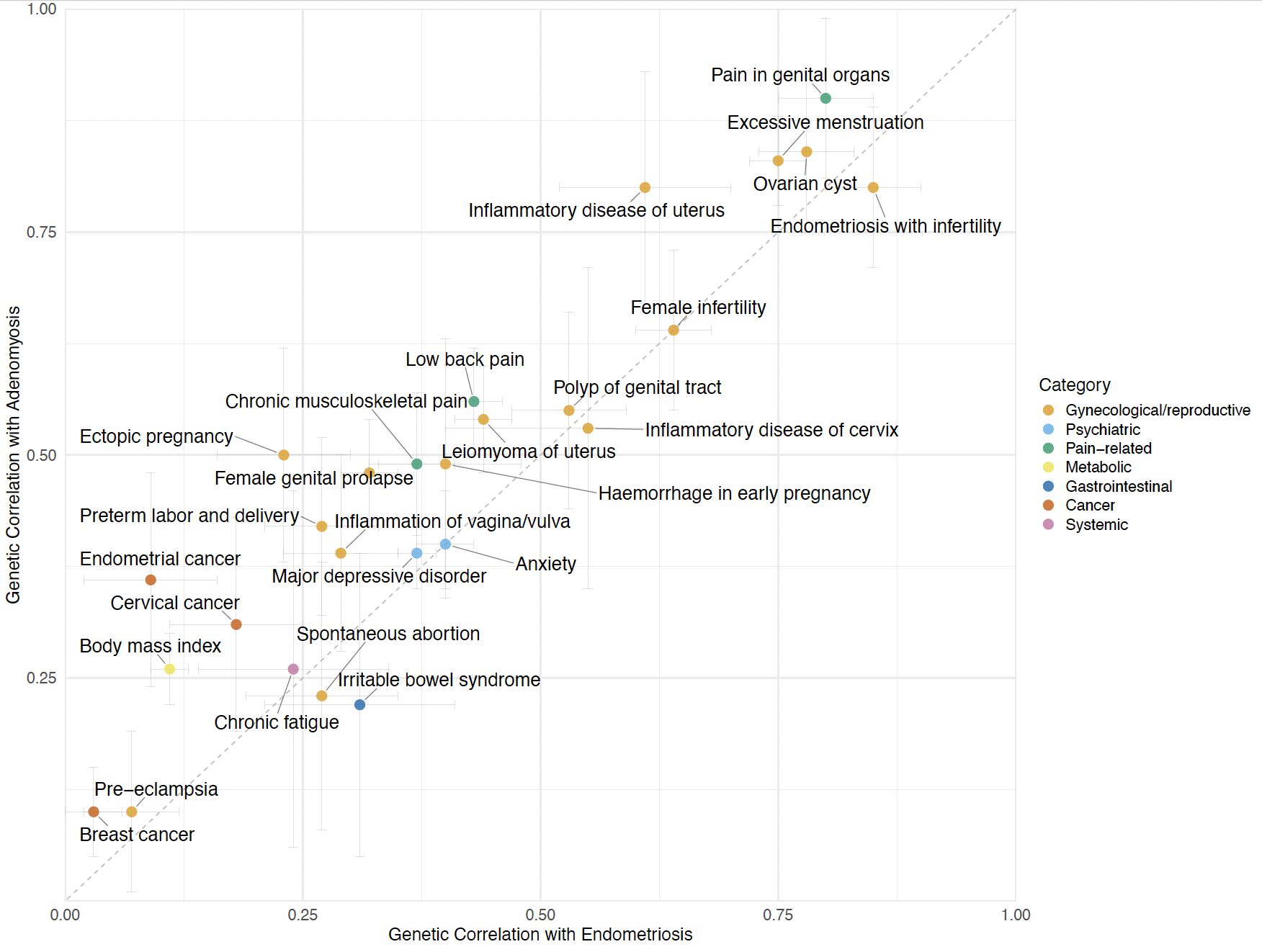
- Significant genetic correlations across nearly all 7 categories, the exceptions being pre-eclampsia and breast cancer.
- Endometriosis was not genetically correlated with endometrial cancer, but adenomyosis was, an important distinction between these two comorbid conditions with ~80 co-occurence.
- 95% of endometriosis risk variants are shared with major depressive disorder, pointing to shared neuroendocrine and inflammatory biology, a finding consistent with our previous work.
- 91-93% overlap with menstrual irregularities and female infertility.
- Shared genetics across psychiatric, pain, gastrointestinal, and systemic categories, consistent with endometriosis as a systemic condition that affects the whole body.
On causality:
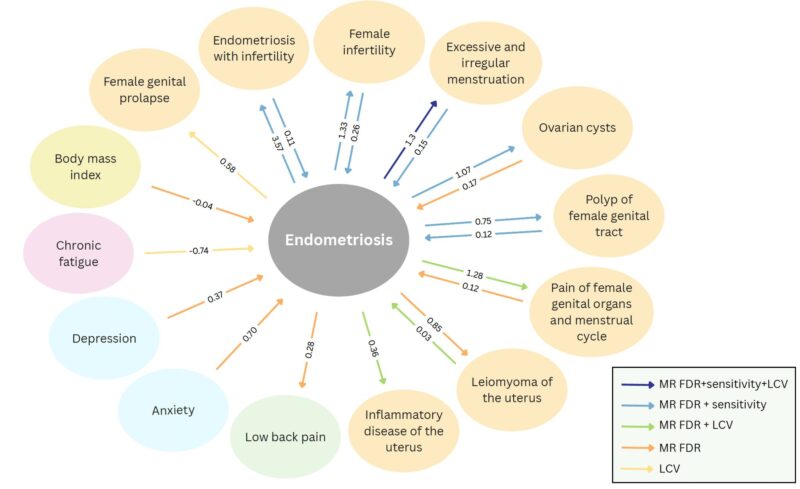
- Bidirectional causal relationship between endometriosis and menstrual dysregulation, menstrual pain conditions, infertility, genital tract polyps, uterine fibroids, and ovarian cysts.
- Endometriosis → female genital prolapse, low back pain, inflammatory disease of the uterus.
- Chronic fatigue → endometriosis: our latent causal variable analysis pointed to a causal effect, the first genetic evidence of this relationship. Chronic fatigue is very common in endometriosis patients, and largely ignored as a symptom.
- Negative causal effect of BMI on endometriosis: lower BMI may predispose to the disease, which has already been described as an environmental risk factor.
This is not the first study to understand the genetic relationship of endometriosis with other traits: previous work (among them our studies) has investigated genetic overlap with immunological, inflammatory, and psychiatric conditions, among others. Our study builds on that foundation, extending the scope of traits and analytical methods, and adding causal inference in a more systematic way.”
Stay updated on all scientific advances in the field of fertility with Fertility News.
-
Oct 10, 2026, 16:11Abieyuwa Ehigiamusoe: Starting Your Embryology Journey?
-
Oct 10, 2026, 16:10Hajar Vahabzadeh: Embryo Quality – The Science Behind the Laboratory Environment
-
Oct 10, 2026, 16:08Karthik Raj: The POSEIDON Concept – Moving Beyond “Poor Responder”
-
Oct 10, 2026, 16:05Marking 15 Years of Fakih IVF Fertility Center
-
Oct 10, 2026, 16:04Eleni Polychronidou: How Men Feel About Infertility
-
Oct 10, 2026, 16:01Philippos Edimiris: Comparing Programmed Ovulatory FET with Modified Natural Cycle FET
-
Oct 10, 2026, 15:57Baby Caleb and His Mom Made the Day – Caperton Fertility Institute
-
Oct 10, 2026, 15:53Marga Esbert Algam: A Constructive and Engaging Visit to the Reproductive Medicine Laboratory and Cryobank
-
Oct 10, 2026, 15:50Why Mental Health Matters on the Fertility Journey – Egg Donor and Surrogate Solutions