

Esraa Atef: Is 24 Hours Too Late to Rescue Unfertilized Oocytes?
Esraa Atef, Embryologist at City Hospital, shared a post on LinkedIn:
“Is 24 hours too late to rescue unfertilized oocytes?
We all know that Artificial Oocyte Activation (AOA) using Calcium Ionophore is an established practice in IVF labs for predicted fertilization failures. However, the real clinical dilemma happens when unexpected Total Fertilization Failure (TFF) catches us off guard the next day.
Is it possible to intervene late? And more importantly, do those delayed embryos follow a normal, healthy development pattern?
A recent study,’Calcium Ionophore (A23187) Rescues the Activation of Unfertilized Oocytes After Intracytoplasmic Sperm Injection and Chromosome Analysis of Blastocyst After Activation,’ addresses this exact timeline.
Here is what makes this research a pivotal point for embryologists:
The Rescue Activation (RA) Paradigm: Instead of completely discarding oocytes that show zero signs of pronuclei (PN) formation 18–24 hours post-ICSI, the study investigated performing a late rescue AOA (10 μM Calcium Ionophore for 10 minutes).
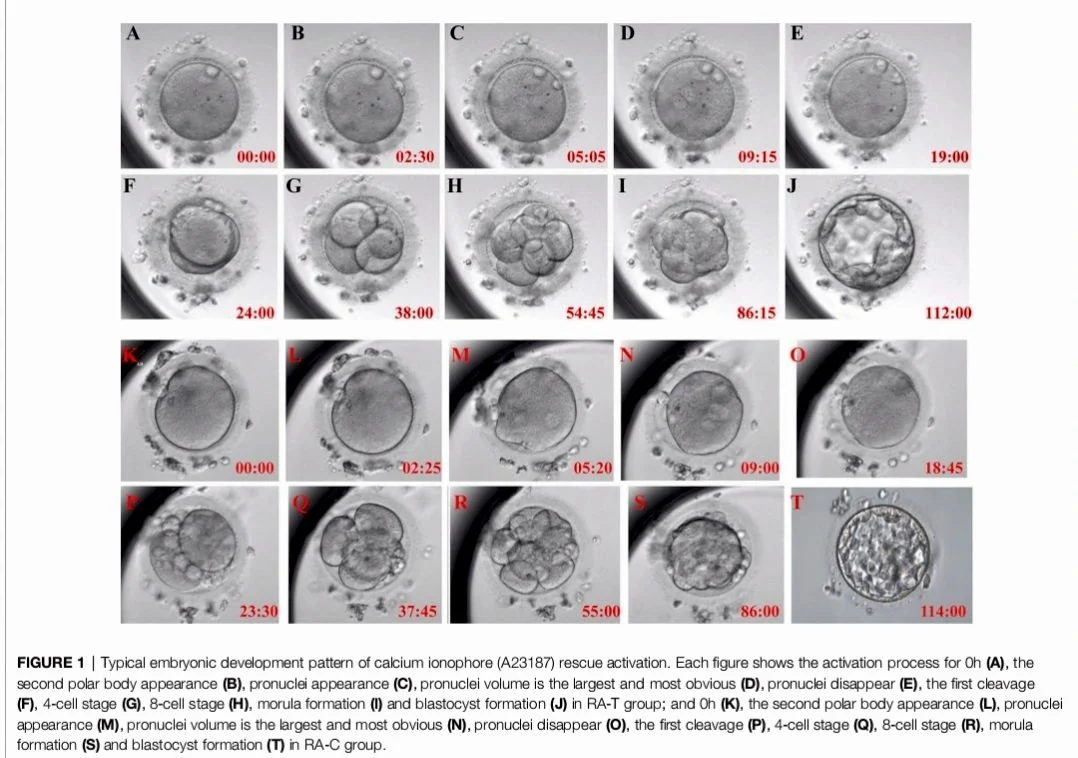
Visualizing the Development (As shown in Figure 1):
Looking at the time-lapse imagery, the study beautifully compares the embryonic development pattern between the Rescue Activation group (RA-T: Figs A–J) and the normal control group (RA-C: Figs K–T).
Parallel Timelines: From the moment of activation (0h), through the second polar body and pronuclei appearance, all the way to the 4-cell, 8-cell, morula, and final blastocyst stages—the rescue group follows a dynamic, consistent, and remarkably parallel developmental timeline compared to routinely fertilized embryos.
Overcoming the ‘Oocyte Aging’ Concern: The biggest fear with delayed activation has always been oocyte aging and subsequent chromosomal abnormalities. This study cracked that concern wide open. By performing SNP Microarray and Next-Generation Sequencing (NGS) on the resulting Day 5/6 blastocysts, the data proved they achieved a normal karyotype. Chromosomal integrity was completely preserved despite the 24-hour delay.
The Ultimate Financial and Emotional Savior, Unexpected fertilization failure usually means terminating the cycle, leading to immense psychological trauma and financial loss for the patient. Late rescue AOA successfully salvages usable, genetically healthy embryos within the same cycle, eliminating the need for another immediate ovarian stimulation.”
Stay updated on all scientific advances in the field of fertility with Fertility News.
-
Oct 18, 2026, 18:01Ting Yuan: Attending a Locally Organised Reproductive Medicine Conference in Malaysia with My Team
-
Oct 18, 2026, 17:55Khalil Faaed: Ovarian Rejuvenation with PRP
-
Oct 18, 2026, 17:49UCLA Law Center on Reproductive Health, Law, and Policy Hosts Panel on Menopause and Women’s Health Equity
-
Oct 18, 2026, 17:41Arora Suhani Gagan: Everyone Was Discussing Her Pregnancy, but Nobody Asked What She Wanted
-
Oct 18, 2026, 17:07Robert Borowczyk: Fertility Questions Need Different Answers
-
Oct 18, 2026, 17:05Farah Yasin: Another Successful ART Fertility Clinics Conference in Abu Dhabi
-
Oct 18, 2026, 17:01Hilary Friedlander: Excited to Offer NeedleFree IVF at Atlantic Fertility
-
Oct 18, 2026, 16:59Rabih Chaoui: New Edition of “First Trimester Ultrasound Diagnosis of Fetal Abnormalities”
-
Oct 18, 2026, 16:56Arsiak Vartenian: My Daughter Was Born Through Surrogacy, and That Is a Story Worth Telling