

Tushar Chauhan: Why Some Chromosomal Disorders are Challenging to Diagnose
Tushar Chauhan, Founder and Scientist at Genetic Education Academy, shared on LinkedIn:
“A 34-year-old woman was carrying twins following IVF.
Her first-trimester NIPT showed a low risk for trisomy 21, 18 and 13.
Everything seemed reassuring.
But the ultrasound told a different story.
One of the twins showed increased nuchal translucency, limb shortening, and mild ventriculomegaly, while the other twin appeared completely normal.
This raised an important question.
If the NIPT was low risk, what was causing these unusual findings in one of the twins?
Further genetic investigations revealed something much rarer.
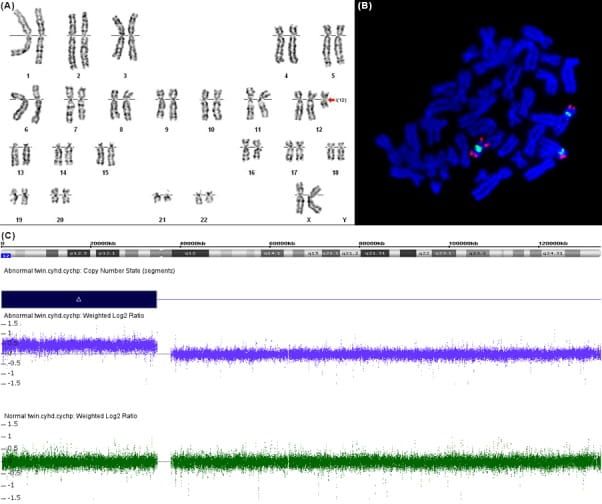
The fetus carried an isochromosome 12p, a structural chromosomal abnormality associated with Pallister-Killian syndrome.
The karyotype showed: 47,XX,i(12p)[40]/46,XX[10]
This means that most of the analyzed cells carried an additional chromosome made up of two copies of the short arm of chromosome 12.
FISH confirmed the presence of the abnormal chromosome, while chromosomal microarray demonstrated the corresponding 12p copy-number gain.
But the case became even more interesting when fetal heart blood was analyzed.
The percentage of abnormal cells was considerably lower than what had been observed in the amniotic fluid.
Why?
Because the abnormal chromosome was not distributed equally across different fetal tissues.
This phenomenon, known as tissue-specific mosaicism, is one of the reasons why some chromosomal disorders can be particularly challenging to diagnose.
I recently explored this fascinating case study, including how an isochromosome forms, why i(12p) is associated with Pallister-Killian syndrome, how FISH helped confirm the abnormality, and why different tissues showed different levels of mosaicism.
Read the full blog to explore the complete case study and its cytogenetic insights.”
Stay informed with the latest updates in fertility and reproductive medicine on Fertility News.
-
Aug 22, 2026, 18:57Lowell Ku: What a Year for the Midwest Reproductive Symposium International
-
Aug 22, 2026, 18:52Does Age Really Affect Fertility? – Mayflower Women’s Hospital
-
Aug 22, 2026, 18:45New Research from the University of Hong Kong Examines Global Infertility Trends Among Women Aged 35-49
-
Aug 22, 2026, 18:37Devyanshi Dixit: Can We Detect Gynecologic Cancer Before Symptoms Appear?
-
Aug 22, 2026, 18:33Hema Divakar: A New Paradigm for Healthy Ageing in Women With POI and Early Menopause
-
Aug 22, 2026, 18:20Lowell Ku: Can What You Eat Affect Fertility?
-
Aug 22, 2026, 18:07Nagma: Building an IVF Portfolio Is Not Just About Adding More Tests…
-
Aug 22, 2026, 18:01Vikram Sinai Talaulikar: Long-Term Associations of Postmenopausal HRT Are Not “One-Size-Fits-All”
-
Aug 22, 2026, 17:57Lucy Froese: 36 Months of Negative Pregnancy Tests and Now I’ve Had 11 Years of Being Your Mum