
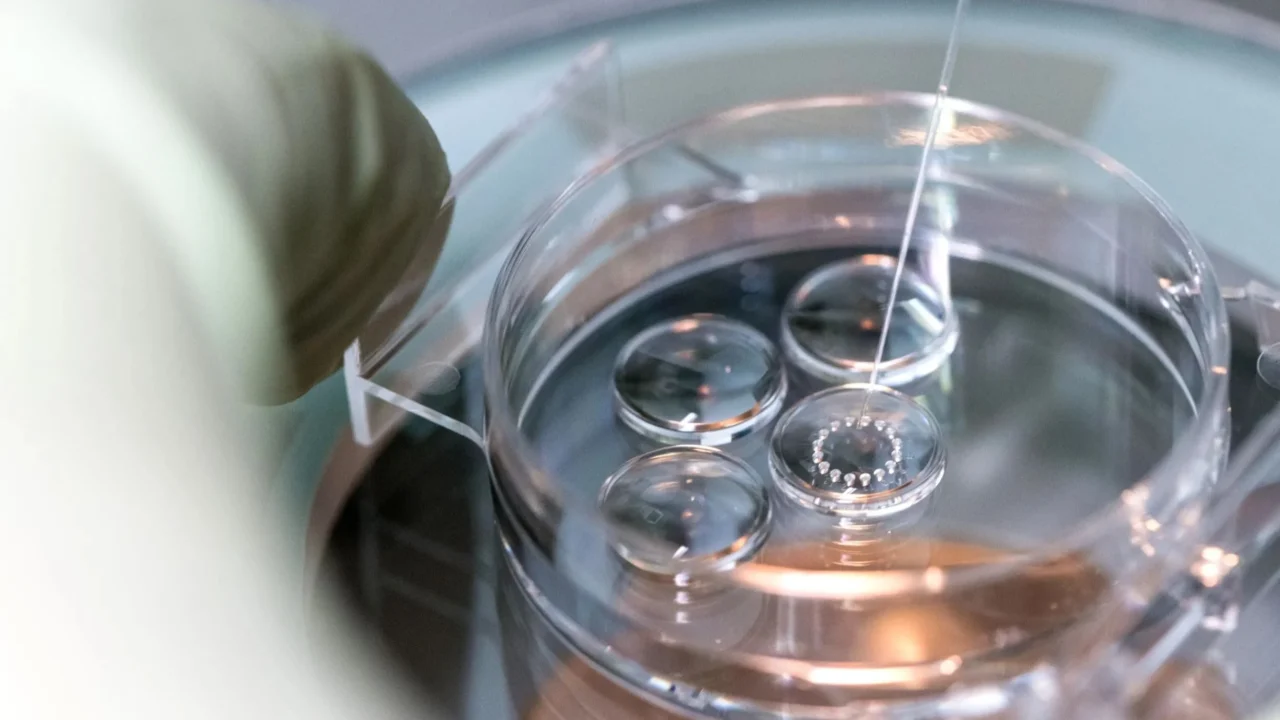
Akinrolayo Faith: Inside the IVF Laboratory – Day 1
Akinrolayo Faith, Junior Embryologist at Present Help Fertility Clinic, shared on LinkedIn:
“Inside the IVF Laboratory – Day 1
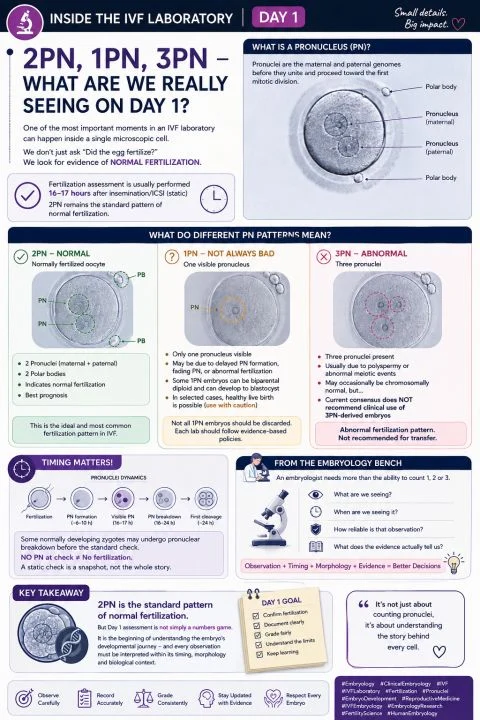
2PN, 1PN, 3PN – What Are We Really Seeing on Day 1?
One of the most important moments in an IVF laboratory can happen inside a single microscopic cell.
After fertilization, we don’t simply ask:
‘Did the egg fertilize?’
We look for evidence of normal fertilization.
And one of the first things we assess is the number and appearance of pronuclei (PN).
The classic 2PN
A normally fertilized oocyte is typically identified by:
2PN + 2 polar bodies
The two pronuclei represent the maternal and paternal genomes following fertilization, before they ultimately unite and proceed toward the first mitotic division.
At the fertilization check, we assess more than simply counting pronuclei. We also consider their size, position and morphology, alongside the presence of the polar bodies.
The current ESHRE good-practice recommendations advise assessment around 16–17 hours after insemination/injection in static observation, with 2PN remaining the standard fertilization pattern.
But what about 1PN and 3PN?
This is where embryology becomes more nuanced.
1PN – one visible pronucleus
This does not automatically mean the embryo is unusable. Evidence summarized in the 2025 ESHRE/ALPHA Istanbul Consensus indicates that some 1PN-derived embryos can be biparental diploid and can develop to blastocyst and, in selected circumstances, result in healthy live births. Their clinical use requires caution and appropriate laboratory policy.
3PN – three pronuclei
This represents an abnormal fertilization pattern and can arise through mechanisms such as polyspermy or abnormal meiotic events. Despite occasional reports of chromosomally normal embryos, the current consensus does not recommend clinical use of 3PN-derived embryos.
A lesson from the embryology bench
One thing that becomes clearer with experience is that what you see at a single time point is not always the complete story.
A static fertilization check is a snapshot.
Pronuclei can form and disappear within a relatively narrow developmental window. Time-lapse observations have shown that some normally developing zygotes may undergo pronuclear breakdown before the conventional fertilization assessment, meaning that simply seeing no PN at the check does not necessarily prove that fertilization never occurred.
That is why an embryologist needs more than the ability to count 1, 2 or 3.
We need to understand:
- What are we seeing?
- When are we seeing it?
- How reliable is that observation?
- And what does the evidence actually tell us?
Key Takeway
2PN is the standard pattern of normal fertilization.
But Day 1 assessment is not simply a numbers game.
It is the beginning of understanding the embryo’s developmental journey, and every observation must be interpreted within its timing, morphology, and biological context.”
Stay informed with the latest updates in fertility and reproductive medicine on Fertility News.
-
Oct 18, 2026, 18:01Ting Yuan: Attending a Locally Organised Reproductive Medicine Conference in Malaysia with My Team
-
Oct 18, 2026, 17:55Khalil Faaed: Ovarian Rejuvenation with PRP
-
Oct 18, 2026, 17:49UCLA Law Center on Reproductive Health, Law, and Policy Hosts Panel on Menopause and Women’s Health Equity
-
Oct 18, 2026, 17:41Arora Suhani Gagan: Everyone Was Discussing Her Pregnancy, but Nobody Asked What She Wanted
-
Oct 18, 2026, 17:07Robert Borowczyk: Fertility Questions Need Different Answers
-
Oct 18, 2026, 17:05Farah Yasin: Another Successful ART Fertility Clinics Conference in Abu Dhabi
-
Oct 18, 2026, 17:01Hilary Friedlander: Excited to Offer NeedleFree IVF at Atlantic Fertility
-
Oct 18, 2026, 16:59Rabih Chaoui: New Edition of “First Trimester Ultrasound Diagnosis of Fetal Abnormalities”
-
Oct 18, 2026, 16:56Arsiak Vartenian: My Daughter Was Born Through Surrogacy, and That Is a Story Worth Telling