
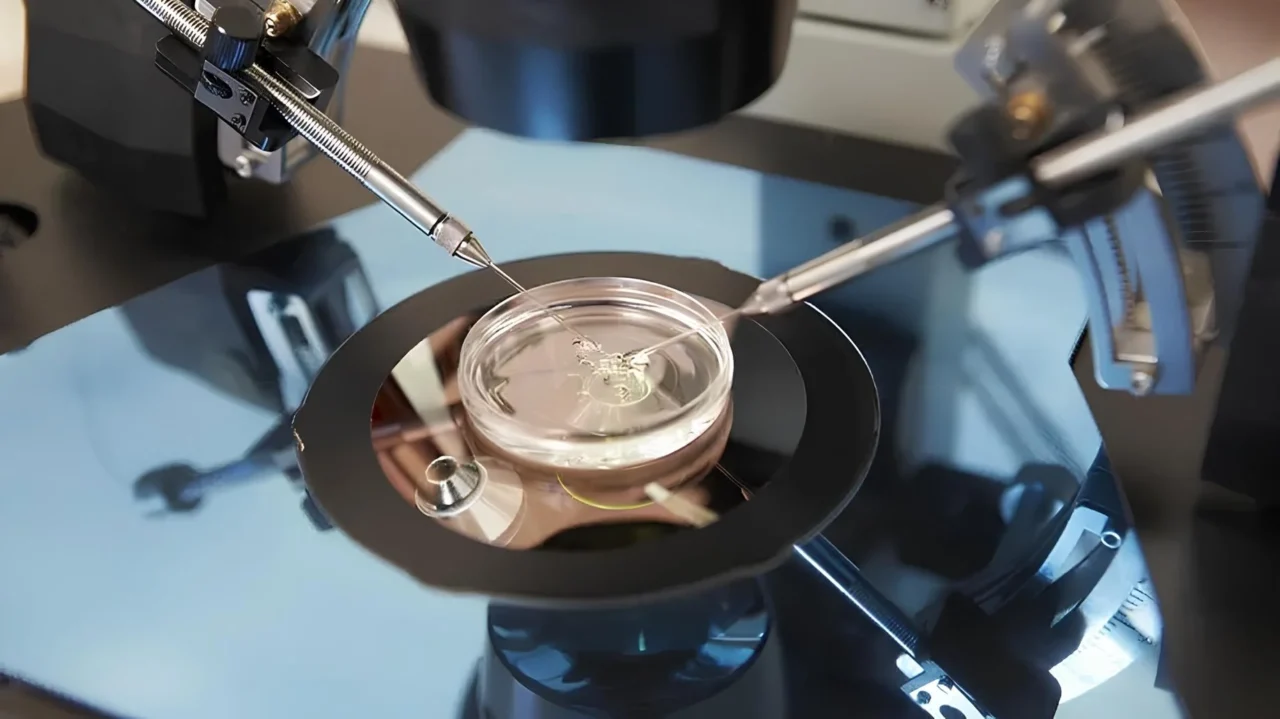
Akinrolayo Faith: Inside the IVF Laboratory – Day 2
Akinrolayo Faith, Junior Embryologist at Present Help Fertility Clinic, shared on LinkedIn:
“Inside the IVF Laboratory – Day 2
From Zygote to Cleavage-Stage Embryo: What Should We See?
Yesterday, we looked at the fertilization check – particularly the significance of 2PN, 1PN, and 3PN.
But fertilization is only the beginning.
Once the pronuclei disappear, the zygote enters its next major phase: cleavage.
The embryo begins dividing from one cell into multiple cells, without an overall increase in embryo volume.
What are we assessing?
At the cleavage stage, an embryologist isn’t simply counting cells.
We assess several morphological features:
- Cell number
Is the embryo developing at an appropriate pace for its developmental day? - Blastomere symmetry
Are the cells relatively similar in size, or is there significant asymmetry? - Fragmentation
How much cytoplasmic fragmentation is present? - Multinucleation
Do individual blastomeres contain more than one nucleus? - Overall embryo organization
Does the embryo demonstrate an appropriate developmental pattern?
Day 2 vs Day 3
A normally developing cleavage-stage embryo commonly progresses from approximately 2-4 cells on Day 2 toward around 6-8 cells on Day 3, although developmental timing can vary.
This is important because embryo development is dynamic.
A single snapshot does not always tell the entire story.
From the embryology bench
One lesson that becomes increasingly important with experience is:
Don’t grade what you expect to see. Grade what you actually observe.
A slower or faster-developing embryo should be assessed based on standardized laboratory criteria rather than assumptions.
And morphology is only one component of embryo assessment.
Research has demonstrated that cleavage-stage morphology can provide useful information about developmental potential, but individual parameters are not perfect predictors of implantation or live birth.
This is why experienced embryologists combine observation + timing + standardized grading + clinical context rather than relying on a single characteristic.
Key Takeway
Cleavage-stage assessment is about more than counting cells.
We’re looking at how the embryo is developing, how its cells are organized, and whether its morphology is consistent with expected development.
The microscope gives us a snapshot.
Our job is to interpret the biology behind that snapshot.”
You can also read the 1st part of this article on Fertility News.
-
Oct 18, 2026, 18:01Ting Yuan: Attending a Locally Organised Reproductive Medicine Conference in Malaysia with My Team
-
Oct 18, 2026, 17:55Khalil Faaed: Ovarian Rejuvenation with PRP
-
Oct 18, 2026, 17:49UCLA Law Center on Reproductive Health, Law, and Policy Hosts Panel on Menopause and Women’s Health Equity
-
Oct 18, 2026, 17:41Arora Suhani Gagan: Everyone Was Discussing Her Pregnancy, but Nobody Asked What She Wanted
-
Oct 18, 2026, 17:07Robert Borowczyk: Fertility Questions Need Different Answers
-
Oct 18, 2026, 17:05Farah Yasin: Another Successful ART Fertility Clinics Conference in Abu Dhabi
-
Oct 18, 2026, 17:01Hilary Friedlander: Excited to Offer NeedleFree IVF at Atlantic Fertility
-
Oct 18, 2026, 16:59Rabih Chaoui: New Edition of “First Trimester Ultrasound Diagnosis of Fetal Abnormalities”
-
Oct 18, 2026, 16:56Arsiak Vartenian: My Daughter Was Born Through Surrogacy, and That Is a Story Worth Telling