

Vikram Sinai Talaulikar։ The Association Between HRT and Dementia Risk Among Postmenopausal Women
Vikram Sinai Talaulikar, Specialist in Reproductive Endocrinology at The LUNA Clinic, shared a post on LinkedIn about a paper by Steven Squires et al. published in Alzheimer’s and Dementia:
“We are seeing an increasing amount of research focused on oestrogens and cognition. Every study adds to our understanding of the topic.
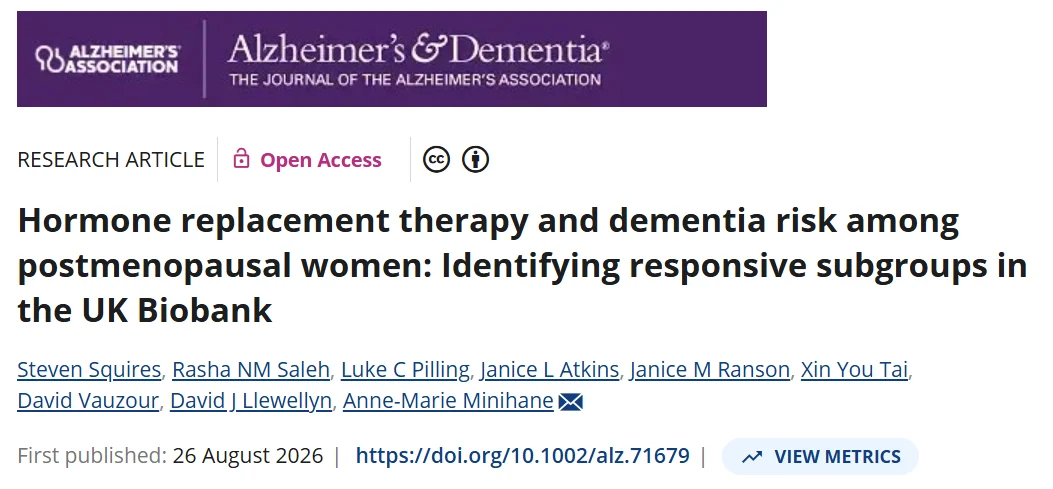
Here is a large observational UK Biobank study from Squires et al. exploring the association between Hormone replacement therapy and dementia risk among postmenopausal women.
In this study, in 183,450 postmenopausal women from the UK Biobank (mean 13.3 years follow-up), multivariable Cox regression models evaluated associations between HRT use (≥1 year) and all-cause dementia and dementia subtypes. Stratified analyses assessed modification by menopause type, lifetime estrogen exposure, apolipoprotein E (APOE) ɛ4 genotype, and age at HRT initiation.
Over 2.43 million person-years, 3,948 dementia cases were identified. HRT use was associated with lower all-cause dementia (hazard ratio [HR] 0.90; 95% CI, 0.84-0.96), with stronger associations in surgical menopause (0.74, 0.65-0.84), APOE ɛ4 carriers (0.87, 0.80-0.95) and women with lower endogenous estrogen exposure (0.84, 0.77-0.93). Initiation between ages 46 and 56 conferred the greatest benefit.
The authors concluded that HRT use was associated with lower dementia risk, and these findings may help inform more tailored approaches to HRT prescribing in relation to women’s lifetime dementia risk.
Strengths of the study – large amount of available data, follow-up for dementia diagnosis, and long follow-up. Women were stratified into various subgroups to show that the association between HRT and dementia risk varies considerably.
Limitations of the study – results are associations and not causal. HRT use is subject to selection (healthy-user) bias, as women who use HRT can differ systematically from non-users, including socioeconomic status, educational attainment, ethnicity, and lifestyle factors.
Also, lack of information on HRT formulation, dose, and route of administration, and potentially participants are disproportionately drawn from more socioeconomically advantaged groups.
Observational studies don’t necessarily prove or disprove theories, facts, or conclusions. But every little piece of evidence adds to our understanding of long-term effects of HRT and is valuable in counselling patients on benefits and risks.”
Title: Hormone replacement therapy and dementia risk among postmenopausal women: Identifying responsive subgroups in the UK Biobank
Authors: Steven Squires, Rasha NM Saleh, Luke C Pilling, Janice L Atkins, Janice M Ranson, Xin You Tai, David Vauzour, David J Llewellyn, Anne-Marie Minihane
You can read the Full Article in Alzheimer’s and Dementia.
Other articles featuring Vikram Sinai Talaulikar on Fertility News.
-
Aug 28, 2026, 17:27Arti Singh: What Could Make an Embryologist Happier Than a 100% Blastulation Rate?
-
Aug 28, 2026, 17:24Sangita Jindal: CELL-a-brating Our 1st Graduating Cohort of CELL Scholars
-
Aug 28, 2026, 17:19An Updated RCOG Scientific Impact Paper on Elective Egg Freezing Has Been Published
-
Aug 28, 2026, 17:16How to Take Your Blood Pressure – Preeclampsia Foundation
-
Aug 28, 2026, 17:05Novel Evidence of a Significant Association Between Adenomyosis and Chronic Endometritis – RBMO
-
Aug 28, 2026, 16:58Jema Lee: Amazing Research Has Uncovered Something New About the Menstrual Cycle
-
Aug 28, 2026, 16:54Devyanshi Dixit: Is the Vaginal Microbiome the Next Frontier in Gynecology?
-
Aug 28, 2026, 16:51How Much Do People Really Know About Fertility? – Fertility Plus
-
Aug 28, 2026, 14:33PCOS to PMOS: What the Name Change Means for Billing, Coding and Clinical Practice – ASRM