
Khalil Faaed: Ovarian Rejuvenation with PRP
Khalil Faaed, Embryologist at Modern IVF Center, shared on LinkedIn:
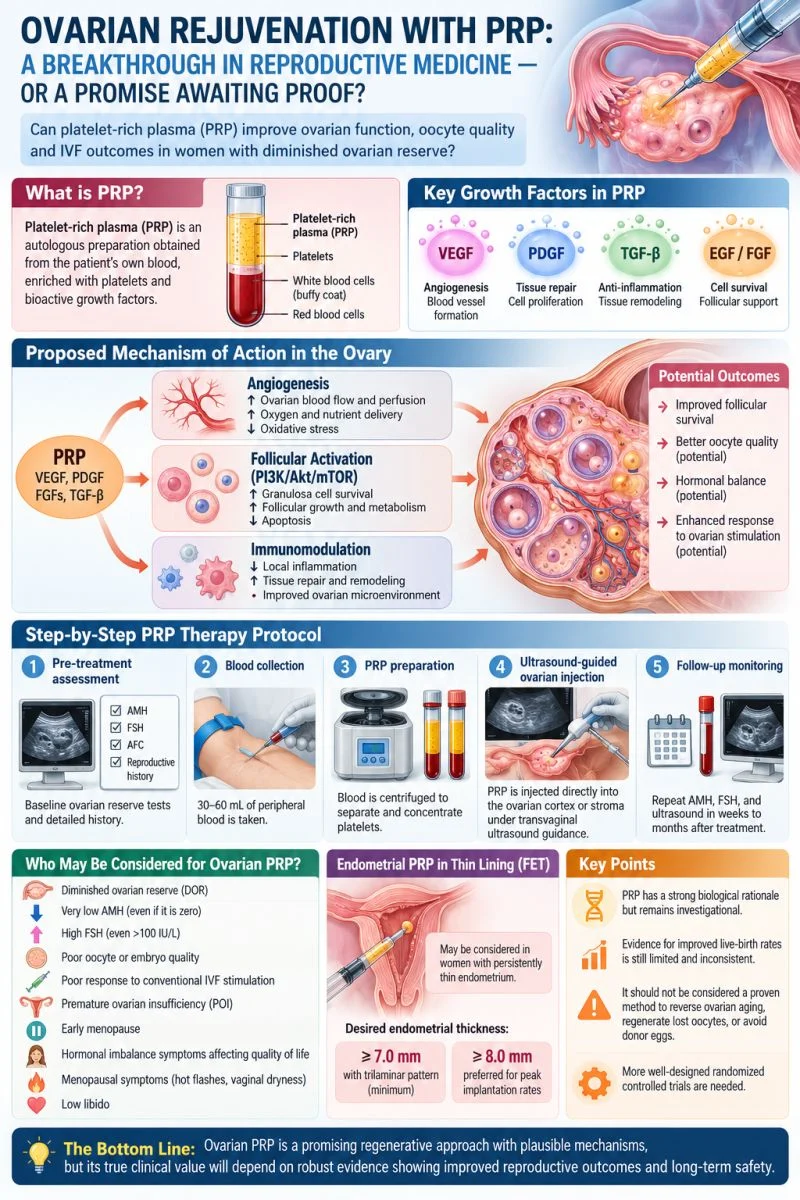
” Ovarian Rejuvenation with PRP: A Breakthrough in Reproductive Medicine or a Promise Awaiting Proof?
Can platelet-rich plasma (PRP) change the future of fertility treatment for women with diminished ovarian reserve?
In reproductive medicine, few topics generate as much interest and debate as ovarian rejuvenation.
Platelet-rich plasma (PRP), an autologous blood-derived preparation enriched in platelets, is being investigated as a potential approach to improving the ovarian microenvironment in women with diminished ovarian reserve (DOR), premature ovarian insufficiency (POI), and poor ovarian response during IVF. But what is the biological rationale behind this approach?
1. Angiogenesis and ovarian perfusion
PRP contains signaling molecules, including VEGF and PDGF, that may influence blood-vessel formation and tissue repair. Researchers hypothesize that these effects could support the ovarian microenvironment.
2. Growth-factor signaling
Mediators released by platelets may interact with cellular pathways involved in cell survival, metabolism, and tissue remodeling, including the PI3K/Akt/mTOR signaling network. However, their effects on human follicular development following intraovarian PRP remain uncertain.
3. Immunomodulation and tissue repair
PRP may influence local inflammatory responses and cellular interactions. Whether these changes meaningfully improve ovarian function or oocyte competence remains an important research question.
4. The ultimate question: Does it improve IVF outcomes?
Changes in AMH, FSH, or antral follicle count are not sufficient to establish clinical success. The outcomes that truly matter include:
- Number of mature MII oocytes retrieved
- Normal fertilization (2PN)
- Blastocyst formation and developmental competence
- Clinical pregnancy and live-birth rates
- Safety for patients and future offspring
Scientific reality matters.
Although ovarian PRP has a plausible biological rationale, current evidence does not establish that it reliably restores ovarian reserve, reverses menopause, regenerates lost oocytes, or improves live-birth rates.
PRP should therefore be regarded as an investigational approach rather than an established treatment for ovarian rejuvenation.
The future of reproductive medicine depends not only on innovative biological concepts, but also on rigorous clinical evidence.
The question is no longer simply whether PRP contains growth factors. The critical question is whether those factors translate into measurable, reproducible, and clinically meaningful improvements in reproductive outcomes.
What is your perspective? Should intraovarian PRP remain a research priority until stronger evidence demonstrates its safety and effectiveness, or does its biological potential justify further carefully controlled clinical trials?”
Other articles featuring Khalil Faaed on Fertility News.
-
Oct 18, 2026, 18:01Ting Yuan: Attending a Locally Organised Reproductive Medicine Conference in Malaysia with My Team
-
Oct 18, 2026, 17:49UCLA Law Center on Reproductive Health, Law, and Policy Hosts Panel on Menopause and Women’s Health Equity
-
Oct 18, 2026, 17:41Arora Suhani Gagan: Everyone Was Discussing Her Pregnancy, but Nobody Asked What She Wanted
-
Oct 18, 2026, 17:07Robert Borowczyk: Fertility Questions Need Different Answers
-
Oct 18, 2026, 17:05Farah Yasin: Another Successful ART Fertility Clinics Conference in Abu Dhabi
-
Oct 18, 2026, 17:01Hilary Friedlander: Excited to Offer NeedleFree IVF at Atlantic Fertility
-
Oct 18, 2026, 16:59Rabih Chaoui: New Edition of “First Trimester Ultrasound Diagnosis of Fetal Abnormalities”
-
Oct 18, 2026, 16:56Arsiak Vartenian: My Daughter Was Born Through Surrogacy, and That Is a Story Worth Telling
-
Oct 18, 2026, 16:51Rajeev Agarwal: Why Rubella IgG Is on My Preconception Sheet