

Daniel Plaksin: HLA-G Glycosylation Emerges as a Potential Mechanism in RPL
Daniel Plaksin, Executive Senior Consultant, shared a post on LinkedIn:
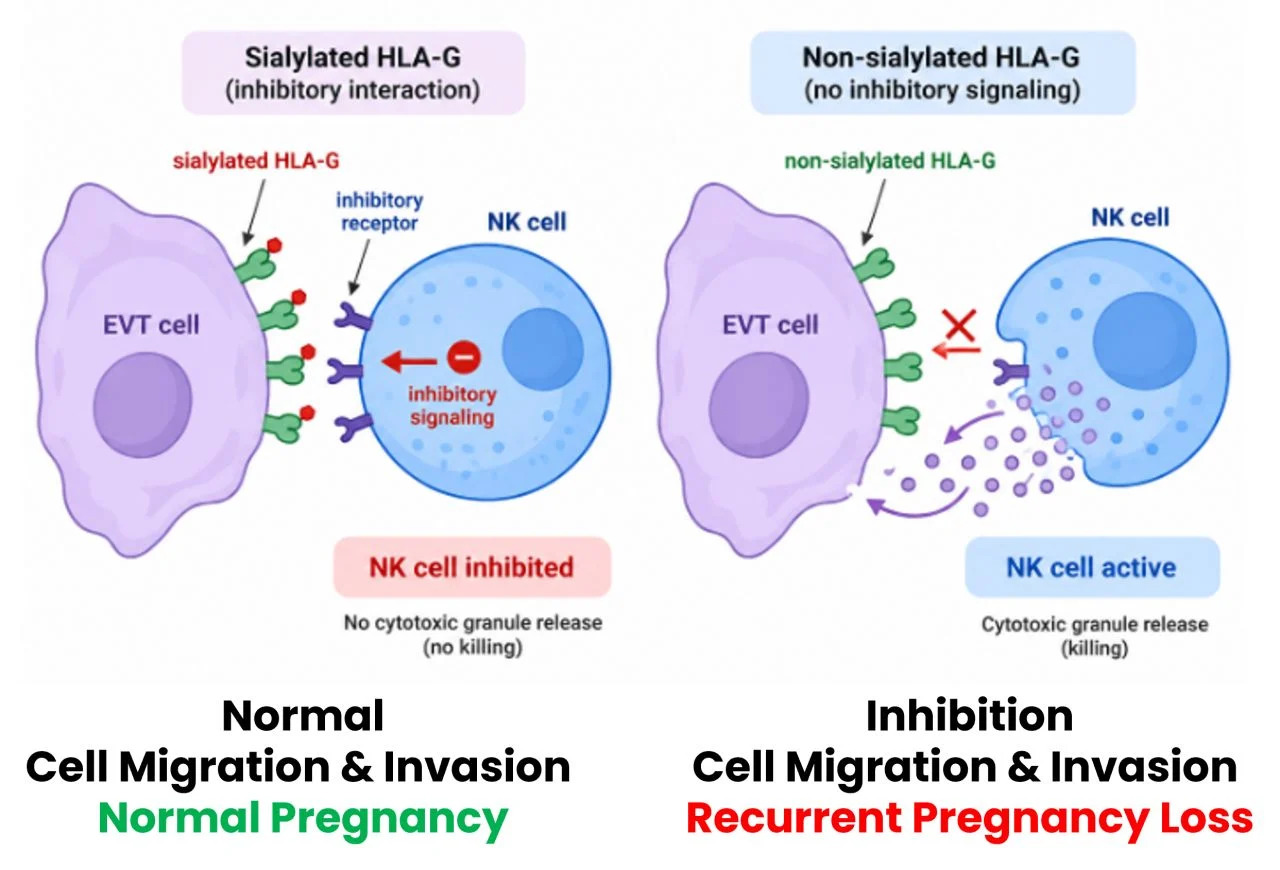
HLA-G glycosylation, especially Asn110-linked sialylation of HLA-G1, is emerging as a mechanistic link to recurrent pregnancy loss (RPL): it enables HLA-G1 to engage the inhibitory NK receptor Siglec-7 at the maternal-fetal interface.
Loss of this sialylation weakens maternal immune tolerance and may contribute to recurrent miscarriage (RM).
Extravillous trophoblast (EVT) cells express HLA-G, a nonclassical MHC-I molecule that suppresses maternal immune responses and supports placental remodeling.
HLA-G interacts with inhibitory receptors including ILT2/ILT4 and KIR2DL4 on decidual immune cells.
A recent study found that HLA-G1 is sialylated at Asn110, and that this glycan is required for binding to Siglec-7, an inhibitory receptor enriched on decidual NK (dNK) cells.
Removing sialic acid with neuraminidase, or mutating Asn110, abolishes the HLA-G1–Siglec-7 interaction.
Disrupted HLA-G1 sialylation reduces HLA-G1 surface localization, promotes lysosomal degradation, and increases NK cytotoxicity and cytokine release.
It also reduces EVT invasiveness, potentially impairing normal placental implantation and remodeling.
Thus, HLA-G1 sialylation appears to function as a glycoimmune checkpoint: properly glycosylated HLA-G restrains dNK activity, whereas aberrant glycosylation may permit excessive NK-mediated attack on trophoblasts.
The glycosylation hypothesis is consistent with broader evidence that reduced or dysfunctional HLA-G is associated with unexplained recurrent miscarriage.
Women with RM have been reported to have lower soluble HLA-G (sHLA-G) concentrations during both pregnancy and non-pregnant states, and placental HLA-G mRNA/protein expression is decreased in RM cohorts.
This information is compelling but still young mechanistic model, not yet an established clinical test or treatment target.
The key glycosylation study is recent and demonstrates mechanism in vitro/ex vivo; it does not by itself prove that defective HLA-G sialylation causes most cases of recurrent miscarriage.
RPL is heterogeneous: uterine anatomical factors, thrombophilia, endocrine disorders, chromosomal abnormalities, infection, and paternal/fetal genetic factors must be excluded before attributing losses to immune-glycan mechanisms.
HLA-G associations in the literature are mixed, and sHLA-G levels vary substantially by individual, trimester, and comorbidities such as obesity.”
Title: Deficient extravillous trophoblast invasion caused by impaired sialylation–Siglec-7 interaction contributes to recurrent pregnancy loss.
Authors: Linyu Zhang, Ying Feng, Peng Wu, Liuyan Chen, Nan Jiang, Xue Ma, Qianhong Ma, Hao-Jie Lu, Xue Xiao and Fang Ma.
You can read the Full Article in Nature.
Title: Defective HLA-G1 glycosylation disrupts Siglec-7–mediated NK cell tolerance at the maternal–fetal interface in recurrent pregnancy loss
Authors: Linyu Zhang, Ying Feng, Yuting Zhang, Xinrui Sun, Shiqi Yi, Kai Wang, Xue Ma, Qianhong Ma, Fang Ma
You can read the Full Article in Cell Communication and Signaling.
Stay informed with the latest updates in fertility and reproductive medicine on Fertility News.
-
Oct 19, 2026, 17:08Shweta Mendiratta: A Baby Boy Was Born From an Embryo that Had Been Frozen for More Than 31 Years
-
Oct 19, 2026, 17:06Partha Sarathi Das: Fertility Begins Before Birth – The Role of Developmental Biology, Genetics, and Epigenetics
-
Oct 19, 2026, 17:04Khalil Faaed: What Morphological Abnormalities Reveal About Oocyte Competence in IVF
-
Oct 19, 2026, 16:59Justin Houman: 4 Checks Before Anyone Starts Testosterone
-
Oct 19, 2026, 16:57Sonia Khourta: Proud to Be Part of the ART Fertility Family
-
Oct 19, 2026, 16:55ACOG Is Moving the Needle on Menopause
-
Oct 19, 2026, 16:53Gila Zarbiv: Why Isn’t Continuity of Midwife Care Happening Everywhere?
-
Oct 19, 2026, 16:50Laura Eyeh Anwah: Why Pregnant Women Should Attend 8 Antenatal Visits Instead of 4
-
Oct 19, 2026, 16:48Diana Kayal: A Full Day of Research and Scientific Data at the 9th ART Fertility Conference