

Rajeev Agarwal: 10 Years On, Fewer Than 3 in 10 Used Their Frozen Eggs
Rajeev Agarwal, Director of Renew Healthcare, shared on LinkedIn:
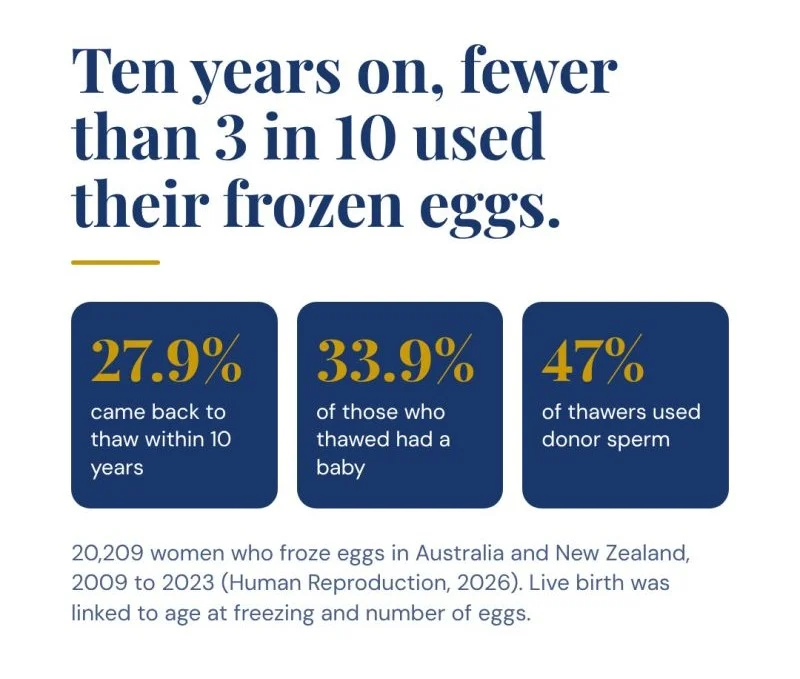
“Ten years on, fewer than 3 in 10 used their frozen eggs.
That is the first lesson on egg freezing from a 15-year registry study from Australia and New Zealand, just published in Human Reproduction, and it should change how all of us counsel.
The registry covered every planned egg freezing cycle in Australia and New Zealand from 2009 to 2023. Uptake rose from 55 women a year to 4,919, an average rise of about 35% a year. Among women with at least ten years of follow-up, 27.9% had come back to thaw. Of those who thawed, 33.9% had a live birth, rising to 37.8% for thaws in 2019 to 2021. Nearly half, 47%, used donor sperm. Live birth was linked to age at freezing and the number of eggs thawed, not to how long the eggs had been frozen.
Age is the heart of it. Women in this registry typically froze between 34 and 38. A 2024 meta-analysis of 8,750 women found that among those who returned, live birth was 52% when eggs were frozen at 35 or younger, against 19% at 40 or older. A widely used model estimates that for a 75% chance of at least one live birth, a woman needs about 10 mature eggs frozen at 34, 20 at 37 and 61 at 42.
For many women that is one or two stimulation cycles at 34, two or three at 37, and at 42 a number few can reach.
What guidelines say. ESHRE makes it a strong recommendation that women be fully informed of success rates, risks, costs and long-term consequences, and asks clinics to give their own live birth rates. ASRM’s 2024 ethics opinion calls planned egg freezing ethically permissible, asks clinics to disclose their own statistics or the lack of them, and disapproves of marketing sessions.
India adds two limits. The ART Act allows treatment for women between 21 and 50, which caps when frozen eggs can be used. And India’s National ART and Surrogacy Registry does not yet publish outcome data, so no Indian woman can be shown Indian thaw-to-live-birth figures.
In my practice, planned egg freezing sits on the preconception counselling sheet, under Planning in the PREPARE method. I raise it as a question of age and egg numbers, with the figures above on the table.
What I would ask of all of us:
- Lead with age and egg number, never with ‘peace of mind’.
- Quote live birth per woman who thaws, and say how few come back.
- Give your own centre’s figures, or say you do not have them.
- Raise it in the early thirties, much before the age at which most women now ask.
Colleagues: do you quote your own centre’s thaw-to-live-birth rate, or a published one?”
Other articles featuring Rajeev Agarwal on Fertility News.
-
Oct 20, 2026, 17:03Bhargavi K.: Sometimes, the Most Interesting Part of Embryology Isn’t Finding an Answer
-
Oct 20, 2026, 17:00Jennifer Straub: Excited to Officially Join Pozitivf Fertility as Chief Operating Officer
-
Oct 20, 2026, 16:57Jordan Abdi: Looking Forward to Co-Hosting the “Rules of Reproduction”
-
Oct 20, 2026, 16:51Andria Besser: Hard to Believe This Is My Last Week at NYU Fertility Center
-
Oct 20, 2026, 16:48Michael Alper: Continuing to Care for Our Patients as Everleap Fertility
-
Oct 20, 2026, 16:43Ankita Sethi: An Insightful Afternoon at First IVF, Abu Dhabi
-
Oct 20, 2026, 16:41Michael Schindler: Our Answer at MedITEX IVF – The Patient and Lab System Is the Integration Layer
-
Oct 20, 2026, 16:35Marcos Meseguer Escrivá: What Happens When We Shorten the Blastocyst Warming Protocol?
-
Oct 20, 2026, 16:30Proud to Be Part of ASRM 2026 Scientific Congress and Expo – MEFS