

Christopher Robinson: AJOG Expert Review Highlights Spiral Artery Transformation Failures in Preeclampsia
Christopher Robinson, Physician/Partner at Charleston Maternal Fetal Medicine, shared a post on LinkedIn about a paper by Eunjung Jung et al. published in AJOG:
“AJOG Expert Review in Preeclampsia: The etiology of preeclampsia – Physiologic transformation of the spiral arteries, failure of physiologic transformation, and atherosis
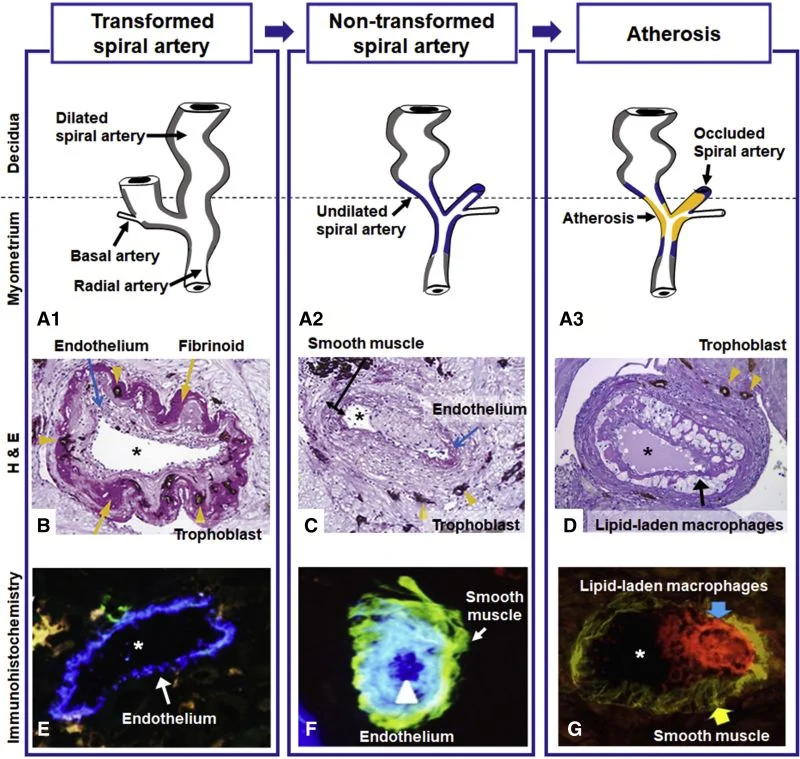
A, Diagram of the maternal blood supply to the placenta. The spiral arteries undergo physiologic changes in normal pregnancy (gray). In preeclampsia, the myometrial segment of the spiral artery fails to undergo physiologic transformation (blue), which is thought to explain the uteroplacental ischemia observed in preeclampsia. Nontransformed spiral arteries are prone to atherosis (yellow), characterized by the presence of lipid-laden macrophages within the lumen. Placental basal plate spiral arteries with hematoxylin-eosin stain (B, C, and D).
B, Transformed spiral arteries are characterized by the presence of intramural trophoblasts (arrowheads) and fibrinoid degeneration (arrows) of the arterial wall.
C, Nontransformed spiral arteries lack intramural trophoblasts and fibrinoid degeneration, and retain smooth muscle. Arrowheads indicate the presence of trophoblasts in myometrium, but not in the wall of the spiral artery.
D, Acute atherosis in a decidual spiral artery. Many lipid-laden macrophages (arrows) are seen in the spiral artery with the lack of invasion of the trophoblast (arrowhead) into a myometrial segment of the spiral artery. Images (B, C, and D) stained with cytokeratin 7 (brown) and periodic acid–Schiff (pink), original magnification ×200. Immunohistochemistry of placental basal plate spiral arteries (E, F, and G).
E, Endothelium (arrow, blue) in vessels with normal trophoblastic invasion, original magnification ×640.
F, A non-transformed spiral artery with endothelium (blue, arrowhead) and smooth muscle cells (green, arrow), original magnification ×640. G, Atherosis lesions show numerous CD36-positive macrophages (red, blue arrow) and smooth muscle cells in the vessel wall (green, yellow arrow), original magnification ×400. Asterisk represents lumen of spiral artery.”
Title: The etiology of preeclampsia
Authors: Eunjung Jung, Roberto Romero, Lami Yeo, Nardhy Gomez-Lopez, Piya Chaemsaithong, Adithep Jaovisidha, Francesca Gotsch, Offer Erez
Read the full article.
Stay updated on all scientific advances in the field of fertility with Fertility News.
-
Sep 13, 2026, 15:11Sachintha Alwis: From Impaired Sperm Motility to Microrobotics
-
Sep 13, 2026, 15:08Laurence Orbuch: Before Endometriosis Surgery, Ask…
-
Sep 13, 2026, 15:05Ademola Ayodele: IUI, IVF or Egg Freezing – Which One Is Right for You?
-
Sep 13, 2026, 14:59Fiona Pathiraja-Møller: Tennis Players No Longer Have to Choose Between Career and Family
-
Sep 13, 2026, 14:571-Day Virtual Experience for People Impacted by PMOS – PCOS Awareness Association
-
Sep 13, 2026, 14:53Ozor Victor: Behind Every Embryo Is a Story of Science, Precision, and Hope
-
Sep 13, 2026, 14:50Diana Kayal: What They Don’t Tell You About IVF
-
Sep 13, 2026, 14:44Vikram Sinai Talaulikar: A Heartfelt Thank You to All Who Donated and Supported “Menopause and Cancer”
-
Sep 13, 2026, 14:41Nicole McPherson: Changing IVF Practices Is Hard – Integration Needs to Be Easy