

Abdelrahman H. Daifalla: The Missing Dimension in IVF
Abdelrahman H. Daifalla, Medical Director and Consultant in IVF/ICSI at Queens Medical Center and Consultant in IVF and Reproductive Medicine at Gannah IVF Hospital, shared on LinkedIn:
“IVF patients don’t just fear failure. They fear the unknown.
What if clinical intelligence could help every couple understand WHY, WHAT’S NEXT, and WHEN?
Discover how DISS is reimagining the IVF journey – from uncertainty to clarity, with personalized medical and surgical roadmaps.
The future of IVF isn’t only about better outcomes. It’s also about a better journey.
The Missing Dimension in IVF: Can Clinical Intelligence Turn Patient Uncertainty into Confidence?
What if every IVF patient could see not only their treatment plan, but also understand WHY, WHEN, and WHAT COMES NEXT?
In reproductive medicine, we invest enormous effort in improving stimulation protocols, laboratory performance, embryo selection, and pregnancy outcomes.
Yet one critical dimension of the patient experience often remains fragmented:
The patient’s understanding of their own fertility journey.
For many couples, IVF is not simply a medical procedure. It is a complex journey involving investigations, uncertainty, financial commitments, emotional stress, and sometimes difficult medical or surgical decisions.
Patients frequently ask:
- Why do I need these investigations?
- Why should we treat this condition before IVF?
- Is surgery necessary, or can we proceed directly?
- How long will optimization take?
- When can we realistically begin treatment?
- What happens if our readiness assessment changes?
These are not secondary questions.
They are central to trust, informed consent, shared decision-making, and meaningful patient participation.
From Clinical Data to Clinical Intelligence
This is one of the challenges that inspired the development of DISS – Daifalla IVF Success System.
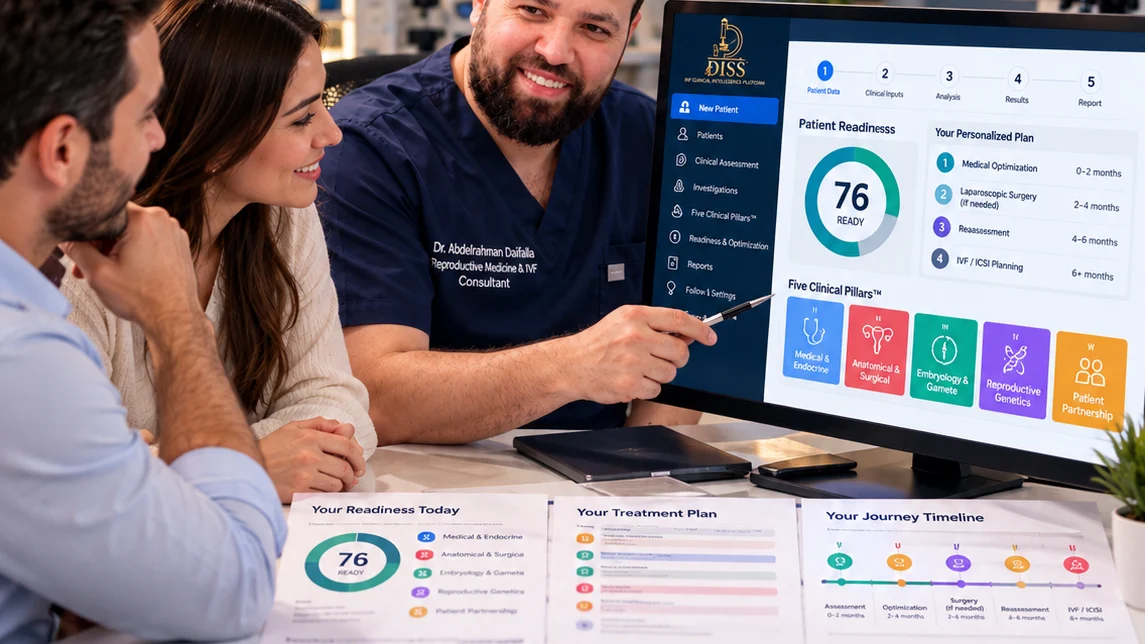
DISS is being developed as an integrated, clinician-led Clinical Intelligence and Research Platform for Reproductive Medicine and IVF/ICSI.
Built around Five Clinical Pillars and Seven Intelligent Clinical Decision-Support and Research Engines, the framework is designed to transform fragmented clinical information into structured, individualized, evidence-informed care pathways.
Its intended capabilities extend beyond assessing whether a couple is ready for IVF.
They include interpreting reproductive investigations, identifying potentially modifiable clinical factors, supporting medical and surgical optimization, and organizing the next steps into a coherent, physician-supervised management plan.
But an equally important innovation is directed not at the physician.
It is directed at the patient.
Introducing Patient-Facing Clinical Intelligence
One of the central goals of DISS is to generate a personalized, patient-friendly clinical intelligence report.
Rather than presenting patients with disconnected laboratory results, unfamiliar medical terminology, and isolated treatment recommendations, the report is designed to explain their reproductive journey in a structured, understandable way.
The patient should be able to understand:
- Where am I now? – A clear explanation of the couple’s current reproductive assessment, clinical readiness, and important findings.
- What needs to be optimized? – An understandable summary of the medical, endocrine, anatomical, surgical, or other factors that may warrant attention before proceeding.
- Why is this treatment recommended? – The clinical reasoning behind proposed interventions, including why medical treatment, surgery, further investigation, or direct IVF may be considered.
- What is my personalized treatment roadmap? – A structured pathway showing the proposed sequence of investigations, optimization, medical or surgical management, reassessment, and potential IVF/ICSI treatment.
- What is my expected timeline? – An individualized, provisional clinical timeline that helps patients understand the anticipated stages of care, their dependencies, and possible delays. Importantly, this is not a promise of a fixed treatment date. Clinical timelines must remain adaptable to the patient’s response, new findings, and physician judgment.
- What happens next? – Clear next steps, follow-up milestones, reassessment points, and decisions that may need to be revisited.
The Intelligent Treatment Roadmap
Imagine a couple leaving an IVF consultation with more than a prescription or a list of investigations.
They receive a clinician-reviewed roadmap explaining:
Assessment – Optimization – Medical or Surgical Intervention (when indicated) – Reassessment – Treatment Readiness – IVF/ICSI Planning – Follow-up
Not every couple requires every stage.
Some may proceed directly to treatment. Others may benefit from targeted optimization. Some may need further evaluation or a carefully considered surgical intervention.
The value lies in making the clinical reasoning and proposed sequence visible, individualized, and understandable.
The roadmap should follow the patient – not force the patient into a predetermined pathway.
Confidence Through Clarity, Not Promises
In fertility care, confidence must never be confused with guaranteeing pregnancy.
No clinical intelligence system can eliminate biological uncertainty or promise a successful outcome.
However, we can work toward reducing avoidable uncertainty about the care process itself.
When patients understand their diagnosis, treatment options, clinical priorities, expected milestones, and the reasons behind medical decisions, we have an opportunity to support greater transparency, informed participation, and trust.
This is the patient-centered ambition of DISS.
Not artificial reassurance.
Not automated promises.
But confidence built on explanation, evidence, and meaningful physician–patient partnership.
A New Value Proposition for Fertility Centers
For IVF clinics and healthcare groups, patient-facing clinical intelligence could offer benefits extending beyond the consultation room.
These include opportunities to evaluate improvements in:
- Consistency of patient communication.
- Understanding of treatment recommendations.
- Shared decision-making and informed consent.
- Transparency of medical and surgical care pathways.
- Continuity between consultations and treatment stages.
- Patient-reported confidence, experience, and satisfaction.
Such benefits must be measured through appropriately designed clinical and patient-experience studies rather than assumed.
From Patient Intelligence to Research Intelligence
The latest evolution of DISS also introduces a seventh engine focused on Research Intelligence.
The goal is to use appropriately governed clinical data to support research insights, hypothesis generation, and independent validation.
This creates an opportunity to investigate questions such as:
Can structured, clinician-supervised intelligence reports improve patients’ understanding of their IVF treatment pathways?
Can personalized treatment roadmaps improve communication and decision quality?
Can greater transparency reduce uncertainty and strengthen patient-reported confidence?
These are research questions – not yet established clinical outcomes of DISS.
The Future of IVF Should Be Understandable to the Patient
Artificial intelligence in reproductive medicine is often discussed in terms of prediction, automation, and laboratory performance.
Those areas matter.
But I believe another frontier deserves equal attention:
Making sophisticated reproductive medicine understandable to the people receiving it.
A patient should not have to navigate one of life’s most emotionally demanding medical journeys without understanding the clinical path ahead.
Our ambition with DISS is to connect three dimensions:
Clinical Intelligence for Physicians.
Clarity, Confidence and Personalized Roadmaps for Patients.
Research Intelligence for Continuous Scientific Learning.
All within a clinician-supervised framework, under development and requiring independent validation.
Because the future of reproductive medicine should not only be more intelligent.
It should also be more transparent, more understandable, and more human.
DISS – Daifalla IVF Success System
Optimize Before Fertilize.
Think Like the Embryo.
Dr. Abdelrahman Daifalla, Reproductive Medicine and IVF Consultant, Advanced Reproductive Surgeon, Founder and Clinical Architect – DISS.”
Other articles featuring Abdelrahman H.. Daifalla on Fertility News.
-
Oct 12, 2026, 16:55Karthik Raj: True Biological Embryo Mosaicism vs. Technical Detection
-
Oct 12, 2026, 16:50Nagi Rostom: Sharing Insights on Reproductive Health and Fertility at a Women’s Health Open Morning
-
Oct 12, 2026, 16:44Katy Encalade: Why Early Education Matters in Egg Donation and Surrogacy
-
Oct 12, 2026, 16:31It’s Time to Talk about Fertility-Aware Workplaces – ESHRE
-
Oct 12, 2026, 16:23Anu Chawla: WHO’s Global Roadmap for Hypertensive Disorders of Pregnancy Is a Significant Step Forward
-
Oct 12, 2026, 16:11Devyanshi Dixit: Behind Every Breakthrough Is a Reason to Keep Going
-
Oct 12, 2026, 16:01Suganya Venkat: The Kindest Thing to Say After a Failed IVF Cycle Is Not “Try Again”
-
Oct 12, 2026, 15:58Lucy Froese: When You Lose a Pregnancy, You Don’t Just Lose Your Baby…
-
Oct 12, 2026, 15:56Beata Blazkova: What Actually Makes an Embryo Keep Going?