
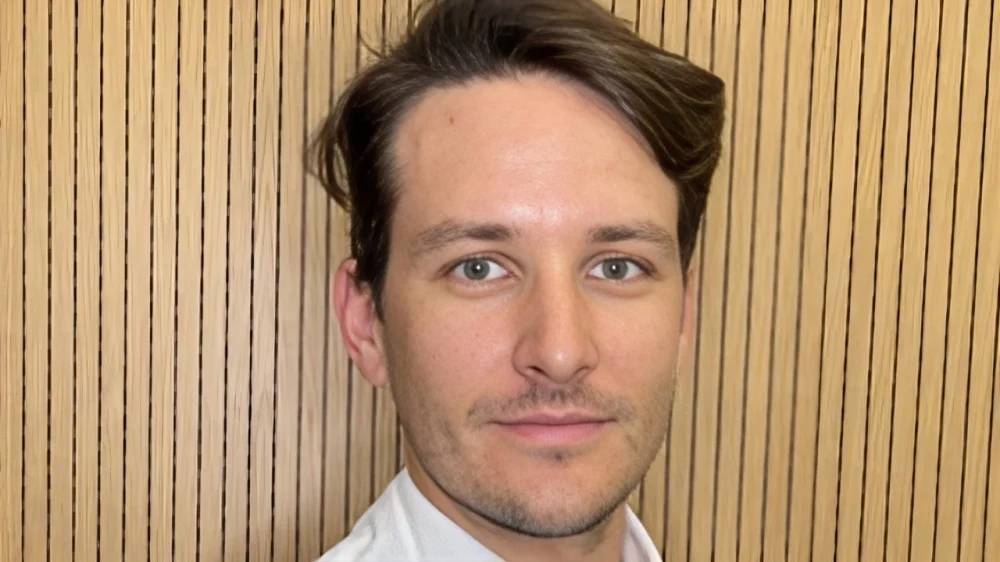
Yannick Hurni: Is Endometriosis a Progressive Disease?
Yannick Hurni, Clinical and research fellow in gynecological surgery at Dexeus Mujer, shared a post on LinkedIn:
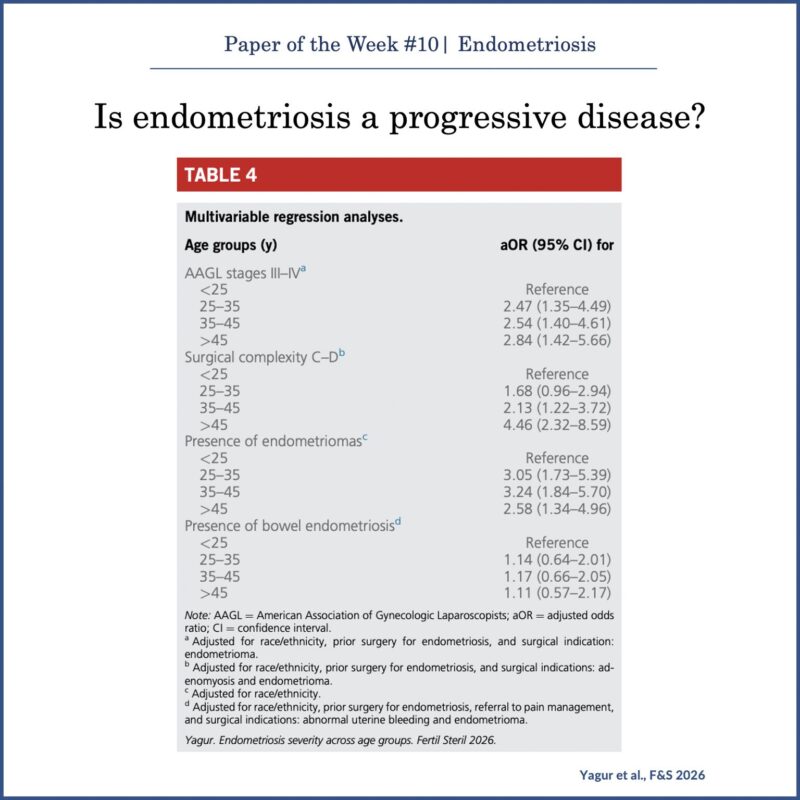
“Paper of the Week 10 – Is endometriosis a progressive disease?
This week I chose a paper on a topic I care deeply about: is endometriosis truly a progressive disease?
I have to say, this question sounds simple but probably isn’t.
Personally, I do believe endometriosis evolves over time. Not necessarily in a linear ‘more lesions = worse disease’ way, but through changes in lesion biology, metabolism, immune response, fibrosis, and tissue remodeling. So for me, the real question is not if the disease changes, but how it changes, in whom, and under which conditions.
This study looks at a large cohort of surgically treated patients and shows that increasing age is associated with higher disease stage (up to a plateau), increasing surgical complexity, and a higher prevalence of endometriomas in mid-reproductive age. Interesting findings, and certainly in line with what many of us observe in clinical practice.
But here is where I struggled a bit.
The paper asks: ‘is endometriosis a progressive disease?’
What it actually answers is something different: whether, in a surgical population, increasing age is associated with higher severity and more complex surgery.
And that’s not the same thing.
There is a subtle but important conceptual issue here. We are mixing three different dimensions: age, cross-sectional severity, and true progression over time. Showing that older patients have more severe disease does not demonstrate that the disease has progressed within the same individual.
Because we simply don’t know.
How do we know that a patient operated at 40 with severe disease didn’t already have a similar phenotype at 25? How do we disentangle biology from clinical decision-making? Maybe younger patients are managed more conservatively. Maybe both patients and surgeons delay more aggressive procedures. Maybe complex cases accumulate over time because they are operated later.
What we might be observing is not progression, but selection and timing.
And this is the core limitation of cross-sectional data: they are not designed to answer questions about change over time. If we really want to understand whether and how endometriosis progresses, we need longitudinal cohorts, following the same patients with repeated clinical, imaging, and ideally biological data.
This paper goes in the right direction, but it doesn’t really move the needle on the big question. And maybe that’s exactly the point; it reminds us how difficult that question actually is.
So perhaps, instead of asking whether endometriosis is progressive, we should ask a better question: what are the different trajectories of endometriosis across a patient’s life?
Curious to hear how others think about this.”
Stay updated on all scientific advances in the field of fertility with Fertility News.
-
Apr 12, 2026, 07:31Antonio La Marca: Upcoming Webinar to Explore Uterine Artery Embolization and Thermal Ablation of Fibroids
-
Apr 12, 2026, 07:28South Carolina, IVF is Under Threat Again! – RESOLVE
-
Apr 12, 2026, 07:18New Series Explores Paths Into Reproductive Medicine Leadership – ASRM
-
Apr 12, 2026, 07:11Latest Episode of RCOG Surgical Skills Project – RCOG
-
Apr 12, 2026, 07:03Christopher Robinson: Uterine Artery Injury During Cesarean Deliveries
-
Apr 12, 2026, 06:58Robert Brown: Overview of Maternal Mortality
-
Apr 12, 2026, 06:54Tanya Freirich: Experts Exchange Lupus Pregnancy and Nutrition Tips
-
Apr 12, 2026, 06:43Peter Humaidan: APHRODITE Criteria to Move Towards a Stratified Gonadotropin Stimulation in Infertile Males
-
Apr 11, 2026, 17:24Marco Zaccaria: Discussing Interstitial Myolisis on Second Day of Society of Endometriosis and Uterine Disorders Conference