

Karen Synesiou: ASRM Acknowledged That Routine PGT-A Screening Value for All IVF Patients Remains Unproven
Karen Synesiou, Director at Infertility Portal, shared a post on LinkedIn:
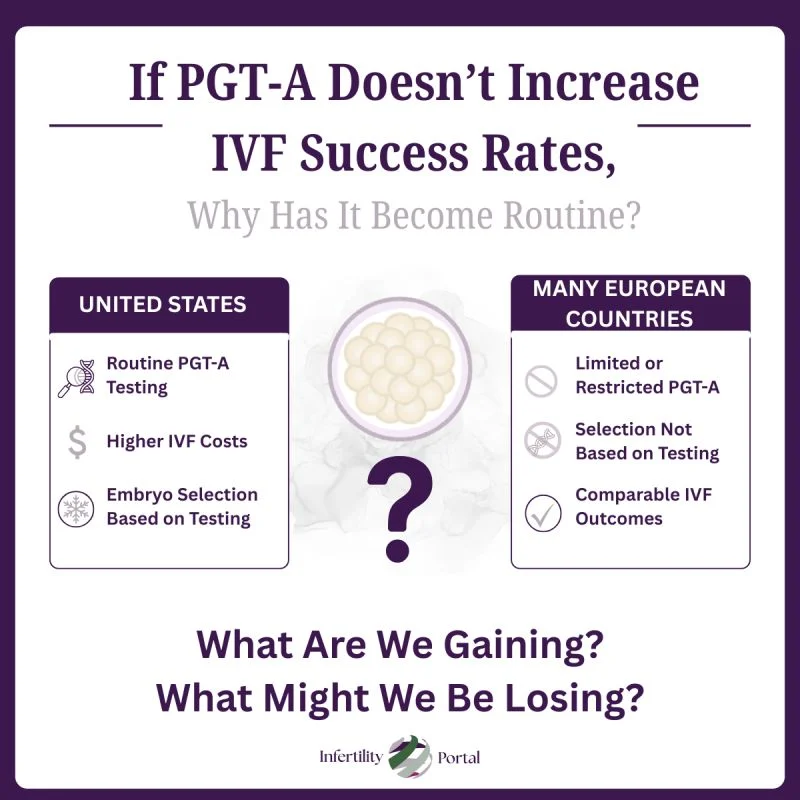
“For many IVF patients in the United States, preimplantation genetic testing for aneuploidy (PGT-A) has become almost routine. The premise is compelling: test embryos for chromosomal abnormalities, identify those believed to have the highest likelihood of success, and improve the chances of achieving a healthy pregnancy and live birth. However, PGT-A also adds thousands of dollars to the cost of treatment and often influences decisions regarding which embryos are transferred, frozen, or discarded.
When considering PGT-A testing worldwide, an interesting question arises. If PGT-A is so valuable, why do many countries that restrict or prohibit routine PGT-A continue to achieve IVF success rates that are broadly comparable to countries where PGT-A is widely used?
Countries such as Sweden, France, Germany, Denmark, and Norway have historically limited the use of routine PGT-A. Yet these countries continue to report IVF outcomes that are comparable to those achieved in many countries where embryo testing is commonly performed.
The American Society for Reproductive Medicine acknowledged in its 2024 Committee Opinion that the value of PGT-A as a routine screening test for all IVF patients has not been demonstrated. While the test may benefit certain patient populations, questions remain regarding its routine use for everyone.
This does not mean PGT-A has no value. Many physicians believe it can be useful in specific circumstances. However, when a technology increases costs and may determine whether an embryo is ever transferred, it is reasonable to ask whether patients are receiving balanced information about both its benefits and its limitations.
The debate is no longer whether PGT-A can identify chromosomal abnormalities. We know it can. The debate is whether routine PGT-A improves the outcome that matters most to patients: taking home a baby. It is also fair to ask whether some embryos with reproductive potential may be excluded from transfer based on information that may not be as definitive as many patients believe.
If countries that restrict routine PGT-A are achieving outcomes comparable to countries that use it extensively, perhaps patients should receive more comprehensive counseling regarding both the potential benefits and the limitations of embryo testing. They should also understand that respected fertility systems around the world have reached different conclusions regarding the routine use of PGT-A.
As reproductive medicine continues to evolve, transparency, informed consent, and patient education may prove to be just as important as the technology itself.”
Stay updated on all scientific advances in the field of fertility with Fertility News.
-
Sep 28, 2026, 17:35Saeed Fathi: Turning AI Innovation into Meaningful Clinical Impact in Fertility Care
-
Sep 28, 2026, 17:31Caspian Ostadian: Fresh vs Frozen Embryo Transfer – Which One Is Better?
-
Sep 28, 2026, 17:28Keshav Malhotra: Bringing the 2nd Edition of RESET to Da Nang, Vietnam
-
Sep 28, 2026, 17:25Christina Walker: Novel Biomarkers for PCOS and DOR
-
Sep 28, 2026, 17:18An Opportunity to Raise Awareness of the Importance of Safe, Accessible Abortion Care – RCOG
-
Sep 28, 2026, 17:13Stephany El-Hayek: From Embryology Intern to Mama and Founder of A Good Start
-
Sep 28, 2026, 17:09Apratim Arora: The Confidence Graph of a Clinical Embryologist
-
Sep 28, 2026, 17:06Vikrant Bhatia: Healthcare Has the Data, But Are We Truly Learning From It?
-
Sep 28, 2026, 17:02Abdelrahman H. Daifalla: DISS IVF – Clinical Intelligence for Reproductive Medicine