

Rajeev Agarwal: “Unexplained” Infertility – 3 Numbers Worth Knowing
Rajeev Agarwal, Director of Renew Healthcare, shared on LinkedIn:
“Unexplained infertility is a diagnosis of exclusion. Our exclusions are often incomplete.
About 30% of infertile couples get that label (ESHRE).
In over 25 years, I have learnt to hear it as ‘not yet explained’, because the couple in front of me hears ‘nobody knows, so nothing can be done’.
First, NICE NG257 has replaced CG156. It still advises two years of trying in total before treatment, but it now suggests considering up to four cycles of IUI with gonadotrophin stimulation as an alternative to IVF, and it says not to offer clomiphene or letrozole alone with timed intercourse.
ESHRE’s 2023 guideline already made stimulated IUI first-line.
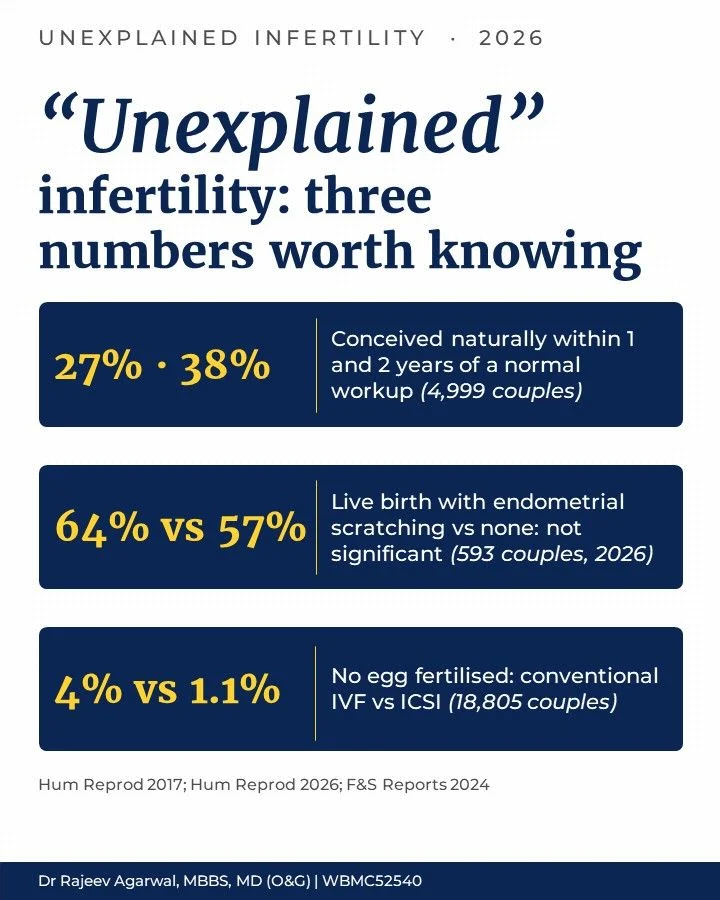
Second, a new Dutch RCT of endometrial scratching in 593 good-prognosis couples found live birth of 64% against 57%: RR 1.12 (0.98 to 1.28), not significant.
One more add-on that has not proven itself.
Third, the prognosis data are clearer than we use them. In 4,999 Dutch couples, cumulative ongoing pregnancy without treatment was 27% at one year after the workup and 38% at two, and the chance per cycle fell from 3.6% to 1.6% after a year. Waiting is a decision with a cost that grows every month, not a neutral default.
On treatment, the Cochrane network meta-analysis of 27 RCTs found that stimulated IUI and IVF beat expectant management only in poor-prognosis couples (OR 4.48 and 4.99, low-certainty evidence; in absolute terms, 31% vs 9% live birth in the New Zealand IUI trial).
For good-prognosis couples, the evidence does not show treatment beats time.
Where I depart, and why:
- I do not ask a couple to wait two years. In India, couples often reach me later and older, and a complete workup is quick and affordable, so I would rather finish the search early and then decide on waiting with real numbers.
- India adds a cause most Western algorithms leave out. ICMR-NIRT puts genital tuberculosis at 3 to 16% of infertile women here, and a patent HSG does not exclude it.
- ESHRE does not recommend ICSI over conventional IVF in unexplained infertility, and as a routine I agree. Cumulative live birth was no higher with ICSI in a US registry of 18,805 such couples. But total fertilisation failure, a cause only the IVF lab can reveal, was 4% with conventional IVF against 1.1% with ICSI, so when eggs are few I sometimes split them between the two methods.
- After three well-conducted IUI cycles in a woman under 35, I still consider laparoscopy, which ESHRE does not advise routinely. A 2024 review found endometriosis in about 44% of women with unexplained infertility who had one, mostly minimal or mild.
Colleagues: with a complete, normal workup, what is your next step for a woman of 32 at 18 months of trying?”
Other articles featuring Rajeev Agarwal on Fertility News.
-
Oct 26, 2026, 17:12Dilpreet Banwait: Could Our IVF Laboratory Consumables Be Introducing Microplastics into Sperm Samples?
-
Oct 26, 2026, 17:05Yashpal Singh Rao: IVF Care Should Adapt to Patients’ Lives, Not Expect Patients to Adapt
-
Oct 26, 2026, 16:57Zeinab Kazemianpour: Fresh or Frozen Embryo Transfer
-
Oct 26, 2026, 16:52Sean Lauber: IVF Birthweights Catching Up to the General Population
-
Oct 26, 2026, 16:43Sanketh Dhumal Satya: The S Value Paradox – The Curious Case of Sperm Size
-
Oct 26, 2026, 16:25Laura Rienzi: My Lab in 2012 – GENERA Center Was Born
-
Oct 26, 2026, 16:08Mina Popovic: Last Week I Had the Pleasure of Giving Two Talks at the 9th ART Fertility Conference
-
Oct 26, 2026, 16:01Margaret Cali: Dear Brave Soul, a Gentle Reminder for This Week
-
Oct 26, 2026, 15:59Rohit Gutgutia: Donor Eggs – The Decision Nobody Plans For