

Somil Singhal: ICSI Setting Spindle Angles
Somil Singhal, Medical Doctor at AIIMS (All India Institute of Medical Sciences, New Delhi), shared on LinkedIn:
“ICSI: Setting spindle angles
The ICSI procedure involves the intracytoplasmic injection of a single sperm cell into an egg.
The procedure is performed when the spermatozoa are positioned at a 90° angle to the tip of the pipette, which is then lowered gently to compress the sperm flagellum.
This is accomplished by dragging the injection needle across the tail until a visible kink or break can be seen.
A correctly immobilized sperm should maintain the shape of its tail. The immobilized sperm is then aspirated into the needle.
Immature gametes probably require additional manipulation to promote membrane permeabilization that enhances the postinjection events involved in nuclear decondensation.
These modifications include the formation of disulfide bonds, a change in the membrane surface charge, a profound qualitative and quantitative modification in their lipid composition, and the absorption of specific proteins secreted by the epithelium of the epididymis).
Lack of all these changes is associated with a decreased ability of an epididymal sperm to bind and penetrate the oocyte.
The oocyte is held in place by suction applied to the holding pipette while the injection pipette is lowered and focused in alignment with the outer right border of the oolemma on the equatorial plane at the 3 o’clock position.
The injecting pipette is pushed against the zona, permitting its penetration and thrusting forward to the inner surface of the oolemma.
As the point of the pipette reaches the approximate center of the egg, a break occurs in the membrane. This is reflected by a proximal flow of the cytoplasmic organelles and the spermatozoon back up into the pipette.
The sperm is then slowly ejected back into the cytoplasm, where aspiration of the cytoplasm becomes an additional stimulus to activate the egg.
Once the pipette is removed, the breach area is observed, and the order of the opening should maintain a funnel shape with the vertex into the egg.
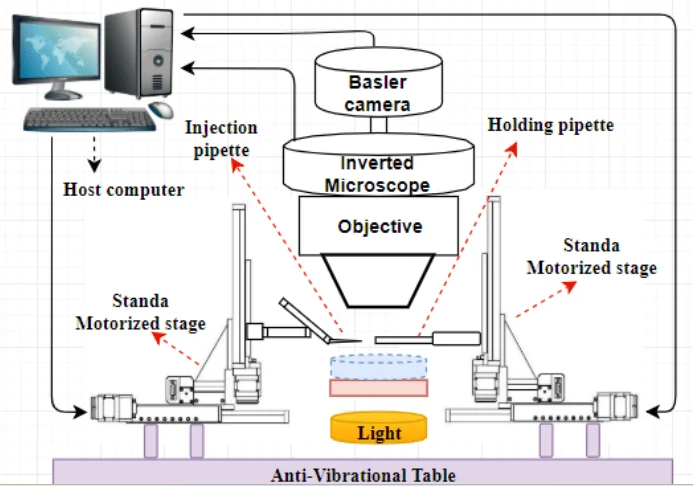
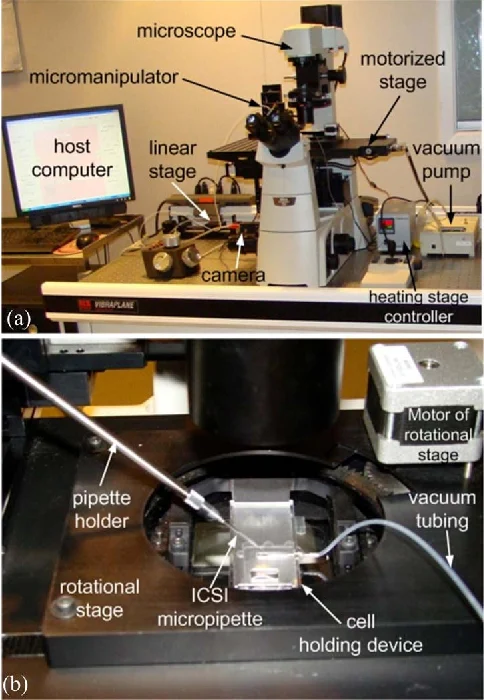
The micromanipulator is used to interact with the oocyte and the sperm under a microscope, where a level of precise movement is necessary so that it cannot be achieved by the unaided human hand.
This apparatus consists of an input joystick, a mechanism for reducing the range of movement, and an output section by means of grasping a microtool to hold the oocyte and inject the sperm as required.
This process is essential with the ICSI procedure as the size of the spermatozoon is approximately 3 to 5 microns and it is injected into an oocyte approximately 100 microns in diameter.
Y-axis movement of manipulators and a focus knob of microscope is essential for alignment of pipettes .
If the Z-axis of manipulators is used prabably there is achance of hittting the pipette causing breaking the pipette.
It is recommended to use the Z-axis after locating the two pipettes in the field of view and when only evening their vertical levels.
After completing the adjustments of the pipettes, a petri dish is put on the microscope stage.
An objective lens of 10x or lower is used during this adjustment.
Move the Y-axis of the coarse manipulator. When the pipette is brought into the optical axis, a shadow of the pipette can be seen in the field of view.
In case the pipette is found angled rotate the knob of the injection holder so as to bring it to the right angle.
In case one dosent find a shadow of the pipette, move the focus of the microscope and repeat the procedure.
Finally, bring the pipette into focus using the focus knob of the microscope .
This is for holding pipettes.
Move the holding pipette to the left boundary of the field of view using the X-axis of the coarse manipulator
If the holding pipette is close to the microscope stage, move the pipette upward and bring it into focus.
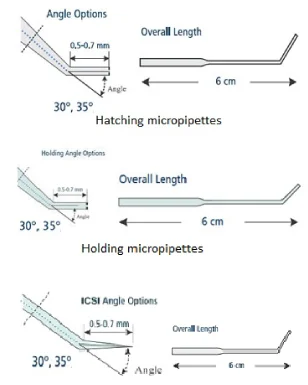
An injection pipette is bent around 30 degrees and is used to damage a sperm’s tail so as to immobilize a sperm.
For the immobilizing procedure, set an injection pipette at a slightly deeper angle than horizontal.
As with the holding pipette, there is no need to look into the microscope at this point.”
Proceed to the video attached to the post.
Other articles featuring Somil Singhal on Fertility News.
-
Oct 10, 2026, 16:11Abieyuwa Ehigiamusoe: Starting Your Embryology Journey?
-
Oct 10, 2026, 16:10Hajar Vahabzadeh: Embryo Quality – The Science Behind the Laboratory Environment
-
Oct 10, 2026, 16:08Karthik Raj: The POSEIDON Concept – Moving Beyond “Poor Responder”
-
Oct 10, 2026, 16:05Marking 15 Years of Fakih IVF Fertility Center
-
Oct 10, 2026, 16:04Eleni Polychronidou: How Men Feel About Infertility
-
Oct 10, 2026, 16:01Philippos Edimiris: Comparing Programmed Ovulatory FET with Modified Natural Cycle FET
-
Oct 10, 2026, 15:57Baby Caleb and His Mom Made the Day – Caperton Fertility Institute
-
Oct 10, 2026, 15:53Marga Esbert Algam: A Constructive and Engaging Visit to the Reproductive Medicine Laboratory and Cryobank
-
Oct 10, 2026, 15:50Why Mental Health Matters on the Fertility Journey – Egg Donor and Surrogate Solutions