

Khalil Faaed։ Why Do Good Embryos Fail to Implant?
Khalil Faaed, Intern of IVF/ICSI and Clinical Embryology at Indira IVF, shared a post on LinkedIn:
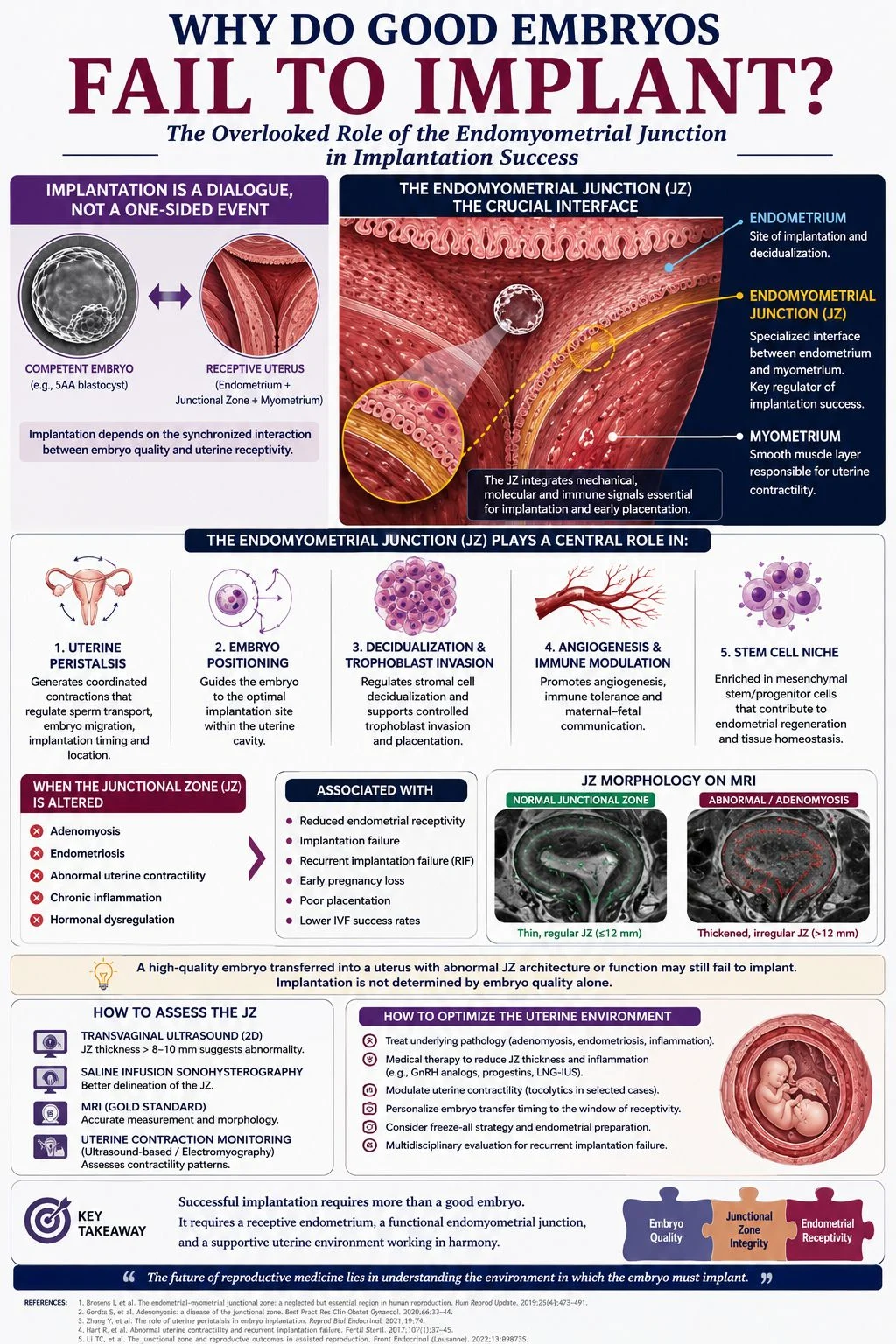
“Why Do Good Embryos Fail to Implant?
The overlooked role of the Endomyometrial Junction in implantation success.
In assisted reproductive technology (ART), considerable emphasis is placed on embryo quality. We meticulously evaluate fertilization, cleavage dynamics, blastocyst morphology, and increasingly, chromosomal competence. Yet despite remarkable advances in embryology, implantation failure remains one of the most persistent challenges in reproductive medicine.
The question therefore arises:
Is embryo quality alone sufficient to achieve implantation?
Emerging evidence suggests that implantation is not determined solely by the developmental competence of the embryo, but also by the biological readiness of the uterus to receive it. Central to this concept is the Endomyometrial Junction (EMJ), also known as the Junctional Zone (JZ) a highly specialized interface between the endometrium and myometrium that serves as far more than a simple anatomical boundary.
The Endomyometrial Junction is increasingly recognized as a critical regulator of uterine peristalsis, embryo positioning, decidualization, trophoblast invasion, angiogenesis, and maternal fetal communication. Through its influence on both mechanical and molecular signaling pathways, this region contributes significantly to the establishment of uterine receptivity and successful implantation.
Disruption of junctional zone architecture or function, as observed in conditions such as adenomyosis and endometriosis, has been associated with abnormal uterine contractility, impaired endometrial receptivity, recurrent implantation failure, and reduced IVF success rates. These observations may help explain why morphologically excellent embryos and even euploid blastocysts can fail to implant despite optimal laboratory conditions.
Perhaps one of the most important paradigm shifts in modern reproductive medicine is the recognition that implantation is not simply an embryo driven event. Rather, it represents a highly coordinated dialogue between embryo competence, endometrial receptivity, junctional zone integrity, immune regulation, and maternal physiology.
As embryologists and fertility specialists, we may need to broaden our perspective beyond the question:
Is the embryo good enough? and begin asking:
Is the uterine environment particularly the Endomyometrial Junction functionally prepared to support implantation?
The future of reproductive medicine may depend not only on selecting the best embryo, but also on understanding the complex uterine microenvironment in which implantation occurs.”
Stay updated on all scientific advances in the field of fertility with Fertility News.
-
Jun 9, 2026, 18:30Christopher Robinson: The Nausicaä Suture in the Management of the Placenta Accreta Spectrum
-
Jun 9, 2026, 18:28Ronald Feinberg: Bridging the Gap Between Fertility and Menopause Care
-
Jun 9, 2026, 18:26Hala El Damanhoury: The Right Questions Shape Better Birth Experiences
-
Jun 9, 2026, 18:25Call for Reviewers, AI in Gynecologic Cancer Literature – IJGC
-
Jun 9, 2026, 18:21Julie Morgan: How Generative AI Is Reshaping Fertility Care?
-
Jun 9, 2026, 18:19Simone Ferrero: The Diagnosis of Endometriosis, From Vision to Publication
-
Jun 9, 2026, 18:17Scammers Are Targeting ESHRE2026 Attendees With Fake Registration and Hotel Offers! – ESHRE
-
Jun 9, 2026, 18:15Diagnostic Challenge, Looking Beyond Renal Duplication and Ureterocele! – CFEF
-
Jun 9, 2026, 18:13Christopher Robinson: Trends in Antenatal Corticosteroid Use in Late Preterm Multiple Gestations