

Shivam Jha/LinkedIn
Mar 25, 2026, 12:31
Shivam Jha: Early Pregnancy on Ultrasound: Key Sonographic Signs of Viability and Intrauterine Gestation
Shivam Jha, Sonographer at Medical imaging, shared a post on LinkedIn:
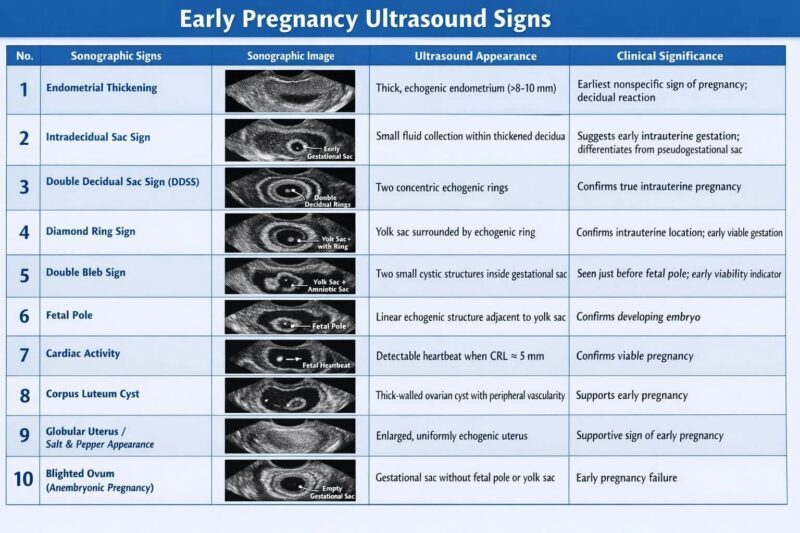
“EARLY PREGNANCY SONOGRAPHIC SIGNS
Endometrial Thickening
- Thick, echogenic endometrium (> 8–10 mm)
- Due to decidual reaction under progesterone
- Earliest and nonspecific ultrasound sign of pregnancy
- Seen before gestational sac is visible
Intradecidual Sac Sign
- Small, round/oval fluid collection within thickened decidua
- Located eccentrically in the endometrium
- Surrounded by echogenic decidua
- Suggests very early intrauterine gestation (≈ 4.5–5 weeks)
- Helps differentiate from pseudogestational sac of ectopic pregnancy
Double Decidual Sac Sign (DDSS)
- Two concentric echogenic rings around gestational sac
- Represents: – Decidua capsularis (inner) – Decidua parietalis (outer)
- Seen at 5–6 weeks
- Highly specific for true intrauterine pregnancy
- Absent in pseudogestational sac
Diamond Ring Sign
- Yolk sac surrounded by a bright echogenic ring
- Ring formed by trophoblastic tissue
- Confirms intrauterine location
- Indicates early viable pregnancy
- Seen around 5 weeks
Double Bleb Sign
- Two adjacent cystic structures inside gestational sac
- Represents: – Yolk sac – Amniotic sac
- Seen before fetal pole becomes visible
- Strong indicator of early viability
- Typically seen at 5.5–6 weeks
Fetal Pole
- Linear or curved echogenic structure
- Located adjacent to yolk sac
- Represents early embryo
- Usually visible by 5.5–6 weeks
- Presence confirms embryonic development
Cardiac Activity
- Detectable fetal heartbeat when CRL ≈ 5 mm
- Usually visible by 6 weeks (TVS)
- Best assessed using M-mode
- Confirms viable intrauterine pregnancy
- Absence beyond expected gestational age → poor prognosis
Corpus Luteum Cyst
- Thick-walled ovarian cyst
- Peripheral increased vascularity on Doppler
- Classic ‘Ring of Fire’ sign
- Produces progesterone to support early pregnancy
- Supportive but not diagnostic of pregnancy
Globular Uterus / Salt and Pepper Appearance
- Enlarged, globular uterus
- Uniformly echogenic myometrium
- Increased vascularity
- Supportive sign of early pregnancy
- Seen due to hormonal and vascular changes
Blighted Ovum (Anembryonic Pregnancy)
- Gestational sac present without yolk sac or fetal pole
- Mean sac diameter ≥ 25 mm with no embryo → diagnostic
- Indicates early pregnancy failure”
Stay updated on all scientific advances in the field of fertility with Fertility News.
Amniotic sac
Blighted Ovum (Anembryonic Pregnancy)
Cardiac Activity
Corpus Luteum Cyst
cystic structures
decidual reaction
Diamond Ring Sign
Double Bleb Sign
Double Decidual Sac Sign
Early Pregnancy
early viability
echogenic endometrium
ectopic pregnancy
Endometrial Thickening
endometrium
Fertility
Fertility News
fetal heartbeat
Fetal Pole
gestational
globular uterus
Globular Uterus / Salt & Pepper Appearance
Intradecidual Sac Sign
intrauterine gestation
nonspecific ultrasound
ovarian cyst
pregnancy failure
progesterone
pseudogestational sac
reproductive health
Reproductive Medicine
Shivam Jha
trophoblastic tissue
-
Oct 16, 2026, 19:56Dina Ibrahem: Poor ICM vs. Poor TE
-
Oct 16, 2026, 19:47Sean Lauber: NIPT and Amniocentesis after PGT-A Reveal Few Abnormalities
-
Oct 16, 2026, 19:42Devyanshi Dixit: C-Section vs. Vaginal Birth – 2 Birth Paths, 2 Very Different Recoveries
-
Oct 16, 2026, 19:32Pawel Kordowitzki: Maternal Vitamin D Homeostasis, Pregnancy Outcomes and Offspring Health
-
Oct 16, 2026, 19:13Shizuko Takahashi: Our Study on Women’s Experiences of Assisted Reproductive Care in China Has Been Accepted by RBMO
-
Oct 16, 2026, 19:09ESHRE Announces ECRES-GESEA Reproductive Surgery Training and Certification in Slovenia
-
Oct 16, 2026, 18:20Kabita KB: What Happens if PLCZ1 Is Defective?
-
Oct 16, 2026, 18:12Partha Sarathi Das: From Reproductive Lifespan to Reproductive Healthspan
-
Oct 16, 2026, 18:05Joyce Harper: It Was a Pleasure to Give 2 Talks Celebrating World Menopause Day