
Does Paternal Age Affect IVF Success and Miscarriage Risk?
Paternal age may play a greater role in IVF success and miscarriage risk than previously recognized. While fertility discussions have traditionally focused on a woman’s age, recent research suggests that the father’s age can also influence pregnancy outcomes, including the chances of achieving a live birth.
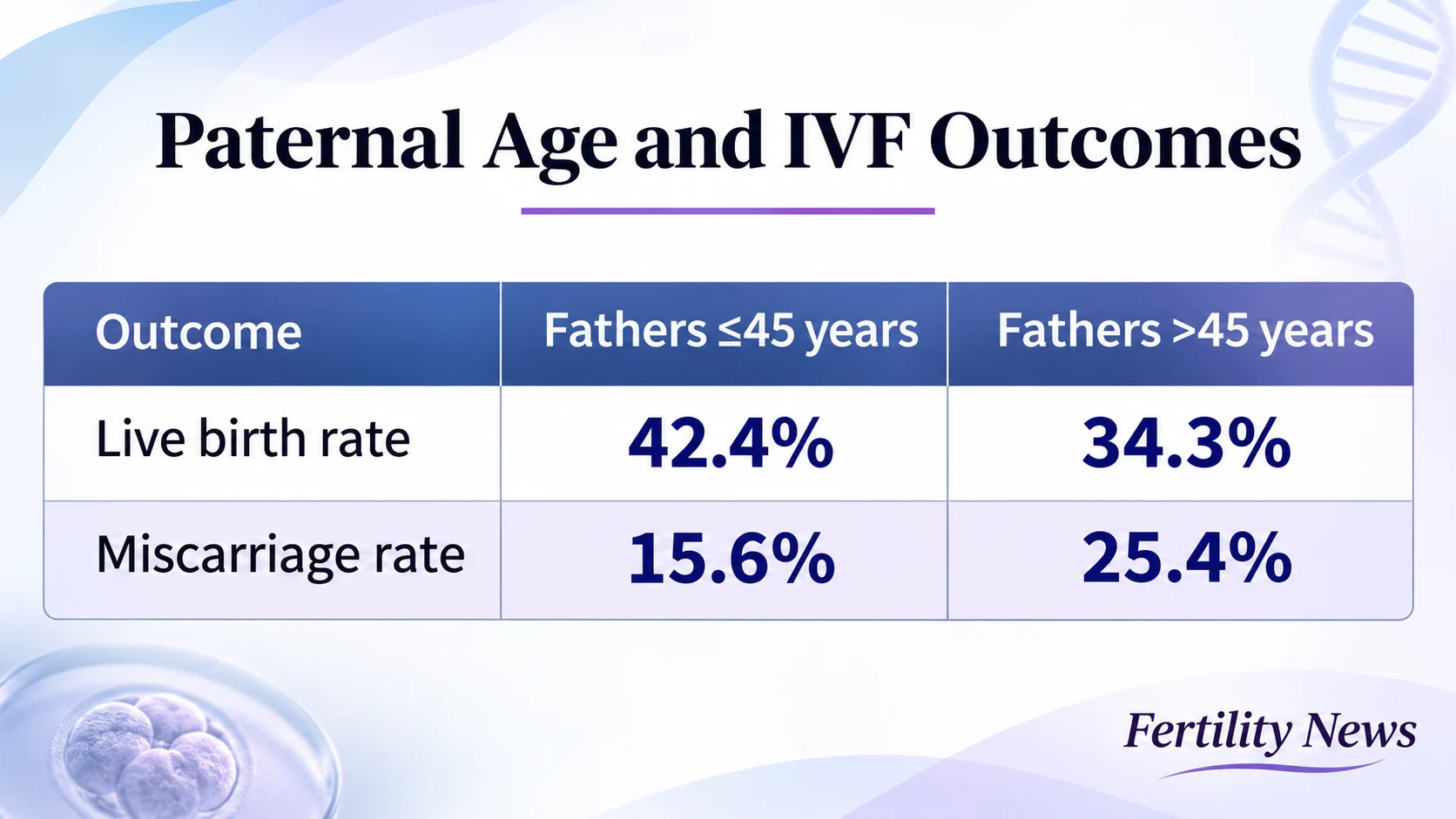
A study published in Human Reproduction in October 2026 examined 1,606 donor-egg fertility treatment cycles across seven IVF centers. Researchers found that men older than 45 had lower live birth rates (34.3% vs. 42.4%) and higher miscarriage rates (25.4% vs. 15.6%) than younger men. These differences remained statistically significant after accounting for several reproductive factors (Fraire-Zamora et al., 2026).
The findings add to growing evidence that male reproductive aging deserves more attention, particularly among couples undergoing in vitro fertilization (IVF). Although men can remain fertile well into later life, changes in sperm quality and DNA integrity may affect reproductive outcomes. However, paternal age is only one factor, and its impact varies between individuals and fertility treatments.
What Is Advanced Paternal Age?
Advanced paternal age generally refers to men becoming fathers at age 40 or older, although there is no universally accepted medical cutoff. Some studies use 35, 40, or 45 years, depending on the outcomes being examined.
Unlike women, who experience a defined end to their reproductive years with menopause, men continue producing sperm throughout much of adulthood. However, sperm production and reproductive function are not unaffected by aging.
Studies have associated increasing paternal age with changes in sperm motility, morphology, and DNA integrity. Older fathers may also have a higher likelihood of passing on new genetic mutations, although the absolute risk of many individual genetic conditions remains low.
The American Society for Reproductive Medicine (ASRM) recommends that reproductive specialists consider the ages of both partners when discussing fertility treatment and potential pregnancy risks (ASRM, 2025).
Age alone, however, is not a reliable measure of male fertility. Many men over 40 or 45 conceive naturally or become fathers through assisted reproductive treatment.
How Does a Father’s Age Affect Sperm Quality and Fertility?
Sperm quality tends to change gradually with age. Research has linked increasing paternal age to lower semen volume, reduced sperm motility, changes in sperm morphology, and greater sperm DNA damage.
A systematic review and meta-analysis by Johnson et al. (2015), involving 90 studies and more than 93,000 men, found age-related declines across several measures of semen quality.
One concern is sperm DNA fragmentation, which occurs when breaks develop in the genetic material carried by sperm cells. Higher levels of DNA fragmentation have been associated with poorer reproductive outcomes, although the relationship is not consistent across all studies.
A systematic review by Gonzalez et al. (2022) found that most included studies reported increasing sperm DNA fragmentation with paternal age.
These changes may affect fertility in different ways. Reduced sperm motility can make natural conception more difficult, while damage to sperm DNA may influence embryo development or pregnancy outcomes.
However, semen parameters vary considerably between men of the same age. A man in his late 40s may have normal semen analysis results, while a younger man may experience significant fertility problems.
For this reason, fertility specialists assess sperm quality alongside medical history, reproductive history, and the female partner’s age rather than relying on paternal age alone.
Does Paternal Age Affect IVF Success Rates?
The relationship between paternal age and IVF success is still being investigated. While maternal age remains a major predictor of treatment outcomes, several studies suggest that older paternal age may also be associated with lower live birth rates.
In the October 2026 study by Fraire-Zamora et al., men older than 45 had a 34.3% live birth rate, compared with 42.4% among men aged 45 or younger.
After adjusting for factors including egg donor age, recipient age, body mass index, and embryo characteristics, paternal age above 45 remained associated with lower odds of live birth (adjusted OR 0.72; 95% CI 0.57–0.91).
The researchers studied cycles involving donated eggs, which helped reduce the influence of age-related changes in egg quality. This made it possible to examine paternal age more closely.
However, not all studies have reported the same results.
A 2024 study by Liao et al., examining 56,113 frozen embryo transfer cycles, found no significant association between paternal age and live birth outcomes when female partners were younger than 36.
These differences suggest that the effect of paternal age on IVF success may depend partly on maternal age, the type of fertility treatment, and other reproductive factors.
Older paternal age does not automatically mean unsuccessful IVF. Rather, it is one factor that may influence the overall probability of achieving a live birth.
Does Older Paternal Age Increase Miscarriage Risk?
Research suggests that miscarriage risk may increase with paternal age, particularly after 40. Although maternal age remains a major contributor to pregnancy loss, studies indicate that the father’s age may also have an independent association.
A systematic review and meta-analysis by du Fossé et al. (2020), published in Human Reproduction Update, examined nine studies investigating paternal age and spontaneous miscarriage.
Compared with fathers aged 25–29, men aged 40–44 had approximately 23% higher relative miscarriage risk, while men aged 45 and older had approximately 43% higher relative risk.
More recent findings point in the same direction.
In the 2026 donor-egg IVF study, miscarriage occurred in 25.4% of pregnancies in the group with fathers older than 45, compared with 15.6% in the younger group. After adjustment, paternal age above 45 was associated with higher odds of miscarriage (adjusted OR 1.86; 95% CI 1.25–2.76).
One possible explanation involves age-related changes in sperm DNA integrity. Genetic damage and accumulated mutations may affect embryo development, although the exact mechanisms linking paternal age to pregnancy loss are not fully understood.
Importantly, an increased relative risk does not mean that miscarriage is inevitable. Many pregnancies involving older fathers result in healthy births, and individual risk depends on several factors beyond paternal age.
What Does Recent Research Say About Paternal Age and IVF Outcomes?
Two studies published in October 2026 provide further insight into how paternal age may influence assisted reproductive treatment.
The first, published in Human Reproduction by Fraire-Zamora and colleagues, examined 1,606 donor-oocyte ICSI cycles performed between 2019 and 2023 across seven fertility centers.
The study focused on outcomes following the first single-blastocyst transfer and compared men aged 45 or younger with those older than 45.
Key findings included:
Despite these differences in pregnancy outcomes, researchers did not identify significant differences in the number of fertilized eggs or blastocysts obtained between the paternal age groups.
This finding is particularly relevant because it suggests that differences in later pregnancy outcomes may occur even when early embryo development appears similar.
A second study, published in Reproductive BioMedicine Online by Ren et al. (2026), analyzed 22,013 IVF/ICSI cycles. Researchers examined how the ages of both partners influenced cumulative live birth rates.
They found that increasing paternal age was associated with lower cumulative live birth rates mainly when the female partner was aged 40 or older. Among women younger than 40, paternal age was not significantly associated with cumulative live birth in the adjusted analysis.
Together, these studies suggest that paternal age should be considered alongside maternal age when counseling couples about IVF outcomes.
However, both were retrospective studies. Their findings demonstrate associations rather than proving that older paternal age directly causes pregnancy loss or IVF failure. The donor-egg study also involved a specific treatment population, meaning its findings should not automatically be applied to every IVF cycle.

Can Older Men Improve Their Chances of Successful IVF?
Although the biological effects of aging cannot be fully reversed, older men may be able to improve their reproductive health by addressing factors that affect sperm production and quality.
Smoking, obesity, excessive alcohol consumption, and certain medical conditions have been associated with poorer semen parameters. Managing these factors may support sperm health, although evidence that lifestyle changes directly improve IVF live birth rates remains limited.
Several steps may be useful before fertility treatment:
- Stop smoking: Smoking is associated with poorer sperm concentration, motility, and DNA integrity.
- Maintain a healthy weight: Excess body weight may affect hormone levels and sperm production.
- Limit alcohol intake: Heavy alcohol consumption may negatively affect reproductive function.
- Exercise regularly: Moderate physical activity supports general health and may benefit reproductive well-being.
- Seek medical assessment: A semen analysis and fertility consultation can help identify potentially treatable problems.
Men with abnormal semen parameters, recurrent pregnancy loss, or unsuccessful IVF attempts may benefit from further evaluation.
In selected cases, specialists may consider sperm DNA fragmentation testing. However, the AUA/ASRM male infertility guideline does not recommend this test routinely during an initial fertility assessment.
Lifestyle changes cannot eliminate age-related reproductive risks, and no single intervention guarantees IVF success. Treatment decisions should be based on the couple’s overall fertility assessment rather than paternal age alone.
When Should Couples Consider Fertility Testing Based on Paternal Age?
Men do not need extensive fertility testing simply because they have turned 40. However, couples planning pregnancy later in life may benefit from discussing their reproductive history and potential age-related risks with a fertility specialist.
According to the ASRM’s 2026 guidance, fertility evaluation is generally recommended after 12 months of unsuccessful attempts to conceive when the female partner is younger than 35, or after 6 months when she is 35 or older.
Earlier evaluation may be appropriate when the female partner is over 40 or when either partner has a known condition that could affect fertility.
For men, the initial assessment typically includes a medical and reproductive history and semen analysis. Depending on the results, additional hormonal, genetic, or other investigations may be recommended.
Couples with recurrent miscarriages or previous unsuccessful assisted reproductive treatment may also require a more detailed assessment of male reproductive factors.
The growing evidence on paternal age does not establish a specific age at which men should stop trying to conceive. Instead, it supports a more balanced approach to fertility counseling, one that considers both partners’ ages, reproductive health, and individual circumstances.
For couples considering IVF, understanding these factors early may help guide decisions about fertility testing, treatment options, and the timing of pregnancy.
Written by Marine Marachlian, MD
FAQ
At What Age Does Male Fertility Start to Decline?
Male fertility generally declines gradually with age, with changes in sperm quality becoming more noticeable after 40. Older men may experience reduced sperm motility, increased sperm DNA fragmentation, and longer times to conception. However, there is no specific age at which men become infertile, and many remain capable of fathering children later in life.
Does a Father's Age Affect IVF Success Rates?
Yes, paternal age may influence IVF success rates, although research findings are mixed. A 2026 study published in Human Reproduction found that men older than 45 had lower live birth rates than younger men undergoing donor-egg fertility treatment (34.3% vs. 42.4%). However, maternal age, egg quality, and other reproductive factors also influence IVF outcomes.
Does Older Paternal Age Increase the Risk of Miscarriage?
Research suggests that miscarriage risk increases with paternal age, particularly after 40–45. A 2020 meta-analysis found that fathers aged 45 and older had a 43% higher relative risk of miscarriage compared with fathers aged 25–29. However, advanced paternal age does not mean pregnancy loss is inevitable, and maternal age remains an important risk factor.
Can Men Over 50 Have Successful IVF Pregnancies?
Yes. Men over 50 can father children through IVF, particularly when sperm quality and other reproductive factors are favorable. However, advanced paternal age may be associated with reduced reproductive success and increased miscarriage risk. Fertility specialists assess semen quality, medical history, and the female partner's reproductive health when estimating the likelihood of successful treatment.
Can Improving Sperm Quality Increase IVF Success in Older Men?
Improving sperm health may support fertility, but it cannot fully reverse age-related reproductive changes. Stopping smoking, maintaining a healthy weight, limiting excessive alcohol consumption, and managing underlying medical conditions may benefit sperm quality. However, evidence that these changes directly improve IVF live birth rates remains limited. A fertility specialist can help identify treatable causes of male infertility and recommend appropriate testing.
-
Nov 4, 2026, 17:32Lucy Froese: What Male Infertility Can Feel Like
-
Nov 4, 2026, 17:25Diana Kayal: Treating Your Body Without Seeing the Rest of You Is Only Half the Job
-
Nov 4, 2026, 17:20Margaret Cali: Sometimes Grief Simply Sits Beside the Joy
-
Nov 4, 2026, 17:11Hossam Elzeiny: Distinguishing Recurrent IVF Failure from True Recurrent Implantation Failure
-
Nov 4, 2026, 17:00Resa Nabor: Fighting Cancer – A Woman’s Brave Journey
-
Nov 4, 2026, 16:22Hannah Travers: Saying Goodbye to the Reproductive Medicine Research Group at the University of Dundee
-
Nov 4, 2026, 16:17Natalie Sutherland: Sharing My Story in Support of the National Fertility Awareness Week
-
Nov 4, 2026, 16:07Pleased to Welcome Justin Tan to the Advisory Committee – Fertility Friends Foundation
-
Nov 4, 2026, 15:53Cynthia Hudson: Panel at the NYC Premiere of THAW – Parenthood on Ice