

PGT-A Offers New Hope for Couples Facing Recurrent Pregnancy Loss – Fertility Plus
Fertility Plus shared a post on LinkedIn:
“Repeated Miscarriage ?
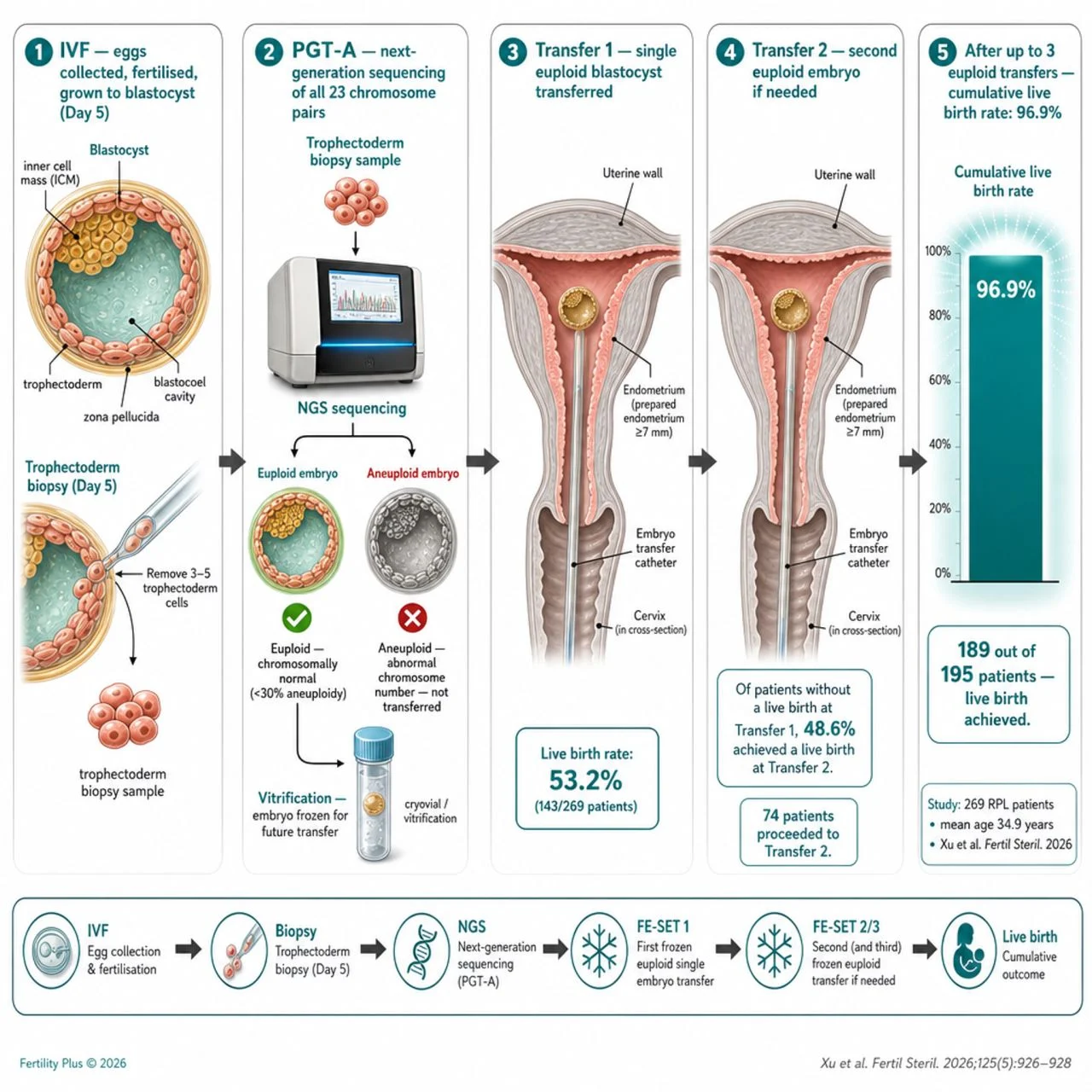
5 Clear Steps to 96.9% Success: The PGT-A Pathway That Changes Recurrent Miscarriage Outcomes
Description:
This simple 5-step guide explains how PGT-A helps women with repeated miscarriages achieve a baby.
Eggs are collected and fertilised to create embryos that grow to Day 5 (blastocyst stage).
A small biopsy is taken and tested with PGT-A to check the embryo’s chromosomes. Only healthy (euploid) embryos are kept.
The first healthy embryo is transferred.
If needed, a second healthy embryo is transferred in the next cycle.
After up to three transfers of only healthy embryos, 96.9% of women had a live birth.
In this study of 269 women with recurrent pregnancy loss, the vast majority went home with a baby. The data clearly shows that selecting chromosomally normal embryos dramatically improves success rates — giving real hope to couples who have experienced multiple losses.”
Stay updated on all scientific advances in the field of fertility with Fertility News.
-
Oct 24, 2026, 17:34Looking Forward to ASRM 2026 – NYU Langone Fertility Center
-
Oct 24, 2026, 17:28Donating Sperm Could Help Someone Achieve Their Dream of Becoming a Parent – Complete Fertility
-
Oct 24, 2026, 17:26Arshhita A.: 3PN Oocytes – Why Does Fertilization Go Wrong?
-
Oct 24, 2026, 17:22Tareq Abadl: Sperm Morphology – A Practical Laboratory Guide
-
Oct 24, 2026, 17:12Rana Mondal: Can We Replace Daily Fertility Injections with a Simple Daily Pill?
-
Oct 24, 2026, 17:03Evaluating Hysteroscopic Subendometrial Human Umbilical Cord Blood Platelet-Rich Plasma Injection – RBMO
-
Oct 24, 2026, 16:56Muhammad Qasim: Excluded Cells and Embryo Biopsy
-
Oct 24, 2026, 16:48Sangita Jindal: Completing My Term on the ASRM Board of Directors as Chair of the Publications Committee
-
Oct 24, 2026, 16:39Somil Singhal: Embryo Selection – Map To Testing