
Khalil Faaed: Who Reaches the Fallopian Tube First? Rethinking the Timing of Human Fertilization
Khalil Faaed, Embryologist at Modern IVF Center, shared on LinkedIn:
”Who Reaches the Fallopian Tube First? Rethinking the Timing of Human Fertilization
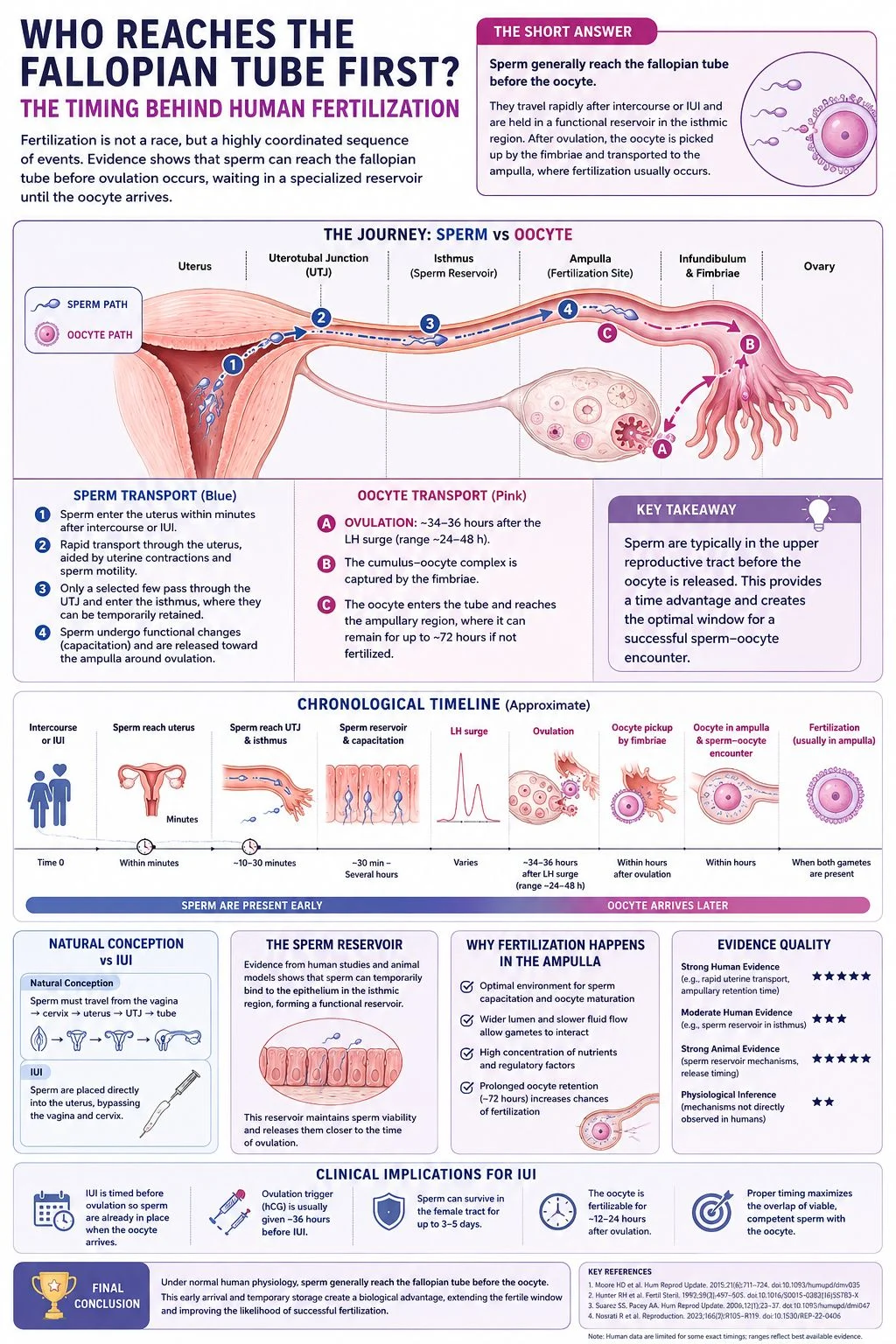
When we think about fertilization, we often imagine sperm racing toward an oocyte that has already been released. But human reproductive physiology is far more sophisticated than this simple picture.
Following intercourse and particularly after IUI, sperm can reach the uterotubal junction and isthmic region before ovulation. A selected population may be temporarily retained within the tubal environment, where sperm undergo functional changes and become prepared for fertilization.
Only later does ovulation release the oocyte. The cumulus-oocyte complex is captured by the fimbriae and transported into the fallopian tube, where sperm and oocyte ultimately meet, primarily in the ampullary region.
Does the sperm reach the fallopian tube before the oocyte?
Generally, yes. Sperm can reach the upper reproductive tract before ovulation, while the oocyte is still within the ovary.
However, we should distinguish early sperm arrival in the tube from the arrival of fertilization-competent sperm at the exact site of fertilization.
Why would sperm arrive before the oocyte?
Because fertilization does not require both gametes to arrive simultaneously. The female reproductive tract can selectively retain and regulate sperm, creating a temporal window in which competent sperm are available when the oocyte is released and transported into the ampulla.
Therefore, fertilization is not simply a race between sperm and oocyte. It is a highly coordinated process involving sperm transport, capacitation, tubal selection, sperm retention, ovulation, oocyte pickup, and synchronized gamete encounter.
The more important question may therefore be:
How does the female reproductive tract synchronize sperm availability with the arrival of the oocyte to create the optimal window for fertilization?
Understanding this timing may provide valuable insights into IUI timing, sperm preparation, ovulation triggering, and the biology of successful fertilization.”
Stay informed with the latest updates in fertility and reproductive medicine on Fertility News.
-
Oct 23, 2026, 17:34Breast Cancer Awareness Month: Supporting Women Through Every Journey – Egg Donor and Surrogate Solutions
-
Oct 23, 2026, 17:28Demián Glujovsky: What Happens to Fertility Patients Between Visits?
-
Oct 23, 2026, 17:21Stephen Parker Ellington: Empathetic Fertility Care Can Scale, Even When Your Team Can’t
-
Oct 23, 2026, 17:16ACOG Releases New Guidance on the Use of GLP-1s in Pregnancy and Lactation
-
Oct 23, 2026, 17:06Emad Sedeek: ESHRE Recommendations on Good Practice in the IVF Laboratory 2026 – Part 2
-
Oct 23, 2026, 16:59Nitiz Murdia: Guiding You Through IVF – Your Journey’s Pilot
-
Oct 23, 2026, 16:56Ben Peipert: Come See My Poster Presentation at ASRM 2026
-
Oct 23, 2026, 16:50New RBMO Review Examines Benefits and Risks of Freeze-All IVF Strategies Across Ovarian Response Groups
-
Oct 23, 2026, 16:381 Week and Counting to the Next Campus Course on Male Infertility – ESHRE