

Zeinab Kazemianpour: Fresh or Frozen Embryo Transfer
Zeinab Kazemianpour, Clinical Embryologist at Nikan Hospital, shared on LinkedIn:
“Fresh or Frozen Embryo Transfer: Is One Always Better Than the Other?
When it comes to implantation, is the key factor the embryo itself, or the uterine environment in which it is transferred?
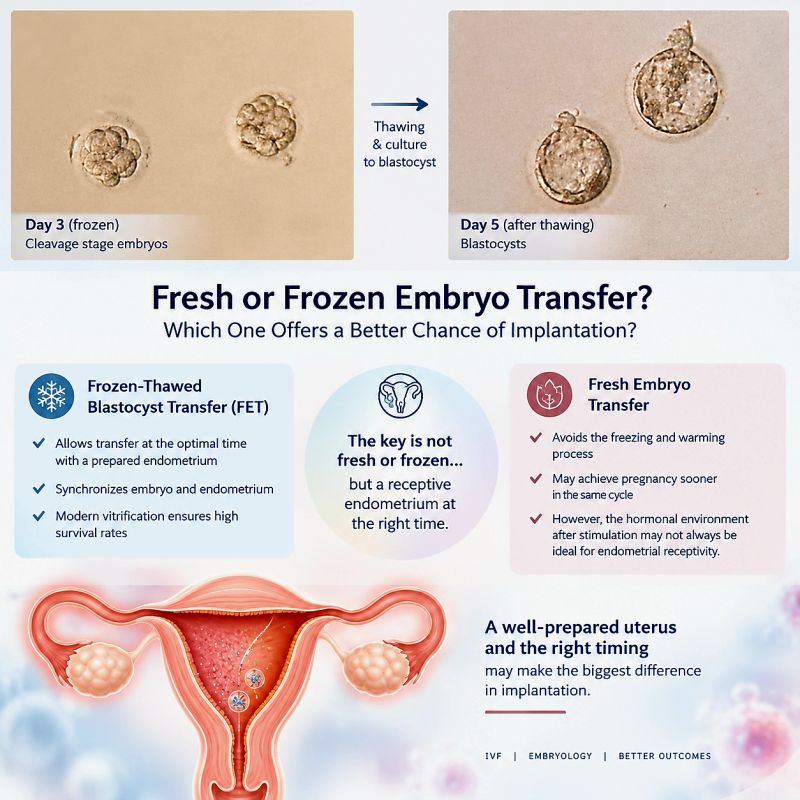
In our laboratory, we freeze embryos at the cleavage stage (Day 3). After warming, the embryos are cultured until they reach the blastocyst stage (Day 5), allowing transfer to be planned according to the patient’s endometrial preparation.
‘Fresh Embryo Transfer’
- Avoids the additional freezing and warming process.
- May allow an earlier transfer within the same treatment cycle.
- However, the hormonal changes associated with ovarian stimulation may affect endometrial receptivity in some patients.
‘Frozen Embryo Transfer (FET)’
- Allows transfer to be scheduled in a separate cycle.
- Provides an opportunity to optimize endometrial preparation and synchronize embryo development with the implantation window.
- Requires an additional warming step, and embryo survival and subsequent development cannot be guaranteed.
So, which approach is better?
Neither fresh nor frozen transfer is universally superior. The best strategy depends on the individual patient, embryo characteristics, hormonal environment, and endometrial receptivity.
‘A good embryo needs the right environment at the right time.’ When embryo development and endometrial receptivity are appropriately synchronized, the chances of successful implantation may improve.
In your experience, how do you decide between fresh and frozen embryo transfer?”
Other articles featuring Zeinab Kazemianpour on Fertility News.
-
Oct 26, 2026, 17:12Dilpreet Banwait: Could Our IVF Laboratory Consumables Be Introducing Microplastics into Sperm Samples?
-
Oct 26, 2026, 17:05Yashpal Singh Rao: IVF Care Should Adapt to Patients’ Lives, Not Expect Patients to Adapt
-
Oct 26, 2026, 16:52Sean Lauber: IVF Birthweights Catching Up to the General Population
-
Oct 26, 2026, 16:43Sanketh Dhumal Satya: The S Value Paradox – The Curious Case of Sperm Size
-
Oct 26, 2026, 16:25Laura Rienzi: My Lab in 2012 – GENERA Center Was Born
-
Oct 26, 2026, 16:08Mina Popovic: Last Week I Had the Pleasure of Giving Two Talks at the 9th ART Fertility Conference
-
Oct 26, 2026, 16:04Rajeev Agarwal: “Unexplained” Infertility – 3 Numbers Worth Knowing
-
Oct 26, 2026, 16:01Margaret Cali: Dear Brave Soul, a Gentle Reminder for This Week
-
Oct 26, 2026, 15:59Rohit Gutgutia: Donor Eggs – The Decision Nobody Plans For