
Akansha Negi: The First 24 Hours of Fertilization After ICSI
Akansha Negi, Trainee Embryologist – Akanksha Ivf Centre at Mata Chanan Devi Hospital, shared a post on LinkedIn:
“What actually happens in the first 24 hours after ICSI?
We inject a single sperm into an oocyte…
and then we wait.
But inside that oocyte, a highly coordinated series of events begins far more complex than what we see under the microscope.
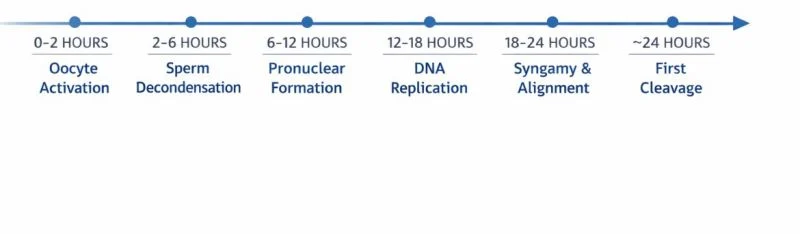
0–2 Hours Post-ICSI: Oocyte Activation
The sperm triggers a cascade of calcium oscillations within the oocyte.
This leads to:
- Completion of meiosis II
- Extrusion of the second polar body
- Initiation of metabolic activity
This step is critical without proper activation, fertilization simply doesn’t proceed.
2–6 Hours: Decondensation of Sperm Chromatin
The tightly packed sperm DNA begins to decondense.
Histones replace protamines, allowing the formation of the male pronucleus.
At the same time, the oocyte forms the female pronucleus.
6–12 Hours: Pronuclear Formation
Two distinct pronuclei (2PN) become visible:
- One maternal
- One paternal
Each carries half the genetic material.
This is the stage we rely on to confirm ‘normal fertilization’, but it’s only a morphological checkpoint.
12–18 Hours: DNA Replication and Alignment
Both pronuclei replicate their DNA independently.
They begin to migrate toward each other, preparing for fusion.
Subtle errors here (which we cannot see) can affect embryo viability.
18–24 Hours: Syngamy Preparation
The pronuclear membranes break down.
Maternal and paternal chromosomes align on the mitotic spindle.
This sets the stage for the first cleavage division.
~24 Hours: First Cleavage Begins
The embryo prepares to divide into 2 cells.
From here, early embryonic development depends on:
- Oocyte cytoplasmic competence
- Sperm contribution
- Proper molecular coordination
Key Insight:
What looks like a ‘simple fertilization check’ at 16–18 hours is actually the result of multiple tightly regulated biological events.
And importantly –
- A normal 2PN does not guarantee normal development
- And abnormalities at any unseen step can influence outcomes
In your experience, which step do you think is most critical but most underestimated in this 24-hour window?”
Stay updated on all scientific advances in the field of fertility with Fertility News.
-
Sep 13, 2026, 15:11Sachintha Alwis: From Impaired Sperm Motility to Microrobotics
-
Sep 13, 2026, 15:08Laurence Orbuch: Before Endometriosis Surgery, Ask…
-
Sep 13, 2026, 15:05Ademola Ayodele: IUI, IVF or Egg Freezing – Which One Is Right for You?
-
Sep 13, 2026, 14:59Fiona Pathiraja-Møller: Tennis Players No Longer Have to Choose Between Career and Family
-
Sep 13, 2026, 14:571-Day Virtual Experience for People Impacted by PMOS – PCOS Awareness Association
-
Sep 13, 2026, 14:53Ozor Victor: Behind Every Embryo Is a Story of Science, Precision, and Hope
-
Sep 13, 2026, 14:50Diana Kayal: What They Don’t Tell You About IVF
-
Sep 13, 2026, 14:44Vikram Sinai Talaulikar: A Heartfelt Thank You to All Who Donated and Supported “Menopause and Cancer”
-
Sep 13, 2026, 14:41Nicole McPherson: Changing IVF Practices Is Hard – Integration Needs to Be Easy